{"title":"In Situ Evolution of Secondary Metallic Phases in Off-Stoichiometric ZrNiSn for Enhanced Thermoelectric Performance","authors":"Kishor Kumar Johari, Durgesh Kumar Sharma, Ajay Kumar Verma, Ruchi Bhardwaj, Nagendra S. Chauhan, Sudhir Kumar*, Manvendra Narayan Singh, Sivaiah Bathula and Bhasker Gahtori*, ","doi":"10.1021/acsami.2c03065","DOIUrl":null,"url":null,"abstract":"<p >The full-Heusler (FH) inclusions in the half-Heusler (HH) matrix is a well-studied approach to reduce the lattice thermal conductivity of ZrNiSn HH alloy. However, excess Ni in ZrNiSn may lead to the in situ formation of FH and/or HH alloys with interstitial Ni defects. The excess Ni develops intermediate electronic states in the band gap of ZrNiSn and also generates defects to scatter phonons, thus providing additional control to tailor electronic and phonon transport properties synergistically. In this work, we present the implication of isoelectronic Ge-doping and excess Ni on the thermoelectric transport of ZrNiSn. The synthesized ZrNi<sub>1.04</sub>Sn<sub>1–<i>x</i></sub>Ge<i><sub>x</sub></i> (<i>x</i> = 0–0.04) samples were prepared by arc-melting and spark plasma sintering, and were extensively probed for microstructural analysis. The in situ evolution of minor secondary phases, i.e., FH, Ni–Sn, and Sn–Zr, primarily observed post sintering resulted in simultaneous optimization of the electrical power factor and lattice thermal conductivity. A <i>ZT</i> of ~1.06 at ~873 K was attained, which is among the highest for Hf-free ZrNiSn-based HH alloys. Additionally, ab initio calculations based on density functional theory (DFT) were performed to provide comparative insights into experimentally measured properties and understand underlying physics. Further, mechanical properties were experimentally extracted to determine the usability of synthesized alloys for device fabrication.</p>","PeriodicalId":5,"journal":{"name":"ACS Applied Materials & Interfaces","volume":"14 17","pages":"19579–19593"},"PeriodicalIF":7.8000,"publicationDate":"2022-04-20","publicationTypes":"Journal Article","fieldsOfStudy":null,"isOpenAccess":false,"openAccessPdf":"","citationCount":"15","resultStr":null,"platform":"Semanticscholar","paperid":null,"PeriodicalName":"ACS Applied Materials & Interfaces","FirstCategoryId":"88","ListUrlMain":"https://pubs.acs.org/doi/10.1021/acsami.2c03065","RegionNum":2,"RegionCategory":"材料科学","ArticlePicture":[],"TitleCN":null,"AbstractTextCN":null,"PMCID":null,"EPubDate":"","PubModel":"","JCR":"Q1","JCRName":"MATERIALS SCIENCE, MULTIDISCIPLINARY","Score":null,"Total":0}
引用次数: 15
Abstract
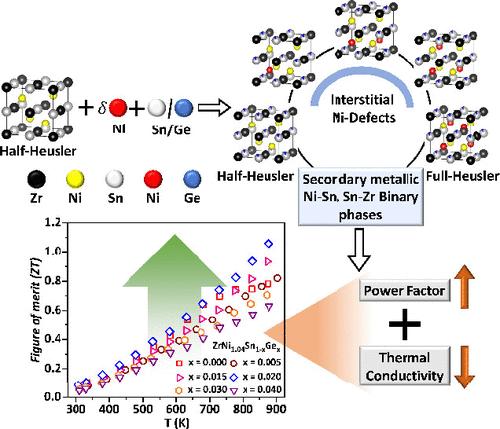
The full-Heusler (FH) inclusions in the half-Heusler (HH) matrix is a well-studied approach to reduce the lattice thermal conductivity of ZrNiSn HH alloy. However, excess Ni in ZrNiSn may lead to the in situ formation of FH and/or HH alloys with interstitial Ni defects. The excess Ni develops intermediate electronic states in the band gap of ZrNiSn and also generates defects to scatter phonons, thus providing additional control to tailor electronic and phonon transport properties synergistically. In this work, we present the implication of isoelectronic Ge-doping and excess Ni on the thermoelectric transport of ZrNiSn. The synthesized ZrNi1.04Sn1–xGex (x = 0–0.04) samples were prepared by arc-melting and spark plasma sintering, and were extensively probed for microstructural analysis. The in situ evolution of minor secondary phases, i.e., FH, Ni–Sn, and Sn–Zr, primarily observed post sintering resulted in simultaneous optimization of the electrical power factor and lattice thermal conductivity. A ZT of ~1.06 at ~873 K was attained, which is among the highest for Hf-free ZrNiSn-based HH alloys. Additionally, ab initio calculations based on density functional theory (DFT) were performed to provide comparative insights into experimentally measured properties and understand underlying physics. Further, mechanical properties were experimentally extracted to determine the usability of synthesized alloys for device fabrication.
期刊介绍:
ACS Applied Materials & Interfaces is a leading interdisciplinary journal that brings together chemists, engineers, physicists, and biologists to explore the development and utilization of newly-discovered materials and interfacial processes for specific applications. Our journal has experienced remarkable growth since its establishment in 2009, both in terms of the number of articles published and the impact of the research showcased. We are proud to foster a truly global community, with the majority of published articles originating from outside the United States, reflecting the rapid growth of applied research worldwide.

 求助内容:
求助内容: 应助结果提醒方式:

 京公网安备 11010802042870号


