{"title":"Mapping global soil acidification under N deposition","authors":"Chen Chen, Wenya Xiao, Han Y. H. Chen","doi":"10.1111/gcb.16813","DOIUrl":null,"url":null,"abstract":"<p>Soil pH is critically important in regulating soil nutrients and thus influencing the biodiversity and ecosystem functions of terrestrial ecosystems. Despite the ongoing threat of nitrogen (N) pollution especially in the fast-developing regions, it remains unclear how increasing N deposition affects soil pH across global terrestrial ecosystems. By conducting a global meta-analysis with paired observations of soil pH under N addition and control from 634 studies spanning major types of terrestrial ecosystems, we show that soil acidification increases rapidly with N addition amount and is most severe in neutral-pH soils. Grassland soil pH decreases most strongly under high N addition while wetlands are the least acidified. By extrapolating these relationships to global mapping, we reveal that atmospheric N deposition leads to a global average soil pH decline of −0.16 in the past 40 years and regions encompassing Eastern United States, Southern Brazil, Europe, and South and East Asia are the hotspots of soil acidification under N deposition. Our results highlight that anthropogenically amplified atmospheric N deposition has profoundly altered global soil pH and chemistry. They suggest that atmospheric N deposition is a major threat to global terrestrial biodiversity and ecosystem functions.</p>","PeriodicalId":175,"journal":{"name":"Global Change Biology","volume":"29 16","pages":"4652-4661"},"PeriodicalIF":12.5000,"publicationDate":"2023-06-09","publicationTypes":"Journal Article","fieldsOfStudy":null,"isOpenAccess":false,"openAccessPdf":"","citationCount":"0","resultStr":null,"platform":"Semanticscholar","paperid":null,"PeriodicalName":"Global Change Biology","FirstCategoryId":"93","ListUrlMain":"https://onlinelibrary.wiley.com/doi/10.1111/gcb.16813","RegionNum":1,"RegionCategory":"环境科学与生态学","ArticlePicture":[],"TitleCN":null,"AbstractTextCN":null,"PMCID":null,"EPubDate":"","PubModel":"","JCR":"Q1","JCRName":"BIODIVERSITY CONSERVATION","Score":null,"Total":0}
引用次数: 0
Abstract
Soil pH is critically important in regulating soil nutrients and thus influencing the biodiversity and ecosystem functions of terrestrial ecosystems. Despite the ongoing threat of nitrogen (N) pollution especially in the fast-developing regions, it remains unclear how increasing N deposition affects soil pH across global terrestrial ecosystems. By conducting a global meta-analysis with paired observations of soil pH under N addition and control from 634 studies spanning major types of terrestrial ecosystems, we show that soil acidification increases rapidly with N addition amount and is most severe in neutral-pH soils. Grassland soil pH decreases most strongly under high N addition while wetlands are the least acidified. By extrapolating these relationships to global mapping, we reveal that atmospheric N deposition leads to a global average soil pH decline of −0.16 in the past 40 years and regions encompassing Eastern United States, Southern Brazil, Europe, and South and East Asia are the hotspots of soil acidification under N deposition. Our results highlight that anthropogenically amplified atmospheric N deposition has profoundly altered global soil pH and chemistry. They suggest that atmospheric N deposition is a major threat to global terrestrial biodiversity and ecosystem functions.
期刊介绍:
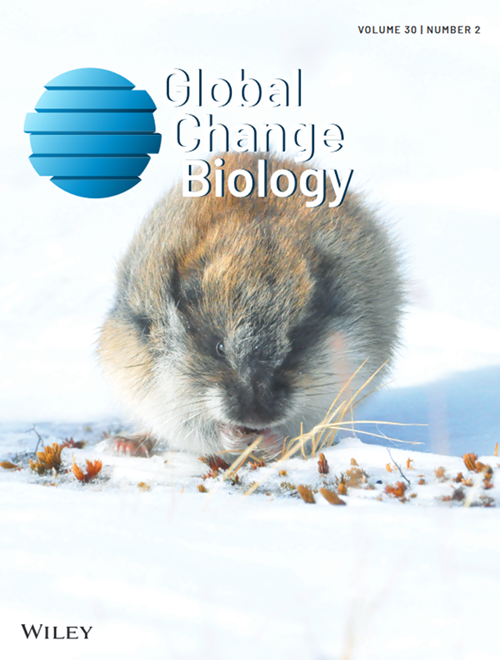
Global Change Biology is an environmental change journal committed to shaping the future and addressing the world's most pressing challenges, including sustainability, climate change, environmental protection, food and water safety, and global health.
Dedicated to fostering a profound understanding of the impacts of global change on biological systems and offering innovative solutions, the journal publishes a diverse range of content, including primary research articles, technical advances, research reviews, reports, opinions, perspectives, commentaries, and letters. Starting with the 2024 volume, Global Change Biology will transition to an online-only format, enhancing accessibility and contributing to the evolution of scholarly communication.


 求助内容:
 应助结果提醒方式:


 京公网安备 11010802042870号


