{"title":"Atomic Layer Deposition of W:Al2O3 Nanocomposite Films with Tunable Resistivity†","authors":"Anil U. Mane, Jeffrey W. Elam","doi":"10.1002/cvde.201307054","DOIUrl":null,"url":null,"abstract":"<p>Nanocomposite tungsten-aluminum oxide (W:Al<sub>2</sub>O<sub>3</sub>) thin films were prepared by atomic layer deposition (ALD) using tungsten hexafluoride (WF<sub>6</sub>) and disilane (Si<sub>2</sub>H<sub>6</sub>) for the W ALD and trimethyl aluminum (TMA) and H<sub>2</sub>O for the Al<sub>2</sub>O<sub>3</sub> ALD. Quartz crystal microbalance (QCM) measurements performed using various W cycle percentages revealed that the W ALD inhibits the Al<sub>2</sub>O<sub>3</sub> ALD and vice versa. Despite this inhibition, the relationship between W content and W cycle percentage was close to that predicted by theoretical calculations based on the growth per cycle values of binary compounds. Depth profiling XPS showed that the (W:Al<sub>2</sub>O<sub>3</sub>) films were uniform in composition and contained Al, O, and metallic W as expected, but also included significant F and C. Cross-sectional TEM revealed the composite film structure to be metallic nanoparticles (∼1 nm) embedded in an amorphous matrix. The resistivity of these composite films could be tuned in the range of 10<sup>12</sup>–10<sup>8</sup> Ω cm by adjusting the W cycle percentage between 10% and 30%W. These films have applications in electron multipliers as well as electron and ion optics.</p>","PeriodicalId":10093,"journal":{"name":"Chemical Vapor Deposition","volume":"19 4-6","pages":"186-193"},"PeriodicalIF":0.0000,"publicationDate":"2013-05-14","publicationTypes":"Journal Article","fieldsOfStudy":null,"isOpenAccess":false,"openAccessPdf":"https://sci-hub-pdf.com/10.1002/cvde.201307054","citationCount":"31","resultStr":null,"platform":"Semanticscholar","paperid":null,"PeriodicalName":"Chemical Vapor Deposition","FirstCategoryId":"1085","ListUrlMain":"https://onlinelibrary.wiley.com/doi/10.1002/cvde.201307054","RegionNum":0,"RegionCategory":null,"ArticlePicture":[],"TitleCN":null,"AbstractTextCN":null,"PMCID":null,"EPubDate":"","PubModel":"","JCR":"","JCRName":"","Score":null,"Total":0}
引用次数: 31
Abstract
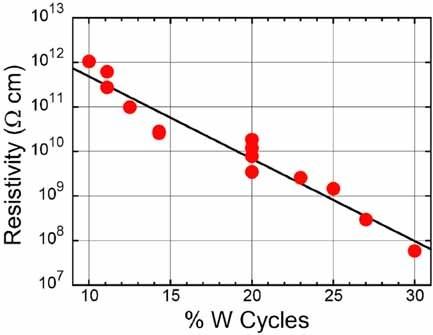
Nanocomposite tungsten-aluminum oxide (W:Al2O3) thin films were prepared by atomic layer deposition (ALD) using tungsten hexafluoride (WF6) and disilane (Si2H6) for the W ALD and trimethyl aluminum (TMA) and H2O for the Al2O3 ALD. Quartz crystal microbalance (QCM) measurements performed using various W cycle percentages revealed that the W ALD inhibits the Al2O3 ALD and vice versa. Despite this inhibition, the relationship between W content and W cycle percentage was close to that predicted by theoretical calculations based on the growth per cycle values of binary compounds. Depth profiling XPS showed that the (W:Al2O3) films were uniform in composition and contained Al, O, and metallic W as expected, but also included significant F and C. Cross-sectional TEM revealed the composite film structure to be metallic nanoparticles (∼1 nm) embedded in an amorphous matrix. The resistivity of these composite films could be tuned in the range of 1012–108 Ω cm by adjusting the W cycle percentage between 10% and 30%W. These films have applications in electron multipliers as well as electron and ion optics.
期刊介绍:
Chemical Vapor Deposition (CVD) publishes Reviews, Short Communications, and Full Papers on all aspects of chemical vapor deposition and related technologies, along with other articles presenting opinion, news, conference information, and book reviews. All papers are peer-reviewed. The journal provides a unified forum for chemists, physicists, and engineers whose publications on chemical vapor deposition have in the past been spread over journals covering inorganic chemistry, materials chemistry, organometallics, applied physics and semiconductor technology, thin films, and ceramic processing.

 求助内容:
求助内容: 应助结果提醒方式:

 京公网安备 11010802042870号


