Hedieh Saffari , Russell M. Condie , Brian R. Watson , Jeffrey J. Krstyen , Kathryn A. Peterson , John M. Hoffman , Gerald J. Gleich , Leonard F. Pease III
{"title":"Biodistribution of orally administered 99mTc-heparin to assess eosinophilic esophagitis associated inflammation","authors":"Hedieh Saffari , Russell M. Condie , Brian R. Watson , Jeffrey J. Krstyen , Kathryn A. Peterson , John M. Hoffman , Gerald J. Gleich , Leonard F. Pease III","doi":"10.1016/j.cesx.2019.100049","DOIUrl":null,"url":null,"abstract":"<div><p>Here we explore the biodistribution of <sup>99m</sup>Tc-heparin, an orally administered radiopharmaceutical candidate expected to identify localized inflammation in eosinophilic esophagitis (EoE). Heparin binds to eosinophil granule proteins in inflamed regions of gastrointestinal (GI) organs, and <sup>99m</sup>Tc signals their location. This article evaluates the biodistribution of this conjugate first within the esophagus by modeling the reactive transport of <sup>99m</sup>Tc-heparin based on the kinetics of <sup>99m</sup>Tc-heparin binding to non-human primate esophagi and second in the remainder of the body by measuring organ specific uptake using single-photon emission computed tomography/computed tomography imaging. Results show that binding and dissociation rate constants remain similar, and that optimal imaging occurs after drinking of the agent is complete. We also find that <sup>99m</sup>Tc-heparin remains within the GI tract simply transporting through the gut and out. These findings provide a new avenue to clinically explore the utility of <sup>99m</sup>Tc-heparin to detect eosinophil associated inflammation in the GI tract.</p></div>","PeriodicalId":37148,"journal":{"name":"Chemical Engineering Science: X","volume":"4 ","pages":"Article 100049"},"PeriodicalIF":0.0000,"publicationDate":"2019-11-01","publicationTypes":"Journal Article","fieldsOfStudy":null,"isOpenAccess":false,"openAccessPdf":"https://sci-hub-pdf.com/10.1016/j.cesx.2019.100049","citationCount":"0","resultStr":null,"platform":"Semanticscholar","paperid":null,"PeriodicalName":"Chemical Engineering Science: X","FirstCategoryId":"1085","ListUrlMain":"https://www.sciencedirect.com/science/article/pii/S2590140019300565","RegionNum":0,"RegionCategory":null,"ArticlePicture":[],"TitleCN":null,"AbstractTextCN":null,"PMCID":null,"EPubDate":"2019/10/28 0:00:00","PubModel":"Epub","JCR":"Q1","JCRName":"Engineering","Score":null,"Total":0}
引用次数: 0
Abstract
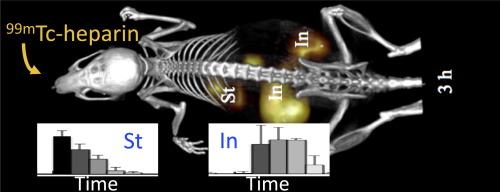
Here we explore the biodistribution of 99mTc-heparin, an orally administered radiopharmaceutical candidate expected to identify localized inflammation in eosinophilic esophagitis (EoE). Heparin binds to eosinophil granule proteins in inflamed regions of gastrointestinal (GI) organs, and 99mTc signals their location. This article evaluates the biodistribution of this conjugate first within the esophagus by modeling the reactive transport of 99mTc-heparin based on the kinetics of 99mTc-heparin binding to non-human primate esophagi and second in the remainder of the body by measuring organ specific uptake using single-photon emission computed tomography/computed tomography imaging. Results show that binding and dissociation rate constants remain similar, and that optimal imaging occurs after drinking of the agent is complete. We also find that 99mTc-heparin remains within the GI tract simply transporting through the gut and out. These findings provide a new avenue to clinically explore the utility of 99mTc-heparin to detect eosinophil associated inflammation in the GI tract.


 求助内容:
求助内容: 应助结果提醒方式:

 京公网安备 11010802042870号


