
Phylotype diversity within soil fungal functional groups drives ecosystem stability
IF 17.1
1区 生物学
Q1 ECOLOGY
引用次数: 46
Abstract
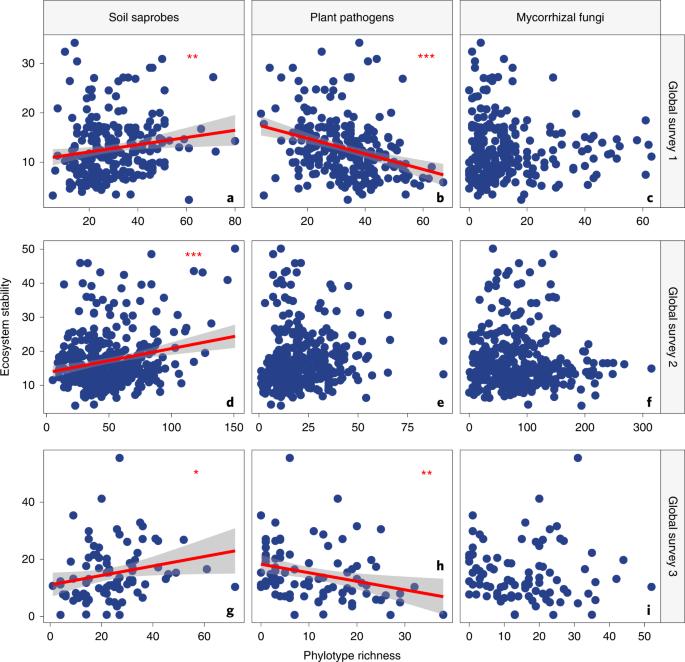
Soil fungi are fundamental to plant productivity, yet their influence on the temporal stability of global terrestrial ecosystems, and their capacity to buffer plant productivity against extreme drought events, remain uncertain. Here we combined three independent global field surveys of soil fungi with a satellite-derived temporal assessment of plant productivity, and report that phylotype richness within particular fungal functional groups drives the stability of terrestrial ecosystems. The richness of fungal decomposers was consistently and positively associated with ecosystem stability worldwide, while the opposite pattern was found for the richness of fungal plant pathogens, particularly in grasslands. We further demonstrated that the richness of soil decomposers was consistently positively linked with higher resistance of plant productivity in response to extreme drought events, while that of fungal plant pathogens showed a general negative relationship with plant productivity resilience/resistance patterns. Together, our work provides evidence supporting the critical role of soil fungal diversity to secure stable plant production over time in global ecosystems, and to buffer against extreme climate events. The authors link fungal diversity to the stability of terrestrial ecosystem productivity across three global datasets, finding that richness of decomposers and mycorrhizae are positively associated with stability while the richness of plant pathogens is negatively related to stability.
土壤真菌功能群的种型多样性驱动生态系统的稳定性
土壤真菌是植物生产力的基础,但它们对全球陆地生态系统时间稳定性的影响以及它们在极端干旱事件中缓冲植物生产力的能力仍不确定。在这里,我们将三项独立的全球土壤真菌实地调查与植物生产力的卫星时间评估相结合,报告了特定真菌功能群中系统型的丰富性对陆地生态系统稳定性的影响。在全球范围内,真菌分解者的丰富程度与生态系统的稳定性一直呈正相关,而植物真菌病原体的丰富程度则与之相反,尤其是在草地上。我们进一步证明,土壤分解者的丰富程度与植物生产力在应对极端干旱事件时的较高抵抗力一直呈正相关,而植物真菌病原体的丰富程度则与植物生产力的恢复力/抵抗力模式普遍呈负相关。总之,我们的工作提供了证据,证明土壤真菌多样性在确保全球生态系统长期稳定的植物生产以及缓冲极端气候事件方面发挥着关键作用。作者通过三个全球数据集将真菌多样性与陆地生态系统生产力的稳定性联系起来,发现分解者和菌根的丰富程度与稳定性呈正相关,而植物病原体的丰富程度与稳定性呈负相关。
本文章由计算机程序翻译,如有差异,请以英文原文为准。
求助全文
约1分钟内获得全文
求助全文
来源期刊
Nature ecology & evolution
Agricultural and Biological Sciences-Ecology, Evolution, Behavior and Systematics
CiteScore
22.20
自引率
2.40%
发文量
282
期刊介绍:
Nature Ecology & Evolution is interested in the full spectrum of ecological and evolutionary biology, encompassing approaches at the molecular, organismal, population, community and ecosystem levels, as well as relevant parts of the social sciences. Nature Ecology & Evolution provides a place where all researchers and policymakers interested in all aspects of life's diversity can come together to learn about the most accomplished and significant advances in the field and to discuss topical issues. An online-only monthly journal, our broad scope ensures that the research published reaches the widest possible audience of scientists.
 求助内容:
求助内容: 应助结果提醒方式:

 京公网安备 11010802042870号


