{"title":"The limits of reopening policy to alter economic behavior: New evidence from Texas.","authors":"Dhaval Dave, Joseph J Sabia, Samuel Safford","doi":"10.1007/s11166-022-09379-8","DOIUrl":null,"url":null,"abstract":"<p><p>In the midst of mass COVID-19 vaccination distribution efforts in the U.S. Texas became the first state to abolish its mask mandate and fully lift capacity constraints for all businesses, effective on March 10, 2021. Proponents claimed that the reopening would generate short-run employment growth and signal a return to normal while opponents argued that it would cause a resurgence of COVID-19 and kill Texans. This study finds that each side was largely incorrect. First, using daily anonymized smartphone data - and synthetic control and difference-in-differences approaches - we find no evidence that the Texas reopening led to substantial changes in mobility, including foot traffic at a wide set of business establishments. Second, we find no evidence that the Texas reopening affected the rate of new COVID-19 cases or deaths during the five weeks following the reopening. Our null results persist across more urbanized and less urbanized counties, as well as across counties that supported Donald Trump and Joe Biden in the 2020 presidential election. Finally, we find no evidence that the Texas reopening impacted short-run employment, including in industries most affected by the reopening. Together, these findings underscore the persistence of late-pandemic era private behavior and stickiness in individuals' risk-related beliefs, and suggest that reopening policies may have impacts that are more muted than policymakers expect.</p><p><strong>Supplementary information: </strong>The online version contains supplementary material available at 10.1007/s11166-022-09379-8.</p>","PeriodicalId":48066,"journal":{"name":"Journal of Risk and Uncertainty","volume":"64 1","pages":"109-145"},"PeriodicalIF":2.2000,"publicationDate":"2022-01-01","publicationTypes":"Journal Article","fieldsOfStudy":null,"isOpenAccess":false,"openAccessPdf":"https://www.ncbi.nlm.nih.gov/pmc/articles/PMC9137256/pdf/","citationCount":"0","resultStr":null,"platform":"Semanticscholar","paperid":null,"PeriodicalName":"Journal of Risk and Uncertainty","FirstCategoryId":"96","ListUrlMain":"https://doi.org/10.1007/s11166-022-09379-8","RegionNum":2,"RegionCategory":"经济学","ArticlePicture":[],"TitleCN":null,"AbstractTextCN":null,"PMCID":null,"EPubDate":"2022/5/27 0:00:00","PubModel":"Epub","JCR":"Q3","JCRName":"BUSINESS, FINANCE","Score":null,"Total":0}
引用次数: 0
Abstract
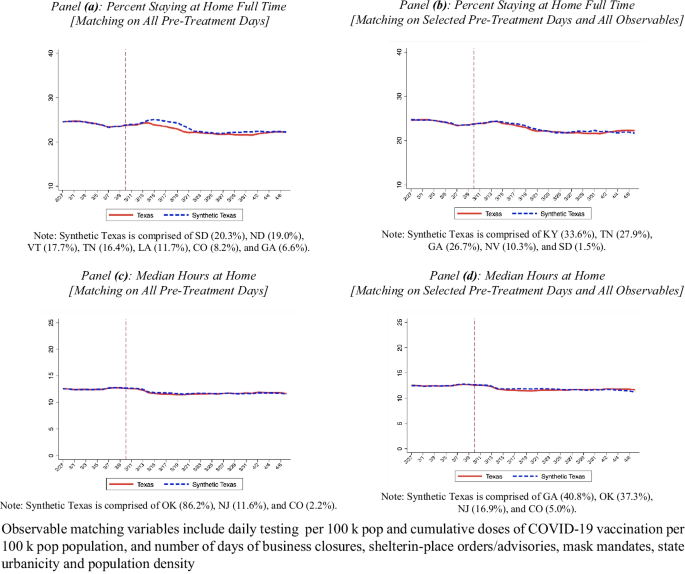
In the midst of mass COVID-19 vaccination distribution efforts in the U.S. Texas became the first state to abolish its mask mandate and fully lift capacity constraints for all businesses, effective on March 10, 2021. Proponents claimed that the reopening would generate short-run employment growth and signal a return to normal while opponents argued that it would cause a resurgence of COVID-19 and kill Texans. This study finds that each side was largely incorrect. First, using daily anonymized smartphone data - and synthetic control and difference-in-differences approaches - we find no evidence that the Texas reopening led to substantial changes in mobility, including foot traffic at a wide set of business establishments. Second, we find no evidence that the Texas reopening affected the rate of new COVID-19 cases or deaths during the five weeks following the reopening. Our null results persist across more urbanized and less urbanized counties, as well as across counties that supported Donald Trump and Joe Biden in the 2020 presidential election. Finally, we find no evidence that the Texas reopening impacted short-run employment, including in industries most affected by the reopening. Together, these findings underscore the persistence of late-pandemic era private behavior and stickiness in individuals' risk-related beliefs, and suggest that reopening policies may have impacts that are more muted than policymakers expect.
Supplementary information: The online version contains supplementary material available at 10.1007/s11166-022-09379-8.
期刊介绍:
The Journal of Risk and Uncertainty (JRU) welcomes original empirical, experimental, and theoretical manuscripts dealing with the analysis of risk-bearing behavior and decision making under uncertainty. The topics covered in the journal include, but are not limited to, decision theory and the economics of uncertainty, experimental investigations of behavior under uncertainty, empirical studies of real world risk-taking behavior, behavioral models of choice under uncertainty, and risk and public policy. Review papers are welcome.
The JRU does not publish finance or behavioral finance research, game theory, note length work, or papers that treat Likert-type scales as having cardinal significance.
An important aim of the JRU is to encourage interdisciplinary communication and interaction between researchers in the area of risk and uncertainty. Authors are expected to provide introductory discussions which set forth the nature of their research and the interpretation and implications of their findings in a manner accessible to knowledgeable researchers in other disciplines.
Officially cited as: J Risk Uncertain

 求助内容:
 应助结果提醒方式:


 京公网安备 11010802042870号


