Ye He, Jianping Sheng, Qin Ren, Yanjuan Sun, Weichang Hao and Fan Dong*,
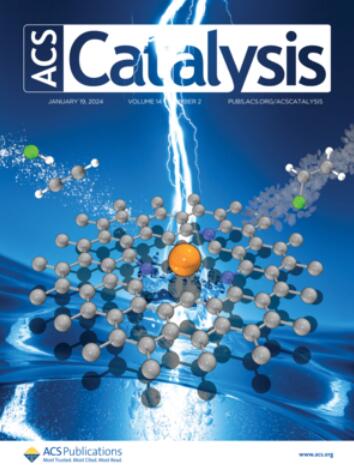
{"title":"Operando Identification of Dynamic Photoexcited Oxygen Vacancies as True Catalytic Active Sites","authors":"Ye He, Jianping Sheng, Qin Ren, Yanjuan Sun, Weichang Hao and Fan Dong*, ","doi":"10.1021/acscatal.2c04238","DOIUrl":null,"url":null,"abstract":"<p >The complex structural evolution of catalysts under realistic reaction conditions causes great difficulty in identifying true active sites and further understanding the correlations between the dynamic behavior and the catalytic property. Herein, we developed a set of operando electron paramagnetic resonance (EPR) measurements to investigate the dynamic behavior of true active sites, particularly the atomic surface structures and interfacial processes under reaction conditions. By constructing reduced TiO<sub>2</sub> as the catalyst model, supported by the developed operando EPR and multiple <i>in situ</i> characterization results, we confirm the generation of previously unrevealed active sites of photoexcited oxygen vacancies (Vo) and further dissect the formation, rebirth, and evolvement of dynamic Vo at the electronic level. Subsequently, the consistent theoretical and experimental results comprehensively justify the dynamic photoexcited Vo as the true active site directly determining the catalytic performance, subverting the classical perception of predesigned Vo as the active site. The relationship between dynamic active site evolution and catalytic performance during operation enables us to understand the interfacial mechanisms at work and design better catalysis systems.</p>","PeriodicalId":9,"journal":{"name":"ACS Catalysis ","volume":"13 1","pages":"191–203"},"PeriodicalIF":13.6000,"publicationDate":"2022-12-13","publicationTypes":"Journal Article","fieldsOfStudy":null,"isOpenAccess":false,"openAccessPdf":"","citationCount":"5","resultStr":null,"platform":"Semanticscholar","paperid":null,"PeriodicalName":"ACS Catalysis ","FirstCategoryId":"92","ListUrlMain":"https://pubs.acs.org/doi/10.1021/acscatal.2c04238","RegionNum":1,"RegionCategory":"化学","ArticlePicture":[],"TitleCN":null,"AbstractTextCN":null,"PMCID":null,"EPubDate":"","PubModel":"","JCR":"Q1","JCRName":"CHEMISTRY, PHYSICAL","Score":null,"Total":0}
引用次数: 5
Abstract
The complex structural evolution of catalysts under realistic reaction conditions causes great difficulty in identifying true active sites and further understanding the correlations between the dynamic behavior and the catalytic property. Herein, we developed a set of operando electron paramagnetic resonance (EPR) measurements to investigate the dynamic behavior of true active sites, particularly the atomic surface structures and interfacial processes under reaction conditions. By constructing reduced TiO2 as the catalyst model, supported by the developed operando EPR and multiple in situ characterization results, we confirm the generation of previously unrevealed active sites of photoexcited oxygen vacancies (Vo) and further dissect the formation, rebirth, and evolvement of dynamic Vo at the electronic level. Subsequently, the consistent theoretical and experimental results comprehensively justify the dynamic photoexcited Vo as the true active site directly determining the catalytic performance, subverting the classical perception of predesigned Vo as the active site. The relationship between dynamic active site evolution and catalytic performance during operation enables us to understand the interfacial mechanisms at work and design better catalysis systems.
期刊介绍:
ACS Catalysis is an esteemed journal that publishes original research in the fields of heterogeneous catalysis, molecular catalysis, and biocatalysis. It offers broad coverage across diverse areas such as life sciences, organometallics and synthesis, photochemistry and electrochemistry, drug discovery and synthesis, materials science, environmental protection, polymer discovery and synthesis, and energy and fuels.
The scope of the journal is to showcase innovative work in various aspects of catalysis. This includes new reactions and novel synthetic approaches utilizing known catalysts, the discovery or modification of new catalysts, elucidation of catalytic mechanisms through cutting-edge investigations, practical enhancements of existing processes, as well as conceptual advances in the field. Contributions to ACS Catalysis can encompass both experimental and theoretical research focused on catalytic molecules, macromolecules, and materials that exhibit catalytic turnover.


 求助内容:
 应助结果提醒方式:


 京公网安备 11010802042870号


