Nengchao Luo, Wei Nie, Junju Mu, Shiyang Liu, Mingrun Li, Jian Zhang, Zhuyan Gao, Fengtao Fan and Feng Wang*,
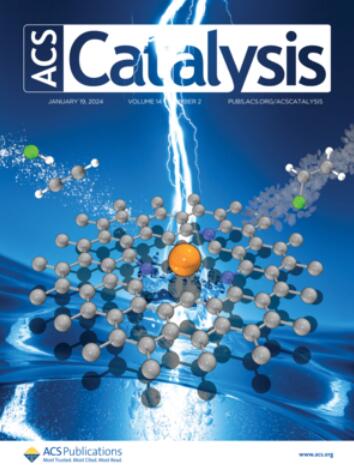
{"title":"Low-Work Function Metals Boost Selective and Fast Scission of Methanol C–H Bonds","authors":"Nengchao Luo, Wei Nie, Junju Mu, Shiyang Liu, Mingrun Li, Jian Zhang, Zhuyan Gao, Fengtao Fan and Feng Wang*, ","doi":"10.1021/acscatal.1c06005","DOIUrl":null,"url":null,"abstract":"<p >Photocatalytic production of chemicals and fuels with H<sub>2</sub> evolution has raised broad interest due to the carbon emission-free feature. In this context, selective and fast scission of methanol C–H bonds for coproduction of H<sub>2</sub> and ethylene glycol (EG) over metal–semiconductor composites remains to be achieved. Here, we demonstrate that indium nanoparticles (In NPs) with a low work function (<4.3 eV) increase the selectivity and activity of ZnIn<sub>2</sub>S<sub>4</sub> for the scission of methanol C–H bonds. By accepting electrons from In NPs, ZnIn<sub>2</sub>S<sub>4</sub> with enriched electrons tends to activate the C–H bond instead of the O–H bond. Besides, a relatively strong built-in field is formed between In NPs and the support, which facilitates photogenerated electron transfer to In NPs for H<sub>2</sub> evolution. Consequently, 84% selectivity of EG is obtained, and the apparent quantum yields (365 nm) of EG and H<sub>2</sub> reach 15.6 and 27.0%, respectively. This concept of methanol C–H bond scission boosted by low-work function metal is also proved by immobilizing In, Cd, and Bi to ZnS, resulting in up to 89% selectivity of EG.</p>","PeriodicalId":9,"journal":{"name":"ACS Catalysis ","volume":"12 11","pages":"6375–6384"},"PeriodicalIF":13.6000,"publicationDate":"2022-05-13","publicationTypes":"Journal Article","fieldsOfStudy":null,"isOpenAccess":false,"openAccessPdf":"","citationCount":"7","resultStr":null,"platform":"Semanticscholar","paperid":null,"PeriodicalName":"ACS Catalysis ","FirstCategoryId":"92","ListUrlMain":"https://pubs.acs.org/doi/10.1021/acscatal.1c06005","RegionNum":1,"RegionCategory":"化学","ArticlePicture":[],"TitleCN":null,"AbstractTextCN":null,"PMCID":null,"EPubDate":"","PubModel":"","JCR":"Q1","JCRName":"CHEMISTRY, PHYSICAL","Score":null,"Total":0}
引用次数: 7
Abstract
Photocatalytic production of chemicals and fuels with H2 evolution has raised broad interest due to the carbon emission-free feature. In this context, selective and fast scission of methanol C–H bonds for coproduction of H2 and ethylene glycol (EG) over metal–semiconductor composites remains to be achieved. Here, we demonstrate that indium nanoparticles (In NPs) with a low work function (<4.3 eV) increase the selectivity and activity of ZnIn2S4 for the scission of methanol C–H bonds. By accepting electrons from In NPs, ZnIn2S4 with enriched electrons tends to activate the C–H bond instead of the O–H bond. Besides, a relatively strong built-in field is formed between In NPs and the support, which facilitates photogenerated electron transfer to In NPs for H2 evolution. Consequently, 84% selectivity of EG is obtained, and the apparent quantum yields (365 nm) of EG and H2 reach 15.6 and 27.0%, respectively. This concept of methanol C–H bond scission boosted by low-work function metal is also proved by immobilizing In, Cd, and Bi to ZnS, resulting in up to 89% selectivity of EG.
期刊介绍:
ACS Catalysis is an esteemed journal that publishes original research in the fields of heterogeneous catalysis, molecular catalysis, and biocatalysis. It offers broad coverage across diverse areas such as life sciences, organometallics and synthesis, photochemistry and electrochemistry, drug discovery and synthesis, materials science, environmental protection, polymer discovery and synthesis, and energy and fuels.
The scope of the journal is to showcase innovative work in various aspects of catalysis. This includes new reactions and novel synthetic approaches utilizing known catalysts, the discovery or modification of new catalysts, elucidation of catalytic mechanisms through cutting-edge investigations, practical enhancements of existing processes, as well as conceptual advances in the field. Contributions to ACS Catalysis can encompass both experimental and theoretical research focused on catalytic molecules, macromolecules, and materials that exhibit catalytic turnover.


 求助内容:
 应助结果提醒方式:


 京公网安备 11010802042870号


