Haiyan Wang, Yanan Diao, Zirui Gao, Kevin J. Smith, Xinwen Guo*, Ding Ma* and Chuan Shi*,
{"title":"H2 Production from Methane Reforming over Molybdenum Carbide Catalysts: From Surface Properties and Reaction Mechanism to Catalyst Development","authors":"Haiyan Wang, Yanan Diao, Zirui Gao, Kevin J. Smith, Xinwen Guo*, Ding Ma* and Chuan Shi*, ","doi":"10.1021/acscatal.2c04619","DOIUrl":null,"url":null,"abstract":"<p >Hydrogen, with its high energy content and environmental-friendly properties, is considered an effective energy carrier in addition to fossil fuels. Methane reforming represents a major method of hydrogen production, although the applied catalysts often suffer from coke deposition and metal sintering at high operating temperatures. Transition-metal carbides (TMCs), particularly molybdenum carbides (Mo<sub><i>x</i></sub>C), possess features such as Pt-like behaviors, affinity with oxidants such as CO<sub>2</sub> and H<sub>2</sub>O, and a strong metal–support interaction for metal dispersion and stabilization, rendering them great prospective candidates for catalyzing the methane reforming reactions (MRRs). This review focuses on the recent applications and challenges of TMCs in MRRs, with an emphasis on the strategies to improve their performance by (1) engineering the operational conditions, (2) designing a dual M–Mo<sub><i>x</i></sub>C (M = Ni or Co etc.) active site, (3) dispersing M–Mo<sub><i>x</i></sub>C on supports, and (4) generating a M–Mo<sub><i>x</i></sub>C/MoO<sub><i>x</i></sub>C<sub><i>y</i></sub> interface <i>in situ</i>. The present review will provide guidance for the future design of efficient catalysts for H<sub>2</sub> production from MRRs.</p>","PeriodicalId":9,"journal":{"name":"ACS Catalysis ","volume":"12 24","pages":"15501–15528"},"PeriodicalIF":13.6000,"publicationDate":"2022-12-02","publicationTypes":"Journal Article","fieldsOfStudy":null,"isOpenAccess":false,"openAccessPdf":"","citationCount":"6","resultStr":null,"platform":"Semanticscholar","paperid":null,"PeriodicalName":"ACS Catalysis ","FirstCategoryId":"92","ListUrlMain":"https://pubs.acs.org/doi/10.1021/acscatal.2c04619","RegionNum":1,"RegionCategory":"化学","ArticlePicture":[],"TitleCN":null,"AbstractTextCN":null,"PMCID":null,"EPubDate":"","PubModel":"","JCR":"Q1","JCRName":"CHEMISTRY, PHYSICAL","Score":null,"Total":0}
引用次数: 6
Abstract
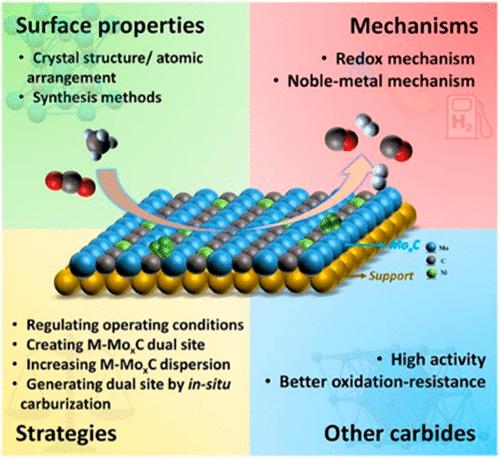
Hydrogen, with its high energy content and environmental-friendly properties, is considered an effective energy carrier in addition to fossil fuels. Methane reforming represents a major method of hydrogen production, although the applied catalysts often suffer from coke deposition and metal sintering at high operating temperatures. Transition-metal carbides (TMCs), particularly molybdenum carbides (MoxC), possess features such as Pt-like behaviors, affinity with oxidants such as CO2 and H2O, and a strong metal–support interaction for metal dispersion and stabilization, rendering them great prospective candidates for catalyzing the methane reforming reactions (MRRs). This review focuses on the recent applications and challenges of TMCs in MRRs, with an emphasis on the strategies to improve their performance by (1) engineering the operational conditions, (2) designing a dual M–MoxC (M = Ni or Co etc.) active site, (3) dispersing M–MoxC on supports, and (4) generating a M–MoxC/MoOxCy interface in situ. The present review will provide guidance for the future design of efficient catalysts for H2 production from MRRs.
期刊介绍:
ACS Catalysis is an esteemed journal that publishes original research in the fields of heterogeneous catalysis, molecular catalysis, and biocatalysis. It offers broad coverage across diverse areas such as life sciences, organometallics and synthesis, photochemistry and electrochemistry, drug discovery and synthesis, materials science, environmental protection, polymer discovery and synthesis, and energy and fuels.
The scope of the journal is to showcase innovative work in various aspects of catalysis. This includes new reactions and novel synthetic approaches utilizing known catalysts, the discovery or modification of new catalysts, elucidation of catalytic mechanisms through cutting-edge investigations, practical enhancements of existing processes, as well as conceptual advances in the field. Contributions to ACS Catalysis can encompass both experimental and theoretical research focused on catalytic molecules, macromolecules, and materials that exhibit catalytic turnover.

 求助内容:
求助内容: 应助结果提醒方式:

 京公网安备 11010802042870号


