Qing Zeng, Shaonan Tian, Hui Liu, Lin Xu, Penglei Cui, Dong Chen, Jing Wang, Jun Yang
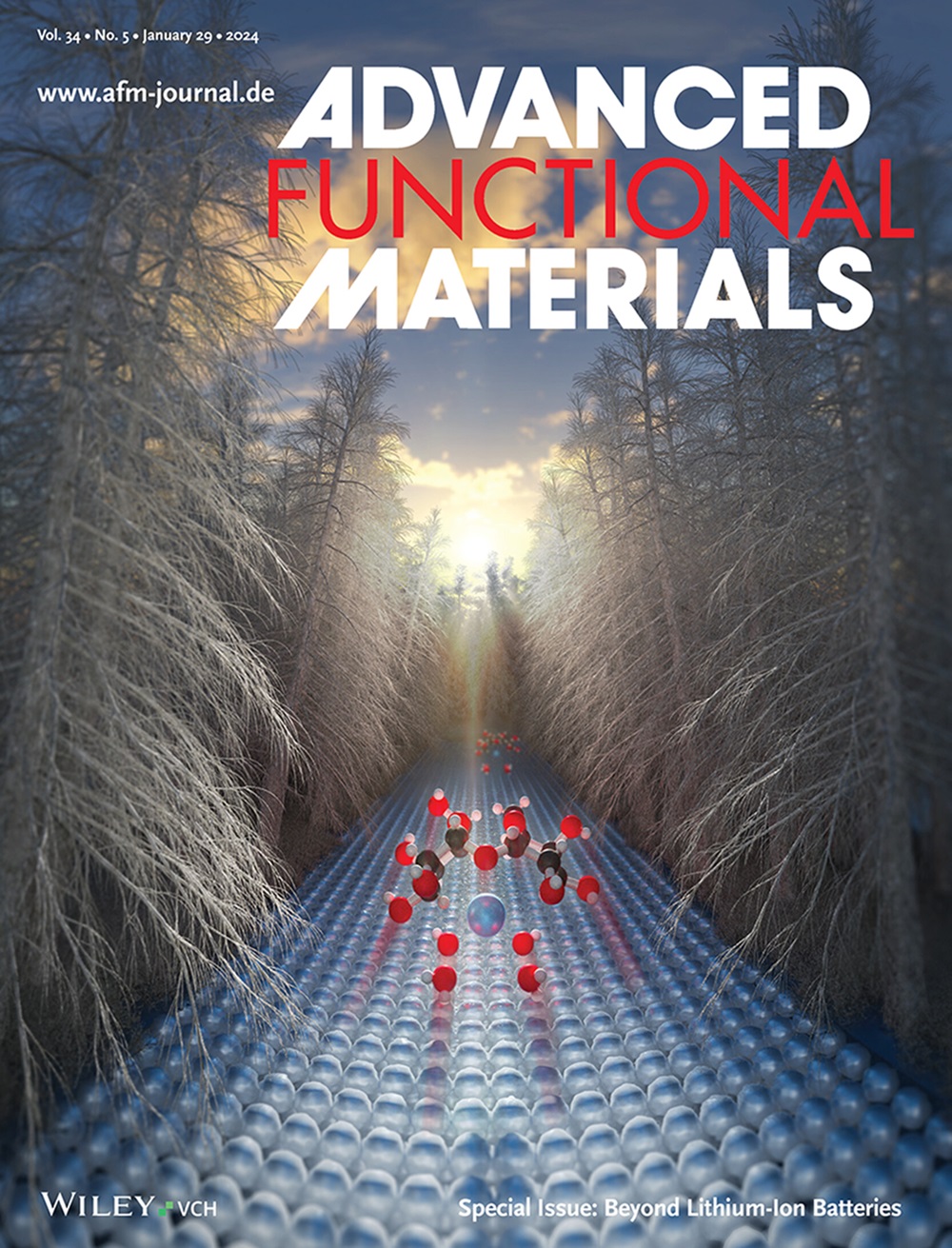
{"title":"Fine AgPd Nanoalloys Achieving Size and Ensemble Synergy for High-Efficiency CO2 to CO Electroreduction","authors":"Qing Zeng, Shaonan Tian, Hui Liu, Lin Xu, Penglei Cui, Dong Chen, Jing Wang, Jun Yang","doi":"10.1002/adfm.202307444","DOIUrl":null,"url":null,"abstract":"<p>Alloying the active metal with a second metal is an effective way to tailor the adsorption of reaction intermediates through an ensemble effect. Herein, based on theoretical calculations validating that the ensemble sites composed of Ag and Pd atoms could reduce the energy gap for *COOH and *CO intermediates generated during electrocatalytic CO<sub>2</sub> reduction reaction (eCO<sub>2</sub>RR) by either weakening the CO adsorption or enhancing the COOH adsorption, a strategy to produce AgPd alloy nanoparticles with fine sizes for synergizing the ensemble effect and size leverage toward high CO faradaic efficiency in eCO<sub>2</sub>RR is reported. In particular, the AgPd alloy nanoparticles at an optimized Ag/Pd atomic ratio of 35/65 affords a maximum CO faradaic efficiency of 98.9% and a CO partial current density of 5.1 mA cm<sup>−2</sup> at the potential of −0.8 V (vs RHE) with satisfactory durability of up to 25 h, outperforming those of most Pd-based electrocatalysts recently reported and demonstrating great potential for further application in producing CO via eCO<sub>2</sub>RR at ambient conditions.</p>","PeriodicalId":112,"journal":{"name":"Advanced Functional Materials","volume":"33 45","pages":""},"PeriodicalIF":19.9000,"publicationDate":"2023-08-30","publicationTypes":"Journal Article","fieldsOfStudy":null,"isOpenAccess":false,"openAccessPdf":"","citationCount":"1","resultStr":null,"platform":"Semanticscholar","paperid":null,"PeriodicalName":"Advanced Functional Materials","FirstCategoryId":"88","ListUrlMain":"https://onlinelibrary.wiley.com/doi/10.1002/adfm.202307444","RegionNum":1,"RegionCategory":"材料科学","ArticlePicture":[],"TitleCN":null,"AbstractTextCN":null,"PMCID":null,"EPubDate":"","PubModel":"","JCR":"Q1","JCRName":"CHEMISTRY, MULTIDISCIPLINARY","Score":null,"Total":0}
引用次数: 1
Abstract
Alloying the active metal with a second metal is an effective way to tailor the adsorption of reaction intermediates through an ensemble effect. Herein, based on theoretical calculations validating that the ensemble sites composed of Ag and Pd atoms could reduce the energy gap for *COOH and *CO intermediates generated during electrocatalytic CO2 reduction reaction (eCO2RR) by either weakening the CO adsorption or enhancing the COOH adsorption, a strategy to produce AgPd alloy nanoparticles with fine sizes for synergizing the ensemble effect and size leverage toward high CO faradaic efficiency in eCO2RR is reported. In particular, the AgPd alloy nanoparticles at an optimized Ag/Pd atomic ratio of 35/65 affords a maximum CO faradaic efficiency of 98.9% and a CO partial current density of 5.1 mA cm−2 at the potential of −0.8 V (vs RHE) with satisfactory durability of up to 25 h, outperforming those of most Pd-based electrocatalysts recently reported and demonstrating great potential for further application in producing CO via eCO2RR at ambient conditions.
将活性金属与第二金属合金化是通过系综效应调整反应中间体吸附的有效方法。本文通过理论计算验证了Ag和Pd原子组成的系综位点可以通过减弱CO吸附或增强COOH吸附来减小电催化CO2还原反应(eCO2RR)中生成的*COOH和*CO中间体的能隙,并报道了一种制备细尺寸AgPd合金纳米颗粒的策略,以协同eCO2RR中的系综效应和尺寸优势,从而提高CO的法拉第效率。特别是,在Ag/Pd原子比为35/65的优化条件下,AgPd合金纳米颗粒的CO faraday效率最高可达98.9%,CO偏电流密度为5.1 mA cm - 2,电势为−0.8 V (vs RHE),持久时间长达25小时,优于最近报道的大多数Pd基电催化剂,并显示出在环境条件下通过eCO2RR生产CO的进一步应用潜力。
期刊介绍:
Firmly established as a top-tier materials science journal, Advanced Functional Materials reports breakthrough research in all aspects of materials science, including nanotechnology, chemistry, physics, and biology every week.
Advanced Functional Materials is known for its rapid and fair peer review, quality content, and high impact, making it the first choice of the international materials science community.


 求助内容:
 应助结果提醒方式:


 京公网安备 11010802042870号


