Ang Hu, Kyoung-Soon Jang, Fanfan Meng, James Stegen, Andrew J. Tanentzap, Mira Choi, Jay T. Lennon, Janne Soininen and Jianjun Wang*,
{"title":"Microbial and Environmental Processes Shape the Link between Organic Matter Functional Traits and Composition","authors":"Ang Hu, Kyoung-Soon Jang, Fanfan Meng, James Stegen, Andrew J. Tanentzap, Mira Choi, Jay T. Lennon, Janne Soininen and Jianjun Wang*, ","doi":"10.1021/acs.est.2c01432","DOIUrl":null,"url":null,"abstract":"<p >Dissolved organic matter (DOM) is a large and complex mixture of molecules that fuels microbial metabolism and regulates biogeochemical cycles. Individual DOM molecules have unique functional traits, but how their assemblages vary deterministically under global change remains poorly understood. Here, we examine DOM and associated bacteria in 300 aquatic microcosms deployed on mountainsides that span contrasting temperatures and nutrient gradients. Based on molecular trait dimensions of reactivity and activity, we partition the DOM composition into labile-active, recalcitrant-active, recalcitrant-inactive, and labile-inactive fractions and quantify the relative influences of deterministic and stochastic processes governing the assembly of each. At both subtropical and subarctic study sites, the assembly of labile or recalcitrant molecules in active fractions is primarily governed by deterministic processes, while stochastic processes are more important for the assembly of molecules within inactive fractions. Surprisingly, the importance of deterministic selection increases with global change gradients for recalcitrant molecules in both active and inactive fractions, and this trend is paralleled by changes in the deterministic assembly of microbial communities and environmental filtering, respectively. Together, our results highlight the shift in focus from potential reactivity to realized activity and indicate that active and inactive fractions of DOM assemblages are structured by contrasting processes, and their recalcitrant components are consistently sensitive to global change. Our study partitions the DOM molecular composition across functional traits and links DOM with microbes via a shared ecological framework of assembly processes. This integrated approach opens new avenues to understand the assembly and turnover of organic carbon in a changing world.</p>","PeriodicalId":36,"journal":{"name":"环境科学与技术","volume":"56 14","pages":"10504–10516"},"PeriodicalIF":12.2000,"publicationDate":"2022-06-23","publicationTypes":"Journal Article","fieldsOfStudy":null,"isOpenAccess":false,"openAccessPdf":"","citationCount":"19","resultStr":null,"platform":"Semanticscholar","paperid":null,"PeriodicalName":"环境科学与技术","FirstCategoryId":"1","ListUrlMain":"https://pubs.acs.org/doi/10.1021/acs.est.2c01432","RegionNum":1,"RegionCategory":"环境科学与生态学","ArticlePicture":[],"TitleCN":null,"AbstractTextCN":null,"PMCID":null,"EPubDate":"","PubModel":"","JCR":"Q1","JCRName":"ENGINEERING, ENVIRONMENTAL","Score":null,"Total":0}
引用次数: 19
Abstract
Dissolved organic matter (DOM) is a large and complex mixture of molecules that fuels microbial metabolism and regulates biogeochemical cycles. Individual DOM molecules have unique functional traits, but how their assemblages vary deterministically under global change remains poorly understood. Here, we examine DOM and associated bacteria in 300 aquatic microcosms deployed on mountainsides that span contrasting temperatures and nutrient gradients. Based on molecular trait dimensions of reactivity and activity, we partition the DOM composition into labile-active, recalcitrant-active, recalcitrant-inactive, and labile-inactive fractions and quantify the relative influences of deterministic and stochastic processes governing the assembly of each. At both subtropical and subarctic study sites, the assembly of labile or recalcitrant molecules in active fractions is primarily governed by deterministic processes, while stochastic processes are more important for the assembly of molecules within inactive fractions. Surprisingly, the importance of deterministic selection increases with global change gradients for recalcitrant molecules in both active and inactive fractions, and this trend is paralleled by changes in the deterministic assembly of microbial communities and environmental filtering, respectively. Together, our results highlight the shift in focus from potential reactivity to realized activity and indicate that active and inactive fractions of DOM assemblages are structured by contrasting processes, and their recalcitrant components are consistently sensitive to global change. Our study partitions the DOM molecular composition across functional traits and links DOM with microbes via a shared ecological framework of assembly processes. This integrated approach opens new avenues to understand the assembly and turnover of organic carbon in a changing world.
期刊介绍:
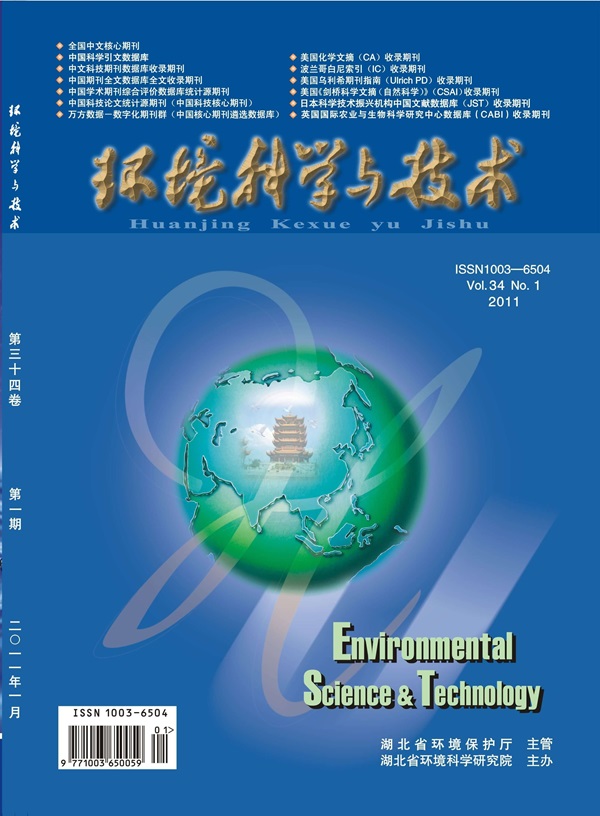
Environmental Science & Technology (ES&T) is a co-sponsored academic and technical magazine by the Hubei Provincial Environmental Protection Bureau and the Hubei Provincial Academy of Environmental Sciences.
Environmental Science & Technology (ES&T) holds the status of Chinese core journals, scientific papers source journals of China, Chinese Science Citation Database source journals, and Chinese Academic Journal Comprehensive Evaluation Database source journals. This publication focuses on the academic field of environmental protection, featuring articles related to environmental protection and technical advancements.


 求助内容:
 应助结果提醒方式:


 京公网安备 11010802042870号


