Niluni M Wijesundara, Song F Lee, Zhenyu Cheng, Ross Davidson, H P Vasantha Rupasinghe
{"title":"Carvacrol exhibits rapid bactericidal activity against Streptococcus pyogenes through cell membrane damage.","authors":"Niluni M Wijesundara, Song F Lee, Zhenyu Cheng, Ross Davidson, H P Vasantha Rupasinghe","doi":"10.1038/s41598-020-79713-0","DOIUrl":null,"url":null,"abstract":"<p><p>Streptococcus pyogenes is an important human pathogen worldwide. The identification of natural antibacterial phytochemicals has renewed interest due to the current scarcity of antibiotic development. Carvacrol is a monoterpenoid found in herbs. We evaluated carvacrol alone and combined with selected antibiotics against four strains of S. pyogenes in vitro. The minimum inhibitory concentration (MIC) and minimum bactericidal concentration (MBC) of carvacrol against S. pyogenes were 125 µg/mL (0.53 mM) and 250 µg/mL (1.05 mM), respectively. Kill curve results showed that carvacrol exhibits instantaneous bactericidal activity against S. pyogenes. We also demonstrated the potential mechanism of action of carvacrol through compromising the cell membrane integrity. Carvacrol induced membrane integrity changes leading to leakage of cytoplasmic content such as lactate dehydrogenase enzymes and nucleic acids. We further confirmed dose-dependent rupturing of cells and cell deaths using transmission electron microscopy. The chequerboard assay results showed that carvacrol possesses an additive-synergistic effect with clindamycin or penicillin. Carvacrol alone, combined with clindamycin or penicillin, can be used as a safe and efficacious natural health product for managing streptococcal pharyngitis.</p>","PeriodicalId":21811,"journal":{"name":"Scientific Reports","volume":" ","pages":"1487"},"PeriodicalIF":4.9000,"publicationDate":"2021-01-15","publicationTypes":"Journal Article","fieldsOfStudy":null,"isOpenAccess":false,"openAccessPdf":"https://sci-hub-pdf.com/10.1038/s41598-020-79713-0","citationCount":"48","resultStr":null,"platform":"Semanticscholar","paperid":null,"PeriodicalName":"Scientific Reports","FirstCategoryId":"103","ListUrlMain":"https://doi.org/10.1038/s41598-020-79713-0","RegionNum":2,"RegionCategory":"综合性期刊","ArticlePicture":[],"TitleCN":null,"AbstractTextCN":null,"PMCID":null,"EPubDate":"","PubModel":"","JCR":"Q1","JCRName":"MULTIDISCIPLINARY SCIENCES","Score":null,"Total":0}
引用次数: 48
Abstract
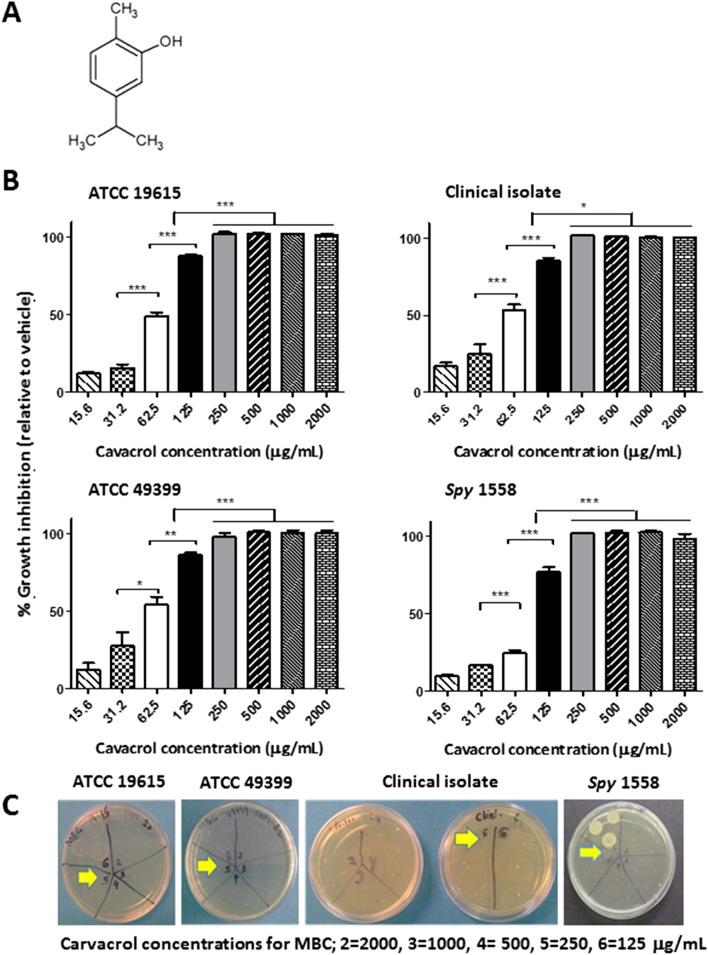
Streptococcus pyogenes is an important human pathogen worldwide. The identification of natural antibacterial phytochemicals has renewed interest due to the current scarcity of antibiotic development. Carvacrol is a monoterpenoid found in herbs. We evaluated carvacrol alone and combined with selected antibiotics against four strains of S. pyogenes in vitro. The minimum inhibitory concentration (MIC) and minimum bactericidal concentration (MBC) of carvacrol against S. pyogenes were 125 µg/mL (0.53 mM) and 250 µg/mL (1.05 mM), respectively. Kill curve results showed that carvacrol exhibits instantaneous bactericidal activity against S. pyogenes. We also demonstrated the potential mechanism of action of carvacrol through compromising the cell membrane integrity. Carvacrol induced membrane integrity changes leading to leakage of cytoplasmic content such as lactate dehydrogenase enzymes and nucleic acids. We further confirmed dose-dependent rupturing of cells and cell deaths using transmission electron microscopy. The chequerboard assay results showed that carvacrol possesses an additive-synergistic effect with clindamycin or penicillin. Carvacrol alone, combined with clindamycin or penicillin, can be used as a safe and efficacious natural health product for managing streptococcal pharyngitis.
期刊介绍:
We publish original research from all areas of the natural sciences, psychology, medicine and engineering. You can learn more about what we publish by browsing our specific scientific subject areas below or explore Scientific Reports by browsing all articles and collections.
Scientific Reports has a 2-year impact factor: 4.380 (2021), and is the 6th most-cited journal in the world, with more than 540,000 citations in 2020 (Clarivate Analytics, 2021).
•Engineering
Engineering covers all aspects of engineering, technology, and applied science. It plays a crucial role in the development of technologies to address some of the world''s biggest challenges, helping to save lives and improve the way we live.
•Physical sciences
Physical sciences are those academic disciplines that aim to uncover the underlying laws of nature — often written in the language of mathematics. It is a collective term for areas of study including astronomy, chemistry, materials science and physics.
•Earth and environmental sciences
Earth and environmental sciences cover all aspects of Earth and planetary science and broadly encompass solid Earth processes, surface and atmospheric dynamics, Earth system history, climate and climate change, marine and freshwater systems, and ecology. It also considers the interactions between humans and these systems.
•Biological sciences
Biological sciences encompass all the divisions of natural sciences examining various aspects of vital processes. The concept includes anatomy, physiology, cell biology, biochemistry and biophysics, and covers all organisms from microorganisms, animals to plants.
•Health sciences
The health sciences study health, disease and healthcare. This field of study aims to develop knowledge, interventions and technology for use in healthcare to improve the treatment of patients.



 求助内容:
求助内容: 应助结果提醒方式:

 京公网安备 11010802042870号


