Jing Gong, Yu Gong, Ting Zou, Yuxiao Zeng, Cao Yang, Lingyue Mo, Jiahui Kang, Xiaotang Fan, Haiwei Xu and Jun Yang
{"title":"A controllable perfusion microfluidic chip for facilitating the development of retinal ganglion cells in human retinal organoids†","authors":"Jing Gong, Yu Gong, Ting Zou, Yuxiao Zeng, Cao Yang, Lingyue Mo, Jiahui Kang, Xiaotang Fan, Haiwei Xu and Jun Yang","doi":"10.1039/D3LC00054K","DOIUrl":null,"url":null,"abstract":"<p >Retinal organoids (ROs) derived from human pluripotent stem cells (hPSCs) have become a promising model <em>in vitro</em> to recapitulate human retinal development, which can be further employed to explore the mechanisms of retinal diseases. However, the current culture systems for ROs lack physiologically relevant microenvironments, such as controllable mechano-physiological cues and dynamic feedback between cells and the extracellular matrix (ECM), which limits the accurate control of RO development. Therefore, we designed a controllable perfusion microfluidic chip (CPMC) with the advantages of precisely controlling fluidic shear stress (FSS) and oxygen concentration distribution in a human embryonic stem cell (hESC)-derived RO culture system. We found that ROs cultured under this system allow for expanding the retinal progenitor cell (RPC) pool, orchestrating the retinal ganglion cell (RGC) specification, and axon growth without disturbing the spatial and temporal patterning events at the early stage of RO development. Furthermore, RNA sequencing data revealed that the activation of voltage-gated ion channels and the increased expression of ECM components synergistically improve the growth of ROs and facilitate the differentiation of RGCs. This study elaborates on the advantages of the designed CPMC to promote RO growth and provide a controllable and reliable platform for the efficient maturity of RGCs in the ROs, promising applications in modeling RGC-related disorders, drug screening, and cell transplantation.</p>","PeriodicalId":85,"journal":{"name":"Lab on a Chip","volume":" 17","pages":" 3820-3836"},"PeriodicalIF":6.3000,"publicationDate":"2023-07-27","publicationTypes":"Journal Article","fieldsOfStudy":null,"isOpenAccess":false,"openAccessPdf":"","citationCount":"2","resultStr":null,"platform":"Semanticscholar","paperid":null,"PeriodicalName":"Lab on a Chip","FirstCategoryId":"5","ListUrlMain":"https://pubs.rsc.org/en/content/articlelanding/2023/lc/d3lc00054k","RegionNum":2,"RegionCategory":"工程技术","ArticlePicture":[],"TitleCN":null,"AbstractTextCN":null,"PMCID":null,"EPubDate":"","PubModel":"","JCR":"Q1","JCRName":"BIOCHEMICAL RESEARCH METHODS","Score":null,"Total":0}
引用次数: 2
Abstract
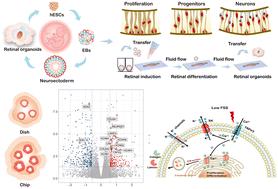
Retinal organoids (ROs) derived from human pluripotent stem cells (hPSCs) have become a promising model in vitro to recapitulate human retinal development, which can be further employed to explore the mechanisms of retinal diseases. However, the current culture systems for ROs lack physiologically relevant microenvironments, such as controllable mechano-physiological cues and dynamic feedback between cells and the extracellular matrix (ECM), which limits the accurate control of RO development. Therefore, we designed a controllable perfusion microfluidic chip (CPMC) with the advantages of precisely controlling fluidic shear stress (FSS) and oxygen concentration distribution in a human embryonic stem cell (hESC)-derived RO culture system. We found that ROs cultured under this system allow for expanding the retinal progenitor cell (RPC) pool, orchestrating the retinal ganglion cell (RGC) specification, and axon growth without disturbing the spatial and temporal patterning events at the early stage of RO development. Furthermore, RNA sequencing data revealed that the activation of voltage-gated ion channels and the increased expression of ECM components synergistically improve the growth of ROs and facilitate the differentiation of RGCs. This study elaborates on the advantages of the designed CPMC to promote RO growth and provide a controllable and reliable platform for the efficient maturity of RGCs in the ROs, promising applications in modeling RGC-related disorders, drug screening, and cell transplantation.
期刊介绍:
Lab on a Chip is the premiere journal that publishes cutting-edge research in the field of miniaturization. By their very nature, microfluidic/nanofluidic/miniaturized systems are at the intersection of disciplines, spanning fundamental research to high-end application, which is reflected by the broad readership of the journal. Lab on a Chip publishes two types of papers on original research: full-length research papers and communications. Papers should demonstrate innovations, which can come from technical advancements or applications addressing pressing needs in globally important areas. The journal also publishes Comments, Reviews, and Perspectives.

 求助内容:
求助内容: 应助结果提醒方式:

 京公网安备 11010802042870号


