Qian Yue, Li Zhang, Cheng-Yu He, Bao-Hua Liu, Wei-Ming Wang, Zhong-Wei Lu, Gang Liu and Xiang-Hu Gao
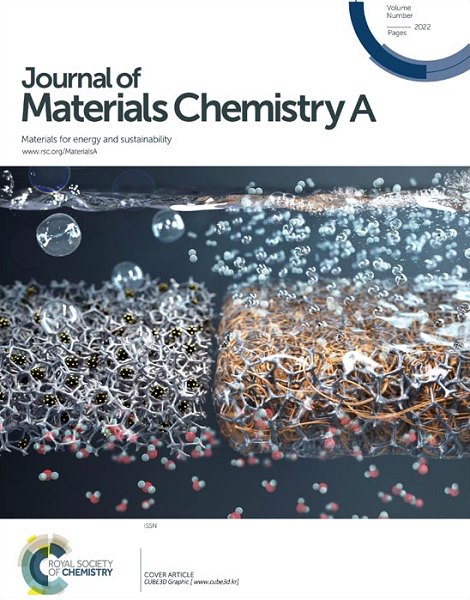
{"title":"Polymer composites with hierarchical architecture and dielectric particles for efficient daytime subambient radiative cooling†","authors":"Qian Yue, Li Zhang, Cheng-Yu He, Bao-Hua Liu, Wei-Ming Wang, Zhong-Wei Lu, Gang Liu and Xiang-Hu Gao","doi":"10.1039/D2TA07453B","DOIUrl":null,"url":null,"abstract":"<p >Passive daytime radiative cooling (PDRC) is an emerging energy-free cooling technology, which can weaken our dependence on energy-consuming air-conditioning requirements. Though the advance in micro/nanostructure PDRC materials achieves excellent sub-ambient cooling performance, the majority of them are facing a huge challenge in terms of practical large-scale applications owing to complicated preparation methods and high costs. Herein, combining a low-cost polymer matrix with inorganic dielectric particles, a hierarchically porous composite (HPC) film with a micro/nanostructure and adjustable spectral properties is developed through a flexible phase-inversion-based method. The HPC-film exhibits a strong solar reflectivity (~98.26%) and infrared emissivity (~97.56%), thus realizing a sub-ambient average cooling temperature of ~9.1 °C and effective radiative cooling power of ~87.2 W m<small><sup>?2</sup></small> under a solar irradiance of ~890 W m<small><sup>?2</sup></small>. As a proof of concept, we demonstrate that the proposed cooler is capable of delaying ice melting by four times compared with the pristine case due to the remarkable radiative cooling performance, which provides inspiration for developing a scalable and sustainable pathway of ice protection and preservation. Overall, the multiple advantages of the facile and flexible manufacturing technique, excellent stability and repeatability in this study promise potentially valuable applications in passive radiative cooling.</p>","PeriodicalId":82,"journal":{"name":"Journal of Materials Chemistry A","volume":" 6","pages":" 3126-3135"},"PeriodicalIF":9.2000,"publicationDate":"2023-01-12","publicationTypes":"Journal Article","fieldsOfStudy":null,"isOpenAccess":false,"openAccessPdf":"","citationCount":"5","resultStr":null,"platform":"Semanticscholar","paperid":null,"PeriodicalName":"Journal of Materials Chemistry A","FirstCategoryId":"88","ListUrlMain":"https://pubs.rsc.org/en/content/articlelanding/2023/ta/d2ta07453b","RegionNum":2,"RegionCategory":"材料科学","ArticlePicture":[],"TitleCN":null,"AbstractTextCN":null,"PMCID":null,"EPubDate":"","PubModel":"","JCR":"Q1","JCRName":"CHEMISTRY, PHYSICAL","Score":null,"Total":0}
引用次数: 5
Abstract
Passive daytime radiative cooling (PDRC) is an emerging energy-free cooling technology, which can weaken our dependence on energy-consuming air-conditioning requirements. Though the advance in micro/nanostructure PDRC materials achieves excellent sub-ambient cooling performance, the majority of them are facing a huge challenge in terms of practical large-scale applications owing to complicated preparation methods and high costs. Herein, combining a low-cost polymer matrix with inorganic dielectric particles, a hierarchically porous composite (HPC) film with a micro/nanostructure and adjustable spectral properties is developed through a flexible phase-inversion-based method. The HPC-film exhibits a strong solar reflectivity (~98.26%) and infrared emissivity (~97.56%), thus realizing a sub-ambient average cooling temperature of ~9.1 °C and effective radiative cooling power of ~87.2 W m?2 under a solar irradiance of ~890 W m?2. As a proof of concept, we demonstrate that the proposed cooler is capable of delaying ice melting by four times compared with the pristine case due to the remarkable radiative cooling performance, which provides inspiration for developing a scalable and sustainable pathway of ice protection and preservation. Overall, the multiple advantages of the facile and flexible manufacturing technique, excellent stability and repeatability in this study promise potentially valuable applications in passive radiative cooling.
被动日间辐射制冷(PDRC)是一种新兴的无能源制冷技术,它可以减少我们对高耗能空调的依赖。虽然微纳结构PDRC材料取得了优异的亚环境冷却性能,但由于制备方法复杂、成本高,大多数PDRC材料在实际大规模应用方面面临巨大挑战。本文将低成本聚合物基质与无机介电颗粒相结合,通过基于柔性相位反转的方法,制备了具有微纳米结构和可调光谱特性的层次多孔复合材料(HPC)薄膜。hpc薄膜具有较强的太阳反射率(~98.26%)和红外发射率(~97.56%),可实现亚环境平均冷却温度~9.1℃,有效辐射冷却功率~87.2 W m?在太阳辐照度约890瓦/米的条件下。作为概念证明,我们证明,由于卓越的辐射冷却性能,所提出的冷却器能够将冰的融化延迟四倍,这为开发可扩展和可持续的冰保护和保存途径提供了灵感。总之,本研究具有制造工艺简单灵活、稳定性好、可重复性好等优点,在被动辐射冷却领域具有潜在的应用价值。
期刊介绍:
The Journal of Materials Chemistry A, B & C covers a wide range of high-quality studies in the field of materials chemistry, with each section focusing on specific applications of the materials studied. Journal of Materials Chemistry A emphasizes applications in energy and sustainability, including topics such as artificial photosynthesis, batteries, and fuel cells. Journal of Materials Chemistry B focuses on applications in biology and medicine, while Journal of Materials Chemistry C covers applications in optical, magnetic, and electronic devices. Example topic areas within the scope of Journal of Materials Chemistry A include catalysis, green/sustainable materials, sensors, and water treatment, among others.


 求助内容:
 应助结果提醒方式:


 京公网安备 11010802042870号


