Chaonan Lv, Yuxin Zhang, Jianjun Ma, Yuanxin Zhu, Dan Huang, Yixin Li, Haiyan Wang and Yougen Tang
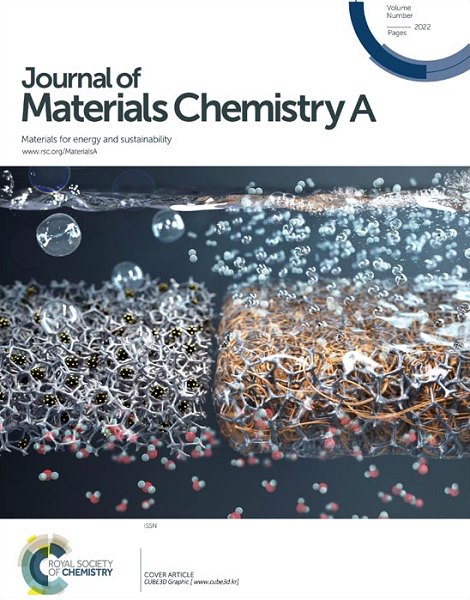
{"title":"Regulating solvation and interface chemistry to inhibit corrosion of the aluminum anode in aluminum–air batteries†","authors":"Chaonan Lv, Yuxin Zhang, Jianjun Ma, Yuanxin Zhu, Dan Huang, Yixin Li, Haiyan Wang and Yougen Tang","doi":"10.1039/D2TA01064J","DOIUrl":null,"url":null,"abstract":"<p >As a promising energy storage technology, aluminum–air batteries possess the advantages of high energy density, safety and low-cost. However, the severe self-corrosion of the aluminum anode greatly limits their practical applications. To address such issues, solvation chemistry and interface chemistry are combined together to reduce the aluminum anode corrosion by adding a concentrated potassium acetate electrolyte component and sodium stannate electrolyte additive, which can greatly decrease the number of free H<small><sub>2</sub></small>O molecules and improve the potential of hydrogen evolution. Thus, the aluminum anode exhibits significantly reduced corrosion rate behavior in the as-prepared electrolyte (0.085 mg cm<small><sup>?2</sup></small> min<small><sup>?1</sup></small> for the blank electrolyte, and 0.011 mg cm<small><sup>?2</sup></small> min<small><sup>?1</sup></small> for the hybrid high concentration electrolyte). The full cell with the optimized electrolyte shows a remarkably increased discharge capacity of 2439 mA h g<small><sup>?1</sup></small> at a current density of 25 mA cm<small><sup>?2</sup></small> and the cathode electrocatalyst is not damaged after discharging.</p>","PeriodicalId":82,"journal":{"name":"Journal of Materials Chemistry A","volume":" 17","pages":" 9506-9514"},"PeriodicalIF":9.2000,"publicationDate":"2022-03-16","publicationTypes":"Journal Article","fieldsOfStudy":null,"isOpenAccess":false,"openAccessPdf":"","citationCount":"8","resultStr":null,"platform":"Semanticscholar","paperid":null,"PeriodicalName":"Journal of Materials Chemistry A","FirstCategoryId":"88","ListUrlMain":"https://pubs.rsc.org/en/content/articlelanding/2022/ta/d2ta01064j","RegionNum":2,"RegionCategory":"材料科学","ArticlePicture":[],"TitleCN":null,"AbstractTextCN":null,"PMCID":null,"EPubDate":"","PubModel":"","JCR":"Q1","JCRName":"CHEMISTRY, PHYSICAL","Score":null,"Total":0}
引用次数: 8
Abstract
As a promising energy storage technology, aluminum–air batteries possess the advantages of high energy density, safety and low-cost. However, the severe self-corrosion of the aluminum anode greatly limits their practical applications. To address such issues, solvation chemistry and interface chemistry are combined together to reduce the aluminum anode corrosion by adding a concentrated potassium acetate electrolyte component and sodium stannate electrolyte additive, which can greatly decrease the number of free H2O molecules and improve the potential of hydrogen evolution. Thus, the aluminum anode exhibits significantly reduced corrosion rate behavior in the as-prepared electrolyte (0.085 mg cm?2 min?1 for the blank electrolyte, and 0.011 mg cm?2 min?1 for the hybrid high concentration electrolyte). The full cell with the optimized electrolyte shows a remarkably increased discharge capacity of 2439 mA h g?1 at a current density of 25 mA cm?2 and the cathode electrocatalyst is not damaged after discharging.
铝空气电池具有能量密度高、安全、成本低等优点,是一种很有发展前景的储能技术。然而,铝阳极严重的自腐蚀问题极大地限制了其实际应用。针对这一问题,将溶剂化化学和界面化学相结合,通过添加浓醋酸钾电解质组分和锡酸钠电解质添加剂来减少铝阳极的腐蚀,可以大大减少游离H2O分子的数量,提高析氢电位。因此,铝阳极在制备的电解质(0.085 mg cm?2分钟?1为空白电解质,0.011 mg cm?2分钟?1为混合型高浓度电解液)。经过优化的电解液使电池的放电容量显著提高,达到2439 mA h g?1,电流密度为25毫安厘米?2、阴极电催化剂放电后不损坏。
期刊介绍:
The Journal of Materials Chemistry A, B & C covers a wide range of high-quality studies in the field of materials chemistry, with each section focusing on specific applications of the materials studied. Journal of Materials Chemistry A emphasizes applications in energy and sustainability, including topics such as artificial photosynthesis, batteries, and fuel cells. Journal of Materials Chemistry B focuses on applications in biology and medicine, while Journal of Materials Chemistry C covers applications in optical, magnetic, and electronic devices. Example topic areas within the scope of Journal of Materials Chemistry A include catalysis, green/sustainable materials, sensors, and water treatment, among others.


 求助内容:
 应助结果提醒方式:


 京公网安备 11010802042870号


