Yize Zhang , Hangshuai Li , Xingyue He , Aiqing Wang , Guoyi Bai , Xingwang Lan
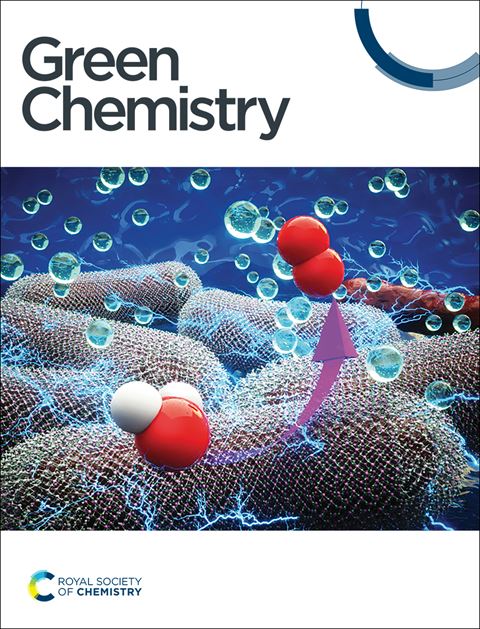
{"title":"Covalent organic frameworks embedding single cadmium sites for efficient carboxylative cyclization of CO2 with propargylic amines†","authors":"Yize Zhang , Hangshuai Li , Xingyue He , Aiqing Wang , Guoyi Bai , Xingwang Lan","doi":"10.1039/d3gc01334k","DOIUrl":null,"url":null,"abstract":"<div><p>Converting CO<sub>2</sub> into value-added chemicals over efficient and recyclable catalysts has attracted increasing attention. Covalent organic frameworks (COFs) have arisen as elegant heterogeneous catalysts for this subject. Herein, we report the synthesis of a crystalline 2,2′-bipyridine-based covalent organic framework bearing Cd single-atom sites (Cd-Bpy-COF) as a synergistic catalyst for the carboxylative cyclization under mild conditions with CO<sub>2</sub> and propargylic amines. Periodically distributed bipyridine coordination units can anchor Cd single sites with high loading on the covalent organic framework, exposing large active surfaces to enhance the activity. The as-synthesized Cd-Bpy-COF exhibits excellent activity and outstanding stability for the carboxylative cyclization with CO<sub>2</sub>. Experimental and theoretical results demonstrate that the integration of COF framework and single Cd active sites remarkably boosts the adsorption and activation of CO<sub>2</sub>, and then promotes its following cyclization reaction. This study further demonstrates the designed possibility of COF catalysts at the molecular level for high-performance CO<sub>2</sub> conversion.</p></div>","PeriodicalId":78,"journal":{"name":"Green Chemistry","volume":"25 14","pages":"Pages 5557-5565"},"PeriodicalIF":10.6000,"publicationDate":"2023-01-01","publicationTypes":"Journal Article","fieldsOfStudy":null,"isOpenAccess":false,"openAccessPdf":"","citationCount":"1","resultStr":null,"platform":"Semanticscholar","paperid":null,"PeriodicalName":"Green Chemistry","FirstCategoryId":"92","ListUrlMain":"https://www.sciencedirect.com/org/science/article/pii/S1463926223007744","RegionNum":1,"RegionCategory":"化学","ArticlePicture":[],"TitleCN":null,"AbstractTextCN":null,"PMCID":null,"EPubDate":"2023/9/4 0:00:00","PubModel":"Epub","JCR":"Q1","JCRName":"CHEMISTRY, MULTIDISCIPLINARY","Score":null,"Total":0}
引用次数: 1
Abstract
Converting CO2 into value-added chemicals over efficient and recyclable catalysts has attracted increasing attention. Covalent organic frameworks (COFs) have arisen as elegant heterogeneous catalysts for this subject. Herein, we report the synthesis of a crystalline 2,2′-bipyridine-based covalent organic framework bearing Cd single-atom sites (Cd-Bpy-COF) as a synergistic catalyst for the carboxylative cyclization under mild conditions with CO2 and propargylic amines. Periodically distributed bipyridine coordination units can anchor Cd single sites with high loading on the covalent organic framework, exposing large active surfaces to enhance the activity. The as-synthesized Cd-Bpy-COF exhibits excellent activity and outstanding stability for the carboxylative cyclization with CO2. Experimental and theoretical results demonstrate that the integration of COF framework and single Cd active sites remarkably boosts the adsorption and activation of CO2, and then promotes its following cyclization reaction. This study further demonstrates the designed possibility of COF catalysts at the molecular level for high-performance CO2 conversion.
期刊介绍:
Green Chemistry is a journal that provides a unique forum for the publication of innovative research on the development of alternative green and sustainable technologies. The scope of Green Chemistry is based on the definition proposed by Anastas and Warner (Green Chemistry: Theory and Practice, P T Anastas and J C Warner, Oxford University Press, Oxford, 1998), which defines green chemistry as the utilisation of a set of principles that reduces or eliminates the use or generation of hazardous substances in the design, manufacture and application of chemical products. Green Chemistry aims to reduce the environmental impact of the chemical enterprise by developing a technology base that is inherently non-toxic to living things and the environment. The journal welcomes submissions on all aspects of research relating to this endeavor and publishes original and significant cutting-edge research that is likely to be of wide general appeal. For a work to be published, it must present a significant advance in green chemistry, including a comparison with existing methods and a demonstration of advantages over those methods.


 求助内容:
 应助结果提醒方式:


 京公网安备 11010802042870号


