Ye Meng , Jinshu Huang , Jie Li , Yumei Jian , Song Yang , Hu Li
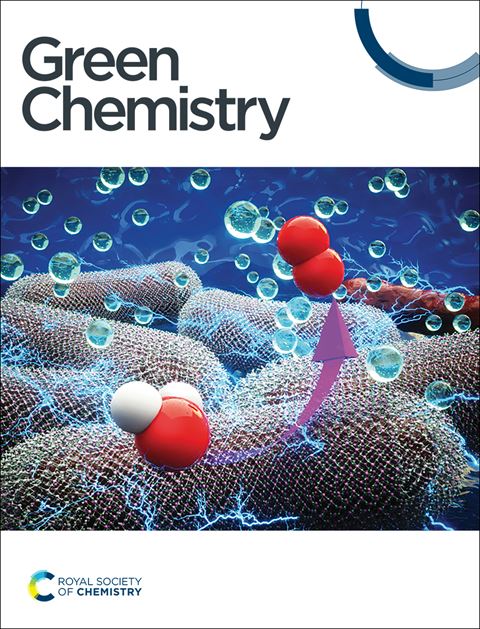
{"title":"Enzyme-mimicking single atoms enable selectivity control in visible-light-driven oxidation/ammoxidation to afford bio-based nitriles†","authors":"Ye Meng , Jinshu Huang , Jie Li , Yumei Jian , Song Yang , Hu Li","doi":"10.1039/d3gc00968h","DOIUrl":null,"url":null,"abstract":"<div><p>Nitriles are versatile nitrogen-containing scaffolds that exist widely in medicines, dyes and functional materials, and are typically synthesized over homogeneous catalysts under relatively harsh conditions. Herein, through mimicking the key active species of hemoglobin p450 heme monooxygenase in most organisms, a Fe–N<sub>4</sub> single atom-doped sulfur-containing carbon nitride (Fe/CNS) photocatalyst was facilely prepared by one-step thermal polymerization, which was illustrated to be efficient for renewable conversion of bio-based alcohols and NH<sub>2</sub>OH·HCl to a wide range of nitriles (80–92% yields) <em>via</em> cascade oxidation–ammoxidation at room temperature, or to quantitatively furnish benzaldehyde <em>via</em> oxidation in the absence of a nitrogen source. Theoretical calculations showed that the isolated Fe–N<sub>4</sub> sites directly capture photogenerated electrons (e<sup>−</sup>) and molecular oxygen (O<sub>2</sub>) to generate superoxide radicals (˙O<sub>2</sub><sup>−</sup>), while the surrounding S atoms confine photogenerated holes (h<sup>+</sup>). The high efficiency of Fe/CNS in the photo-generation of ˙O<sub>2</sub><sup>−</sup> and holes may contribute to the smooth formation of nitriles by cascade photocatalytic oxidation of alcohol and ammoxidation <em>via</em> an <em>in situ</em> formed oxime, respectively. Moreover, Fe/CNS was also applicable to the selective synthesis of various imines (83–98% yields) from the oxidation of benzylamines or heterocyclic amines under visible-light irradiation, and could be recycled at least 5 times with no evident decline in catalytic activity. The strategy of rationally constructing atomic sites to spatially isolate paired electron–holes and form specific reactive species for enhanced photocatalytic activity/selectivity provides an efficient and green approach for biomass valorization.</p></div>","PeriodicalId":78,"journal":{"name":"Green Chemistry","volume":"25 11","pages":"Pages 4453-4462"},"PeriodicalIF":10.6000,"publicationDate":"2023-01-01","publicationTypes":"Journal Article","fieldsOfStudy":null,"isOpenAccess":false,"openAccessPdf":"","citationCount":"2","resultStr":null,"platform":"Semanticscholar","paperid":null,"PeriodicalName":"Green Chemistry","FirstCategoryId":"92","ListUrlMain":"https://www.sciencedirect.com/org/science/article/pii/S1463926223006301","RegionNum":1,"RegionCategory":"化学","ArticlePicture":[],"TitleCN":null,"AbstractTextCN":null,"PMCID":null,"EPubDate":"2023/5/11 0:00:00","PubModel":"Epub","JCR":"Q1","JCRName":"CHEMISTRY, MULTIDISCIPLINARY","Score":null,"Total":0}
引用次数: 2
Abstract
Nitriles are versatile nitrogen-containing scaffolds that exist widely in medicines, dyes and functional materials, and are typically synthesized over homogeneous catalysts under relatively harsh conditions. Herein, through mimicking the key active species of hemoglobin p450 heme monooxygenase in most organisms, a Fe–N4 single atom-doped sulfur-containing carbon nitride (Fe/CNS) photocatalyst was facilely prepared by one-step thermal polymerization, which was illustrated to be efficient for renewable conversion of bio-based alcohols and NH2OH·HCl to a wide range of nitriles (80–92% yields) via cascade oxidation–ammoxidation at room temperature, or to quantitatively furnish benzaldehyde via oxidation in the absence of a nitrogen source. Theoretical calculations showed that the isolated Fe–N4 sites directly capture photogenerated electrons (e−) and molecular oxygen (O2) to generate superoxide radicals (˙O2−), while the surrounding S atoms confine photogenerated holes (h+). The high efficiency of Fe/CNS in the photo-generation of ˙O2− and holes may contribute to the smooth formation of nitriles by cascade photocatalytic oxidation of alcohol and ammoxidation via an in situ formed oxime, respectively. Moreover, Fe/CNS was also applicable to the selective synthesis of various imines (83–98% yields) from the oxidation of benzylamines or heterocyclic amines under visible-light irradiation, and could be recycled at least 5 times with no evident decline in catalytic activity. The strategy of rationally constructing atomic sites to spatially isolate paired electron–holes and form specific reactive species for enhanced photocatalytic activity/selectivity provides an efficient and green approach for biomass valorization.
期刊介绍:
Green Chemistry is a journal that provides a unique forum for the publication of innovative research on the development of alternative green and sustainable technologies. The scope of Green Chemistry is based on the definition proposed by Anastas and Warner (Green Chemistry: Theory and Practice, P T Anastas and J C Warner, Oxford University Press, Oxford, 1998), which defines green chemistry as the utilisation of a set of principles that reduces or eliminates the use or generation of hazardous substances in the design, manufacture and application of chemical products. Green Chemistry aims to reduce the environmental impact of the chemical enterprise by developing a technology base that is inherently non-toxic to living things and the environment. The journal welcomes submissions on all aspects of research relating to this endeavor and publishes original and significant cutting-edge research that is likely to be of wide general appeal. For a work to be published, it must present a significant advance in green chemistry, including a comparison with existing methods and a demonstration of advantages over those methods.


 求助内容:
 应助结果提醒方式:


 京公网安备 11010802042870号


