Meng-Ting Ming , Yu-Chen Wang , Wei-Xue Tao , Wen-Jie Shi , Di-Chang Zhong , Tong-Bu Lu
{"title":"Designing dual-atom cobalt catalysts anchored on amino-functionalized MOFs for efficient CO2 photoreduction†","authors":"Meng-Ting Ming , Yu-Chen Wang , Wei-Xue Tao , Wen-Jie Shi , Di-Chang Zhong , Tong-Bu Lu","doi":"10.1039/d3gc01461d","DOIUrl":null,"url":null,"abstract":"<div><p>Unlocking the potential of sustainable fuel production through the development of highly efficient CO<sub>2</sub> reduction catalysts under visible light irradiation remains an ongoing challenge. Herein, we report a strategically designed Zr-based metal–organic framework (MOF) photocatalyst, incorporating binuclear cobalt complexes as catalytic sites for effective CO<sub>2</sub> reduction. Impressively, our Co<sub>2</sub>-MOF(–NH<sub>2</sub>) catalyst showcased a CO yield of 2.44 mmol g<sub>Co</sub><sup>−1</sup> h<sup>−1</sup>, outperforming its mononuclear counterpart Co-MOF(–NH<sub>2</sub>) (0.23 mmol g<sub>Co</sub><sup>−1</sup> h<sup>−1</sup>) by 10.5 times, underscoring the exceptional catalytic capabilities of the dual-atom catalyst. A combination of experimental findings and Density Functional Theory (DFT) calculations unveiled the synergistic catalytic effect between the two Co sites and the heightened light absorption attributed to the incorporation of the amino group. Notably, such characteristics are evocative of cooperative catalysis observed in biological enzyme systems. This study highlights a pioneering, bioinspired approach to designing efficient dual-atom MOF photocatalysts for CO<sub>2</sub> reduction, offering significant implications for the future of sustainable energy production.</p></div>","PeriodicalId":78,"journal":{"name":"Green Chemistry","volume":"25 16","pages":"Pages 6207-6211"},"PeriodicalIF":10.6000,"publicationDate":"2023-01-01","publicationTypes":"Journal Article","fieldsOfStudy":null,"isOpenAccess":false,"openAccessPdf":"","citationCount":"0","resultStr":null,"platform":"Semanticscholar","paperid":null,"PeriodicalName":"Green Chemistry","FirstCategoryId":"92","ListUrlMain":"https://www.sciencedirect.com/org/science/article/pii/S1463926223006933","RegionNum":1,"RegionCategory":"化学","ArticlePicture":[],"TitleCN":null,"AbstractTextCN":null,"PMCID":null,"EPubDate":"2023/7/25 0:00:00","PubModel":"Epub","JCR":"Q1","JCRName":"CHEMISTRY, MULTIDISCIPLINARY","Score":null,"Total":0}
引用次数: 0
Abstract
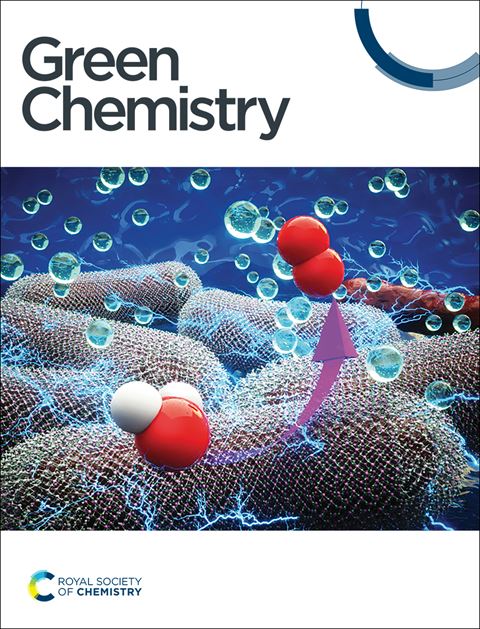
Unlocking the potential of sustainable fuel production through the development of highly efficient CO2 reduction catalysts under visible light irradiation remains an ongoing challenge. Herein, we report a strategically designed Zr-based metal–organic framework (MOF) photocatalyst, incorporating binuclear cobalt complexes as catalytic sites for effective CO2 reduction. Impressively, our Co2-MOF(–NH2) catalyst showcased a CO yield of 2.44 mmol gCo−1 h−1, outperforming its mononuclear counterpart Co-MOF(–NH2) (0.23 mmol gCo−1 h−1) by 10.5 times, underscoring the exceptional catalytic capabilities of the dual-atom catalyst. A combination of experimental findings and Density Functional Theory (DFT) calculations unveiled the synergistic catalytic effect between the two Co sites and the heightened light absorption attributed to the incorporation of the amino group. Notably, such characteristics are evocative of cooperative catalysis observed in biological enzyme systems. This study highlights a pioneering, bioinspired approach to designing efficient dual-atom MOF photocatalysts for CO2 reduction, offering significant implications for the future of sustainable energy production.
期刊介绍:
Green Chemistry is a journal that provides a unique forum for the publication of innovative research on the development of alternative green and sustainable technologies. The scope of Green Chemistry is based on the definition proposed by Anastas and Warner (Green Chemistry: Theory and Practice, P T Anastas and J C Warner, Oxford University Press, Oxford, 1998), which defines green chemistry as the utilisation of a set of principles that reduces or eliminates the use or generation of hazardous substances in the design, manufacture and application of chemical products. Green Chemistry aims to reduce the environmental impact of the chemical enterprise by developing a technology base that is inherently non-toxic to living things and the environment. The journal welcomes submissions on all aspects of research relating to this endeavor and publishes original and significant cutting-edge research that is likely to be of wide general appeal. For a work to be published, it must present a significant advance in green chemistry, including a comparison with existing methods and a demonstration of advantages over those methods.


 求助内容:
 应助结果提醒方式:


 京公网安备 11010802042870号


