
Bend, stretch, and touch: Locating a finger on an actively deformed transparent sensor array
IF 13.9
1区 综合性期刊
Q1 MULTIDISCIPLINARY SCIENCES
引用次数: 254
Abstract
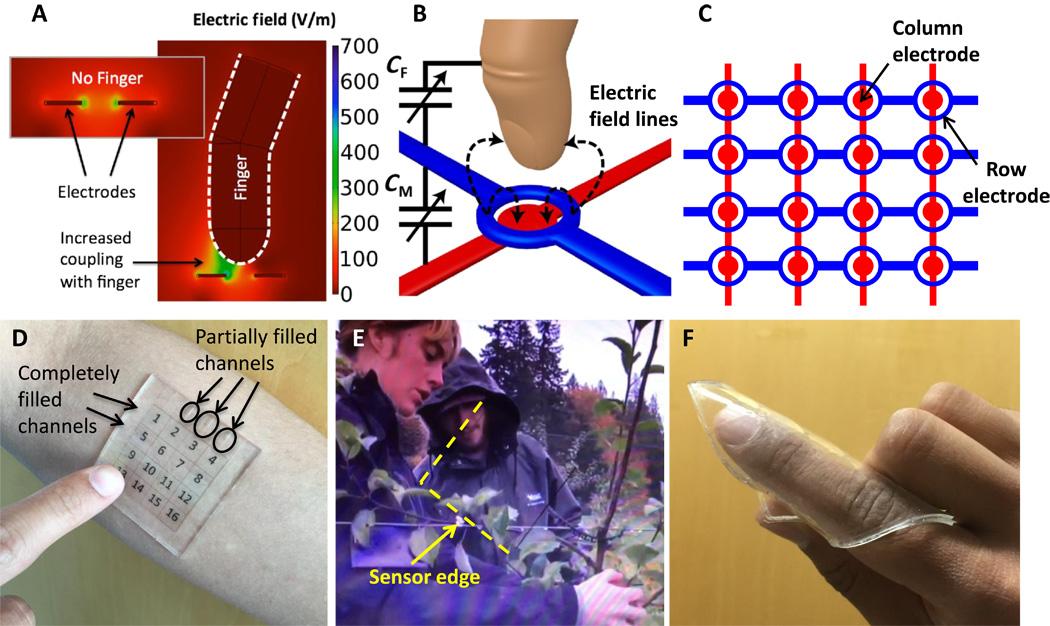
The development of bendable, stretchable, and transparent touch sensors is an emerging technological goal in a variety of fields, including electronic skin, wearables, and flexible handheld devices. Although transparent tactile sensors based on metal mesh, carbon nanotubes, and silver nanowires demonstrate operation in bent configurations, we present a technology that extends the operation modes to the sensing of finger proximity including light touch during active bending and even stretching. This is accomplished using stretchable and ionically conductive hydrogel electrodes, which project electric field above the sensor to couple with and sense a finger. The polyacrylamide electrodes are embedded in silicone. These two widely available, low-cost, transparent materials are combined in a three-step manufacturing technique that is amenable to large-area fabrication. The approach is demonstrated using a proof-of-concept 4 × 4 cross-grid sensor array with a 5-mm pitch. The approach of a finger hovering a few centimeters above the array is readily detectable. Light touch produces a localized decrease in capacitance of 15%. The movement of a finger can be followed across the array, and the location of multiple fingers can be detected. Touch is detectable during bending and stretch, an important feature of any wearable device. The capacitive sensor design can be made more or less sensitive to bending by shifting it relative to the neutral axis. Ultimately, the approach is adaptable to the detection of proximity, touch, pressure, and even the conformation of the sensor surface.
弯曲、拉伸和触摸在主动变形的透明传感器阵列上定位手指
开发可弯曲、可拉伸和透明的触摸传感器是电子皮肤、可穿戴设备和柔性手持设备等多个领域的新兴技术目标。虽然基于金属网、碳纳米管和银纳米线的透明触觉传感器在弯曲配置下可以工作,但我们提出的技术可以将工作模式扩展到手指接近感应,包括在主动弯曲甚至拉伸过程中的轻触。这是通过使用可拉伸的离子导电水凝胶电极实现的,电极在传感器上方投射电场,与手指耦合并感应手指。聚丙烯酰胺电极嵌入硅胶中。这两种广泛使用的低成本透明材料通过三步制造技术相结合,适合大面积制造。该方法通过一个间距为 5 毫米的 4 × 4 跨栅传感器阵列进行了概念验证。在阵列上方几厘米处悬停的手指很容易被探测到。轻触会使局部电容降低 15%。手指在阵列上的移动可以被跟踪,多个手指的位置也可以被检测到。在弯曲和拉伸过程中也能检测到触摸,这是任何可穿戴设备的一个重要特征。电容式传感器设计可以通过相对于中轴线的移动来提高或降低对弯曲的敏感度。最终,这种方法可以适应近距离、触摸、压力甚至传感器表面形状的检测。
本文章由计算机程序翻译,如有差异,请以英文原文为准。
求助全文
约1分钟内获得全文
求助全文
来源期刊
Science Advances
综合性期刊-综合性期刊
CiteScore
21.40
自引率
1.50%
发文量
1937
审稿时长
29 weeks
期刊介绍:
Science Advances, an open-access journal by AAAS, publishes impactful research in diverse scientific areas. It aims for fair, fast, and expert peer review, providing freely accessible research to readers. Led by distinguished scientists, the journal supports AAAS's mission by extending Science magazine's capacity to identify and promote significant advances. Evolving digital publishing technologies play a crucial role in advancing AAAS's global mission for science communication and benefitting humankind.
 求助内容:
求助内容: 应助结果提醒方式:

 京公网安备 11010802042870号


