Shiv Bolan , Leela Kempton , Timothy McCarthy , Hasintha Wijesekara , Udara Piyathilake , Tahereh Jasemizad , Lokesh P. Padhye , Tao Zhang , Jörg Rinklebe , Hailong Wang , M.B. Kirkham , Kadambot H.M. Siddique , Nanthi Bolan
{"title":"Sustainable management of hazardous asbestos-containing materials: Containment, stabilization and inertization","authors":"Shiv Bolan , Leela Kempton , Timothy McCarthy , Hasintha Wijesekara , Udara Piyathilake , Tahereh Jasemizad , Lokesh P. Padhye , Tao Zhang , Jörg Rinklebe , Hailong Wang , M.B. Kirkham , Kadambot H.M. Siddique , Nanthi Bolan","doi":"10.1016/j.scitotenv.2023.163456","DOIUrl":null,"url":null,"abstract":"<div><p>Asbestos is a group of six major silicate minerals that belong to the serpentine and amphibole families, and include chrysotile, amosite, crocidolite, anthophyllite, tremolite and actinolite. Weathering and human disturbance of asbestos-containing materials (ACMs) can lead to the emission of asbestos dust, and the inhalation of respirable asbestos fibrous dust can lead to ‘mesothelioma’ cancer and other diseases, including the progressive lung disease called ‘asbestosis’. There is a considerable legacy of in-situ ACMs in the built environment, and it is not practically or economically possible to safely remove ACMs from the built environment. The aim of the review is to examine the three approaches used for the sustainable management of hazardous ACMs in the built environment: containment, stabilization, and inertization or destruction. Most of the asbestos remaining in the built environment can be contained in a physically secured form so that it does not present a significant health risk of emitting toxic airborne fibres. In settings where safe removal is not practically feasible, stabilization and encapsulation can provide a promising solution, especially in areas where ACMs are exposed to weathering or disturbance. Complete destruction and inertization of asbestos can be achieved by thermal decomposition using plasma and microwave radiation. Bioremediation and chemical treatment (e.g., ultrasound with oxalic acid) have been found to be effective in the inertization of ACMs. Technologies that achieve complete destruction of ACMs are found to be attractive because the treated products can be recycled or safely disposed of in landfills.</p></div>","PeriodicalId":422,"journal":{"name":"Science of the Total Environment","volume":"881 ","pages":"Article 163456"},"PeriodicalIF":8.0000,"publicationDate":"2023-07-10","publicationTypes":"Journal Article","fieldsOfStudy":null,"isOpenAccess":false,"openAccessPdf":"","citationCount":"2","resultStr":null,"platform":"Semanticscholar","paperid":null,"PeriodicalName":"Science of the Total Environment","FirstCategoryId":"93","ListUrlMain":"https://www.sciencedirect.com/science/article/pii/S0048969723020752","RegionNum":1,"RegionCategory":"环境科学与生态学","ArticlePicture":[],"TitleCN":null,"AbstractTextCN":null,"PMCID":null,"EPubDate":"2023/4/14 0:00:00","PubModel":"Epub","JCR":"Q1","JCRName":"ENVIRONMENTAL SCIENCES","Score":null,"Total":0}
引用次数: 2
Abstract
Asbestos is a group of six major silicate minerals that belong to the serpentine and amphibole families, and include chrysotile, amosite, crocidolite, anthophyllite, tremolite and actinolite. Weathering and human disturbance of asbestos-containing materials (ACMs) can lead to the emission of asbestos dust, and the inhalation of respirable asbestos fibrous dust can lead to ‘mesothelioma’ cancer and other diseases, including the progressive lung disease called ‘asbestosis’. There is a considerable legacy of in-situ ACMs in the built environment, and it is not practically or economically possible to safely remove ACMs from the built environment. The aim of the review is to examine the three approaches used for the sustainable management of hazardous ACMs in the built environment: containment, stabilization, and inertization or destruction. Most of the asbestos remaining in the built environment can be contained in a physically secured form so that it does not present a significant health risk of emitting toxic airborne fibres. In settings where safe removal is not practically feasible, stabilization and encapsulation can provide a promising solution, especially in areas where ACMs are exposed to weathering or disturbance. Complete destruction and inertization of asbestos can be achieved by thermal decomposition using plasma and microwave radiation. Bioremediation and chemical treatment (e.g., ultrasound with oxalic acid) have been found to be effective in the inertization of ACMs. Technologies that achieve complete destruction of ACMs are found to be attractive because the treated products can be recycled or safely disposed of in landfills.
期刊介绍:
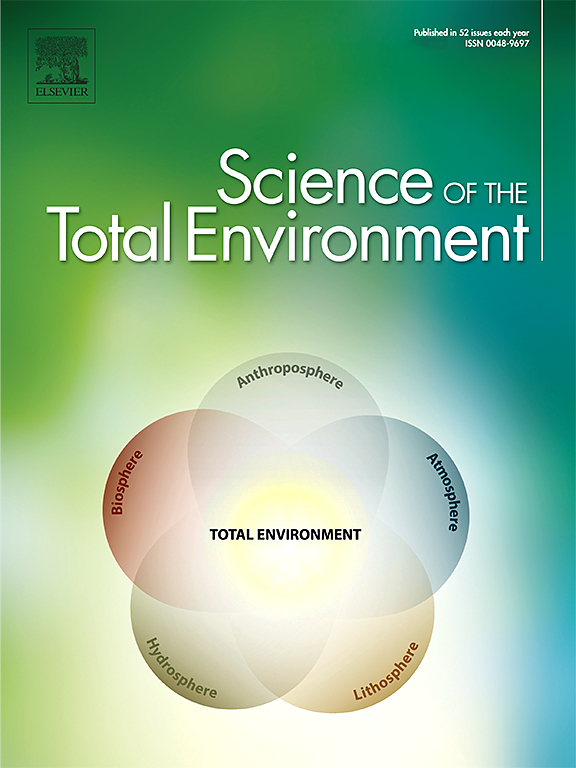
The Science of the Total Environment is an international journal dedicated to scientific research on the environment and its interaction with humanity. It covers a wide range of disciplines and seeks to publish innovative, hypothesis-driven, and impactful research that explores the entire environment, including the atmosphere, lithosphere, hydrosphere, biosphere, and anthroposphere.
The journal's updated Aims & Scope emphasizes the importance of interdisciplinary environmental research with broad impact. Priority is given to studies that advance fundamental understanding and explore the interconnectedness of multiple environmental spheres. Field studies are preferred, while laboratory experiments must demonstrate significant methodological advancements or mechanistic insights with direct relevance to the environment.


 求助内容:
 应助结果提醒方式:


 京公网安备 11010802042870号


