{"title":"Siderophores: an alternative bioremediation strategy?","authors":"Zuzana Roskova, Radek Skarohlid, Lenka McGachy","doi":"10.1016/j.scitotenv.2022.153144","DOIUrl":null,"url":null,"abstract":"<div><p>Siderophores are small molecular weight iron scavengers that are mainly produced by bacteria, fungi, and plants. Recently, they have attracted increasing attention because of their potential role in environmental bioremediation. Although siderophores are generally considered to exhibit high specificity for iron, they have also been reported to bind to various metal and metalloid ions. This unique ability allows siderophores to solubilise and mobilise heavy metals and metalloids from soil, thereby facilitating their bioremediation. In addition, because of their redox nature, they can mediate the production of reactive oxygen species (ROS), and thus promote the biodegradation of organic contaminants. The aim of this review is to summarise the existing knowledge on the developed strategies of siderophore-assisted bioremediation of metals, metalloids, and organic contaminants. Additionally, this review also includes the biosynthesis and classification of microbial and plant siderophores.</p></div>","PeriodicalId":422,"journal":{"name":"Science of the Total Environment","volume":"819 ","pages":"Article 153144"},"PeriodicalIF":8.0000,"publicationDate":"2022-05-01","publicationTypes":"Journal Article","fieldsOfStudy":null,"isOpenAccess":false,"openAccessPdf":"","citationCount":"38","resultStr":null,"platform":"Semanticscholar","paperid":null,"PeriodicalName":"Science of the Total Environment","FirstCategoryId":"93","ListUrlMain":"https://www.sciencedirect.com/science/article/pii/S0048969722002340","RegionNum":1,"RegionCategory":"环境科学与生态学","ArticlePicture":[],"TitleCN":null,"AbstractTextCN":null,"PMCID":null,"EPubDate":"2022/1/15 0:00:00","PubModel":"Epub","JCR":"Q1","JCRName":"ENVIRONMENTAL SCIENCES","Score":null,"Total":0}
引用次数: 38
Abstract
Siderophores are small molecular weight iron scavengers that are mainly produced by bacteria, fungi, and plants. Recently, they have attracted increasing attention because of their potential role in environmental bioremediation. Although siderophores are generally considered to exhibit high specificity for iron, they have also been reported to bind to various metal and metalloid ions. This unique ability allows siderophores to solubilise and mobilise heavy metals and metalloids from soil, thereby facilitating their bioremediation. In addition, because of their redox nature, they can mediate the production of reactive oxygen species (ROS), and thus promote the biodegradation of organic contaminants. The aim of this review is to summarise the existing knowledge on the developed strategies of siderophore-assisted bioremediation of metals, metalloids, and organic contaminants. Additionally, this review also includes the biosynthesis and classification of microbial and plant siderophores.
期刊介绍:
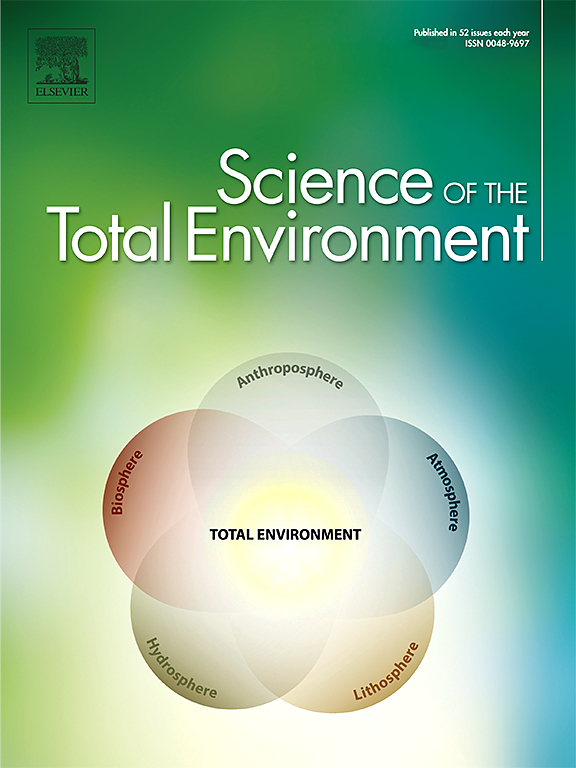
The Science of the Total Environment is an international journal dedicated to scientific research on the environment and its interaction with humanity. It covers a wide range of disciplines and seeks to publish innovative, hypothesis-driven, and impactful research that explores the entire environment, including the atmosphere, lithosphere, hydrosphere, biosphere, and anthroposphere.
The journal's updated Aims & Scope emphasizes the importance of interdisciplinary environmental research with broad impact. Priority is given to studies that advance fundamental understanding and explore the interconnectedness of multiple environmental spheres. Field studies are preferred, while laboratory experiments must demonstrate significant methodological advancements or mechanistic insights with direct relevance to the environment.


 求助内容:
 应助结果提醒方式:


 京公网安备 11010802042870号


