Shuaidong Li , Jie Fang , Xinshu Zhu , Robert G.M. Spencer , Xosé Antón Álvarez -Salgado , Yongcui Deng , Tao Huang , Hao Yang , Changchun Huang
{"title":"Properties of sediment dissolved organic matter respond to eutrophication and interact with bacterial communities in a plateau lake","authors":"Shuaidong Li , Jie Fang , Xinshu Zhu , Robert G.M. Spencer , Xosé Antón Álvarez -Salgado , Yongcui Deng , Tao Huang , Hao Yang , Changchun Huang","doi":"10.1016/j.envpol.2022.118996","DOIUrl":null,"url":null,"abstract":"<div><p><span><span>Sediment dissolved organic matter<span> (DOM) in inland waters is commonly affected by environmental changes. However, knowledge about how sediment DOM responds to </span></span>eutrophication<span> and the associations between sediment DOM and bacterial communities requires further investigation. We selected a sediment core<span> from Dianchi Lake (China) that was dated from 1864 to 2019 by the activity of radionuclides (</span></span></span><sup>210</sup>Pb and <sup>137</sup>Cs). <em>δ</em><sup>13</sup>C<sub>DOC</sub><span><span> changes fit well with the historical record that heavy eutrophic status in Dianchi Lake were observed since 1980s. Large amounts of dissolved organic carbon (DOC), chromophoric (CDOM) and fluorescent (FDOM) DOM accumulated at the top of the sediments during the eutrophication period (1982-present). The additional algae sources with a higher degradation rate altered the composition, aromaticity and </span>humification of DOM. After long-term mineralization, the remaining DOM became more and more recalcitrant and kept a relatively stable level at older sediments. A co-occurrence network analysis revealed that Proteobacteria, Chloroflexi, Acidobacteriota, Bacteroidota and Desulfobacterota were the most abundant species at the phylum level and clustered into three primary modules. Different microbes shared unique preferences for niches, causing a heterogeneous bacterial distribution at different depths. We conducted Spearman's correlation and redundancy analysis (RDA) to explore potential interactions between bacterial community and sediment DOM. The richness and diversity of bacterial communities were positively related to DOM content, suggesting abundant DOM can produce more available resources for bacteria. RDA results showed some specific species might modify DOM composition and structure. This study suggests that sediment DOM properties were regulated by source transformation during eutrophication, and emphasizes the importance of microbial role on sediment biogeochemical process.</span></p></div>","PeriodicalId":311,"journal":{"name":"Environmental Pollution","volume":"301 ","pages":"Article 118996"},"PeriodicalIF":7.2000,"publicationDate":"2022-05-15","publicationTypes":"Journal Article","fieldsOfStudy":null,"isOpenAccess":false,"openAccessPdf":"","citationCount":"14","resultStr":null,"platform":"Semanticscholar","paperid":null,"PeriodicalName":"Environmental Pollution","FirstCategoryId":"93","ListUrlMain":"https://www.sciencedirect.com/science/article/pii/S026974912200210X","RegionNum":2,"RegionCategory":"环境科学与生态学","ArticlePicture":[],"TitleCN":null,"AbstractTextCN":null,"PMCID":null,"EPubDate":"2022/2/15 0:00:00","PubModel":"Epub","JCR":"Q1","JCRName":"ENVIRONMENTAL SCIENCES","Score":null,"Total":0}
引用次数: 14
Abstract
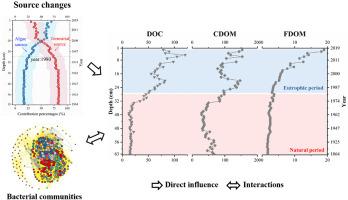
Sediment dissolved organic matter (DOM) in inland waters is commonly affected by environmental changes. However, knowledge about how sediment DOM responds to eutrophication and the associations between sediment DOM and bacterial communities requires further investigation. We selected a sediment core from Dianchi Lake (China) that was dated from 1864 to 2019 by the activity of radionuclides (210Pb and 137Cs). δ13CDOC changes fit well with the historical record that heavy eutrophic status in Dianchi Lake were observed since 1980s. Large amounts of dissolved organic carbon (DOC), chromophoric (CDOM) and fluorescent (FDOM) DOM accumulated at the top of the sediments during the eutrophication period (1982-present). The additional algae sources with a higher degradation rate altered the composition, aromaticity and humification of DOM. After long-term mineralization, the remaining DOM became more and more recalcitrant and kept a relatively stable level at older sediments. A co-occurrence network analysis revealed that Proteobacteria, Chloroflexi, Acidobacteriota, Bacteroidota and Desulfobacterota were the most abundant species at the phylum level and clustered into three primary modules. Different microbes shared unique preferences for niches, causing a heterogeneous bacterial distribution at different depths. We conducted Spearman's correlation and redundancy analysis (RDA) to explore potential interactions between bacterial community and sediment DOM. The richness and diversity of bacterial communities were positively related to DOM content, suggesting abundant DOM can produce more available resources for bacteria. RDA results showed some specific species might modify DOM composition and structure. This study suggests that sediment DOM properties were regulated by source transformation during eutrophication, and emphasizes the importance of microbial role on sediment biogeochemical process.
期刊介绍:
Environmental Pollution is an international peer-reviewed journal that publishes high-quality research papers and review articles covering all aspects of environmental pollution and its impacts on ecosystems and human health.
Subject areas include, but are not limited to:
• Sources and occurrences of pollutants that are clearly defined and measured in environmental compartments, food and food-related items, and human bodies;
• Interlinks between contaminant exposure and biological, ecological, and human health effects, including those of climate change;
• Contaminants of emerging concerns (including but not limited to antibiotic resistant microorganisms or genes, microplastics/nanoplastics, electronic wastes, light, and noise) and/or their biological, ecological, or human health effects;
• Laboratory and field studies on the remediation/mitigation of environmental pollution via new techniques and with clear links to biological, ecological, or human health effects;
• Modeling of pollution processes, patterns, or trends that is of clear environmental and/or human health interest;
• New techniques that measure and examine environmental occurrences, transport, behavior, and effects of pollutants within the environment or the laboratory, provided that they can be clearly used to address problems within regional or global environmental compartments.

 求助内容:
求助内容: 应助结果提醒方式:

 京公网安备 11010802042870号


