Tao Xing , Zhi Wang , Feng Zhen , Huiliang Liu , Defang Wo , Lianhua Li , Ying Guo , Xiaoying Kong , Yongming Sun
{"title":"Initial pH-driven production of volatile fatty acid from hybrid Pennisetum","authors":"Tao Xing , Zhi Wang , Feng Zhen , Huiliang Liu , Defang Wo , Lianhua Li , Ying Guo , Xiaoying Kong , Yongming Sun","doi":"10.1016/j.biortech.2021.126426","DOIUrl":null,"url":null,"abstract":"<div><p>In this work, the impact of initial pH on the production of volatile fatty acids (VFAs) of hybrid <em>Pennisetum</em> was investigated. The batch experiments were conducted under six distinct beginning pH at a mesophilic temperature. Initial pH had an obvious effect on VFA yield and composition, and severe alkaline circumstances (pH<sub>in</sub> = 11.0) could boost VFA production and acetic acid selectivity. The highest VFAs yield and acetate proportion were obtained when the initial pH was 11.0, with 518 ± 29 mg g<sup>−1</sup>VS and 92%. Furthermore, microbial community analysis showed that alkaliphilic acetogenic anaerobe such as <em>Amphibacillus</em>, <em>Tissierella</em>, and <em>Natronincola</em> were the dominant species when the initial pH was 11.0. The Amphibacillus is the main hydrolysis bacterium under these conditions because of its high ability for xylan degradation at pH 9.0–10.0. Because of the increased VFA yield and superior acetic acid selectivity, the results suggest that adjusting the initial pH to 11.0 in batch mode would be possible for scaling-up purposes.</p></div>","PeriodicalId":258,"journal":{"name":"Bioresource Technology","volume":"347 ","pages":"Article 126426"},"PeriodicalIF":8.2000,"publicationDate":"2022-03-01","publicationTypes":"Journal Article","fieldsOfStudy":null,"isOpenAccess":false,"openAccessPdf":"","citationCount":"9","resultStr":null,"platform":"Semanticscholar","paperid":null,"PeriodicalName":"Bioresource Technology","FirstCategoryId":"5","ListUrlMain":"https://www.sciencedirect.com/science/article/pii/S0960852421017685","RegionNum":1,"RegionCategory":"环境科学与生态学","ArticlePicture":[],"TitleCN":null,"AbstractTextCN":null,"PMCID":null,"EPubDate":"2021/11/25 0:00:00","PubModel":"Epub","JCR":"Q1","JCRName":"AGRICULTURAL ENGINEERING","Score":null,"Total":0}
引用次数: 9
Abstract
In this work, the impact of initial pH on the production of volatile fatty acids (VFAs) of hybrid Pennisetum was investigated. The batch experiments were conducted under six distinct beginning pH at a mesophilic temperature. Initial pH had an obvious effect on VFA yield and composition, and severe alkaline circumstances (pHin = 11.0) could boost VFA production and acetic acid selectivity. The highest VFAs yield and acetate proportion were obtained when the initial pH was 11.0, with 518 ± 29 mg g−1VS and 92%. Furthermore, microbial community analysis showed that alkaliphilic acetogenic anaerobe such as Amphibacillus, Tissierella, and Natronincola were the dominant species when the initial pH was 11.0. The Amphibacillus is the main hydrolysis bacterium under these conditions because of its high ability for xylan degradation at pH 9.0–10.0. Because of the increased VFA yield and superior acetic acid selectivity, the results suggest that adjusting the initial pH to 11.0 in batch mode would be possible for scaling-up purposes.
期刊介绍:
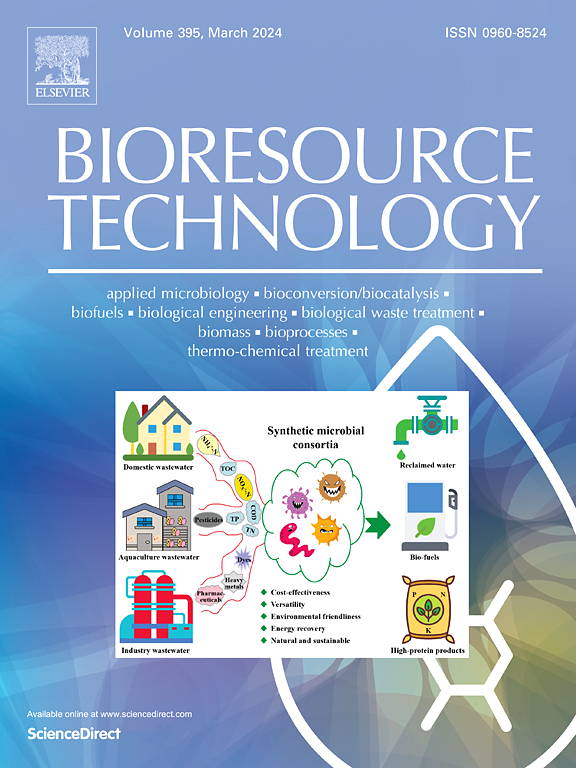
Bioresource Technology publishes original articles, review articles, case studies, and short communications covering the fundamentals, applications, and management of bioresource technology. The journal seeks to advance and disseminate knowledge across various areas related to biomass, biological waste treatment, bioenergy, biotransformations, bioresource systems analysis, and associated conversion or production technologies.
Topics include:
• Biofuels: liquid and gaseous biofuels production, modeling and economics
• Bioprocesses and bioproducts: biocatalysis and fermentations
• Biomass and feedstocks utilization: bioconversion of agro-industrial residues
• Environmental protection: biological waste treatment
• Thermochemical conversion of biomass: combustion, pyrolysis, gasification, catalysis.


 求助内容:
 应助结果提醒方式:


 京公网安备 11010802042870号


