
Influence of Supports on Electrocatalytic Performance of Dual‐Atom Catalysts
IF 3.7
2区 化学
Q2 CHEMISTRY, APPLIED
引用次数: 0
Abstract
Due to excellent atomic usage, stability, activity, and selectivity, dual‐atom catalysts (DACs) have attracted a lot of attention in electrocatalysis. The dispersion, electrical structure, stability, and catalytic reaction dynamics of the functional sites are all directly influenced by the chemical and physical properties of the supports, including specific surface area, pore structure, conductivity, and surface chemical state. Here, the support categorization and structure design of DACs are examined. To expedite the development of high‐performance DACs and uncover the structure–performance relationship, a sensible modulation technique is subsequently put out. Furthermore, the dynamic evolution of diatomic sites during the electrocatalytic processes is demonstrated using sophisticated characterization techniques. Afterward, the applications of DACs in energy conversion devices and electrocatalysis are examined. Finally, the potential and problems associated with the continued development of DACs for energy‐related applications are presented.载体对双原子催化剂电催化性能的影响
双原子催化剂(dual - atom catalyst, dac)由于其优异的原子利用率、稳定性、活性和选择性,在电催化领域引起了广泛的关注。功能位点的分散性、电结构、稳定性和催化反应动力学都直接受到载体的化学和物理性质的影响,包括比表面积、孔结构、电导率和表面化学状态。本文对dac的支撑分类和结构设计进行了研究。为了加速高性能dac的发展并揭示结构-性能关系,随后提出了一种合理的调制技术。此外,在电催化过程中,双原子位点的动态演变是用复杂的表征技术证明的。然后,对dac在能量转换装置和电催化中的应用进行了研究。最后,提出了在能源相关应用中持续发展dac的潜力和存在的问题。
本文章由计算机程序翻译,如有差异,请以英文原文为准。
求助全文
约1分钟内获得全文
求助全文
来源期刊
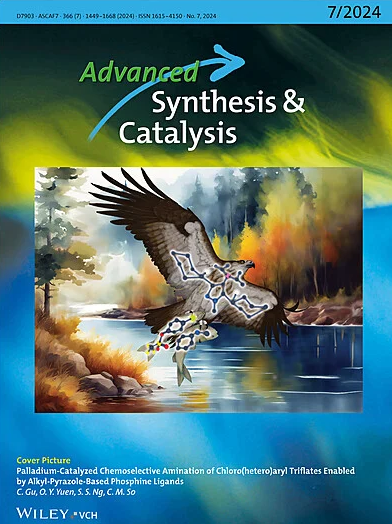
Advanced Synthesis & Catalysis
化学-应用化学
CiteScore
9.40
自引率
7.40%
发文量
447
审稿时长
1.8 months
期刊介绍:
Advanced Synthesis & Catalysis (ASC) is the leading primary journal in organic, organometallic, and applied chemistry.
The high impact of ASC can be attributed to the unique focus of the journal, which publishes exciting new results from academic and industrial labs on efficient, practical, and environmentally friendly organic synthesis. While homogeneous, heterogeneous, organic, and enzyme catalysis are key technologies to achieve green synthesis, significant contributions to the same goal by synthesis design, reaction techniques, flow chemistry, and continuous processing, multiphase catalysis, green solvents, catalyst immobilization, and recycling, separation science, and process development are also featured in ASC. The Aims and Scope can be found in the Notice to Authors or on the first page of the table of contents in every issue.
 求助内容:
 应助结果提醒方式:


 京公网安备 11010802042870号


