Y Zhang, S Wang, W Yang, D D Qi, Z Y Zhu, X P Wang, G X Yan, C Y Gao
{"title":"[The incidence and 1-year prognosis of heart failure following myocardial infarction during hospitalization in patients with first STEMI].","authors":"Y Zhang, S Wang, W Yang, D D Qi, Z Y Zhu, X P Wang, G X Yan, C Y Gao","doi":"10.3760/cma.j.cn112148-20260514-00314","DOIUrl":null,"url":null,"abstract":"<p><p><b>Objective:</b> To investigate the incidence of in-hospital heart failure (HF) following myocardial infarction (MI) and 1-year mortality in patients with first ST-segment elevation myocardial infarction (STEMI), and to compare the 1-year mortality risk among different types of HF. <b>Methods:</b> Data were derived from the Henan STEMI registry, which was a multicentre, prospective, observational study in central China. After excluding patients with a history of MI or HF, patients with first STEMI were divided into the HF and non-HF groups according to the occurrence of in-hospital HF. Based on the left ventricular ejection fraction (LVEF) measured on the last echocardiogram during hospitalization, patients with HF were classified into HF with preserved ejection fraction (HFpEF, LVEF≥50%), HF with mildly reduced ejection fraction (HFmrEF, LVEF 41%-49%), HF with reduced ejection fraction (HFrEF, LVEF≤40%), and HF with missing LVEF. Survival analysis was performed using the Kaplan-Meier method, and differences between groups were assessed with the log-rank test. Multivariate Cox frailty models were used to analyze the associations of HF status (present vs. absent) and different LVEF subgroups with 1-year mortality, using the non-HF group as the reference. <b>Results:</b> A total of 4 737 patients with first STEMI were included in the final analysis, with a median age of 62.8 (52.4, 70.8) years, of whom 1 158 (24.4%) were female. During hospitalization, 1 978 cases (41.8%) developed HF following MI, including 268 (13.5%) with HFrEF, 309 (15.6%) with HFmrEF, 707 (35.7%) with HFpEF, and 694 (35.1%) with missing LVEF. A total of 3 967 (83.7%) patients completed the 1-year follow-up. The 1-year mortality was significantly higher among STEMI patients complicated by HF than in those without (23.3% (391/1 680) vs. 5.8% (132/2 287), log-rank <i>P</i><0.001). Specifically, the rates were 29.6% (67/226) for HFrEF, 20.8% (53/255) for HFmrEF, 11.7% (72/615) for HFpEF and 34.1% (199/584) for HF with missing LVEF. Multivariate Cox frailty models identified in-hospital HF following MI as a risk factor for 1-year mortality (<i>HR</i>=2.13, 95%<i>CI</i>: 1.70-2.67). Notably, HFpEF was associated with the lowest risk of 1-year mortality (<i>HR</i>=1.59, 95%<i>CI</i>: 1.16-2.17), while the HF group with missing LVEF carried the highest risk (<i>HR</i>=2.49, 95%<i>CI</i>: 1.91-3.26). <b>Conclusions:</b> The incidence of HF following first STEMI during hospitalization was 41.8%, with a corresponding 1-year mortality of 23.3%. In-hospital HF following MI is a risk factor for 1-year mortality in patients with STEMI. Prognosis differed notably across HF subgroups: HFpEF was associated with the lowest risk, whereas patients with missing LVEF had the worst outcome.</p>","PeriodicalId":38755,"journal":{"name":"中华心血管病杂志","volume":"54 10","pages":"1164-1171"},"PeriodicalIF":0.0000,"publicationDate":"2026-10-24","publicationTypes":"Journal Article","fieldsOfStudy":null,"isOpenAccess":false,"openAccessPdf":"","citationCount":"0","resultStr":null,"platform":"Semanticscholar","paperid":null,"PeriodicalName":"中华心血管病杂志","FirstCategoryId":"3","ListUrlMain":"https://doi.org/10.3760/cma.j.cn112148-20260514-00314","RegionNum":0,"RegionCategory":null,"ArticlePicture":[],"TitleCN":null,"AbstractTextCN":null,"PMCID":null,"EPubDate":"","PubModel":"","JCR":"Q3","JCRName":"Medicine","Score":null,"Total":0}
引用次数: 0
Abstract
Objective: To investigate the incidence of in-hospital heart failure (HF) following myocardial infarction (MI) and 1-year mortality in patients with first ST-segment elevation myocardial infarction (STEMI), and to compare the 1-year mortality risk among different types of HF. Methods: Data were derived from the Henan STEMI registry, which was a multicentre, prospective, observational study in central China. After excluding patients with a history of MI or HF, patients with first STEMI were divided into the HF and non-HF groups according to the occurrence of in-hospital HF. Based on the left ventricular ejection fraction (LVEF) measured on the last echocardiogram during hospitalization, patients with HF were classified into HF with preserved ejection fraction (HFpEF, LVEF≥50%), HF with mildly reduced ejection fraction (HFmrEF, LVEF 41%-49%), HF with reduced ejection fraction (HFrEF, LVEF≤40%), and HF with missing LVEF. Survival analysis was performed using the Kaplan-Meier method, and differences between groups were assessed with the log-rank test. Multivariate Cox frailty models were used to analyze the associations of HF status (present vs. absent) and different LVEF subgroups with 1-year mortality, using the non-HF group as the reference. Results: A total of 4 737 patients with first STEMI were included in the final analysis, with a median age of 62.8 (52.4, 70.8) years, of whom 1 158 (24.4%) were female. During hospitalization, 1 978 cases (41.8%) developed HF following MI, including 268 (13.5%) with HFrEF, 309 (15.6%) with HFmrEF, 707 (35.7%) with HFpEF, and 694 (35.1%) with missing LVEF. A total of 3 967 (83.7%) patients completed the 1-year follow-up. The 1-year mortality was significantly higher among STEMI patients complicated by HF than in those without (23.3% (391/1 680) vs. 5.8% (132/2 287), log-rank P<0.001). Specifically, the rates were 29.6% (67/226) for HFrEF, 20.8% (53/255) for HFmrEF, 11.7% (72/615) for HFpEF and 34.1% (199/584) for HF with missing LVEF. Multivariate Cox frailty models identified in-hospital HF following MI as a risk factor for 1-year mortality (HR=2.13, 95%CI: 1.70-2.67). Notably, HFpEF was associated with the lowest risk of 1-year mortality (HR=1.59, 95%CI: 1.16-2.17), while the HF group with missing LVEF carried the highest risk (HR=2.49, 95%CI: 1.91-3.26). Conclusions: The incidence of HF following first STEMI during hospitalization was 41.8%, with a corresponding 1-year mortality of 23.3%. In-hospital HF following MI is a risk factor for 1-year mortality in patients with STEMI. Prognosis differed notably across HF subgroups: HFpEF was associated with the lowest risk, whereas patients with missing LVEF had the worst outcome.
中华心血管病杂志Medicine-Cardiology and Cardiovascular Medicine
CiteScore
1.40
自引率
0.00%
发文量
10577
期刊介绍:
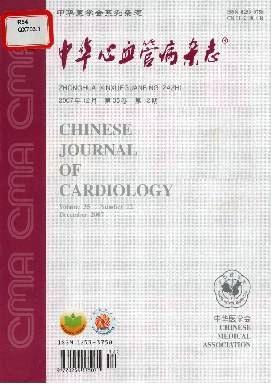
The Chinese Journal of Cardiology , established in February 1973, is one of the major academic medical journals sponsored by the Chinese Medical Association and a leading periodical in the field of cardiology in China. It specializes in cardiology and related disciplines with a readership of more than 25 000. The journal publishes editorials and guidelines as well as important original articles on clinical and experimental investigations, reflecting achievements made in China and promoting academic communication between domestic and foreign cardiologists. The journal includes the following columns: Editorials, Strategies, Comments, Clinical Investigations, Experimental Investigations, Epidemiology and Prevention, Lectures, Comprehensive Reviews, Continuing Medical Education, etc.

 求助内容:
 应助结果提醒方式:


 京公网安备 11010802042870号


