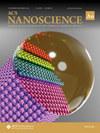
{"title":"Atomic-Scale Anisotropy Competition Drives Spin Reorientation in Intercalated 2D Ferromagnets","authors":"Yu-Sheng Tseng, Wan-Sheng Tang, Bao-Huei Huang, Yu-Hui Tang","doi":"10.1021/acsnanoscienceau.6c00043","DOIUrl":null,"url":null,"abstract":"<p>Precise control over\r\nmagnetic anisotropy (MA) in two-dimensional\r\n(2D) van der Waals ferromagnets is essential for advancing next-generation\r\nspintronics; however, the atomic-scale mechanisms dictating intercalation-induced\r\nMA modulation remain largely unresolved. In this study, we elucidate\r\nthe microscopic origins of the complex magnetic phase diagram in Cr-intercalated\r\nCrTe<sub>2</sub> by integrating layer-resolved density functional\r\ntheory-based spin–orbit torque (DFT-SOT) calculations with\r\nmicromagnetic simulations. We uncover a concealed source of perpendicular\r\nmagnetic anisotropy (PMA) localized within the intercalation layer,\r\nwhich directly competes with the robust surface-driven in-plane magnetic\r\nanisotropy (IMA). Macroscopically, this atomic-scale competition drives\r\na thickness-dependent spin reorientation transition, wherein the volumetric\r\naccumulation of bulk-like PMA ultimately dominates over interfacial\r\neffects. Our findings propose a plausible microscopic framework for\r\nunderstanding the stoichiometry-dependent anisotropy in chromium chalcogenides,\r\noffering a promising theoretical perspective for exploring magnetic\r\nphases in 2D spintronic architectures.</p>","PeriodicalId":29799,"journal":{"name":"ACS Nanoscience Au","volume":"6 5","pages":"850–856"},"PeriodicalIF":7.5000,"publicationDate":"2026-10-21","publicationTypes":"Journal Article","fieldsOfStudy":null,"isOpenAccess":false,"openAccessPdf":"","citationCount":"0","resultStr":null,"platform":"Semanticscholar","paperid":null,"PeriodicalName":"ACS Nanoscience Au","FirstCategoryId":"1085","ListUrlMain":"https://pubs.acs.org/doi/10.1021/acsnanoscienceau.6c00043","RegionNum":0,"RegionCategory":null,"ArticlePicture":[],"TitleCN":null,"AbstractTextCN":null,"PMCID":null,"EPubDate":"2026/7/7 0:00:00","PubModel":"Epub","JCR":"Q2","JCRName":"NANOSCIENCE & NANOTECHNOLOGY","Score":null,"Total":0}
引用次数: 0
Abstract
Precise control over
magnetic anisotropy (MA) in two-dimensional
(2D) van der Waals ferromagnets is essential for advancing next-generation
spintronics; however, the atomic-scale mechanisms dictating intercalation-induced
MA modulation remain largely unresolved. In this study, we elucidate
the microscopic origins of the complex magnetic phase diagram in Cr-intercalated
CrTe2 by integrating layer-resolved density functional
theory-based spin–orbit torque (DFT-SOT) calculations with
micromagnetic simulations. We uncover a concealed source of perpendicular
magnetic anisotropy (PMA) localized within the intercalation layer,
which directly competes with the robust surface-driven in-plane magnetic
anisotropy (IMA). Macroscopically, this atomic-scale competition drives
a thickness-dependent spin reorientation transition, wherein the volumetric
accumulation of bulk-like PMA ultimately dominates over interfacial
effects. Our findings propose a plausible microscopic framework for
understanding the stoichiometry-dependent anisotropy in chromium chalcogenides,
offering a promising theoretical perspective for exploring magnetic
phases in 2D spintronic architectures.
期刊介绍:
ACS Nanoscience Au is an open access journal that publishes original fundamental and applied research on nanoscience and nanotechnology research at the interfaces of chemistry biology medicine materials science physics and engineering.The journal publishes short letters comprehensive articles reviews and perspectives on all aspects of nanoscience and nanotechnology:synthesis assembly characterization theory modeling and simulation of nanostructures nanomaterials and nanoscale devicesdesign fabrication and applications of organic inorganic polymer hybrid and biological nanostructuresexperimental and theoretical studies of nanoscale chemical physical and biological phenomenamethods and tools for nanoscience and nanotechnologyself- and directed-assemblyzero- one- and two-dimensional materialsnanostructures and nano-engineered devices with advanced performancenanobiotechnologynanomedicine and nanotoxicologyACS Nanoscience Au also publishes original experimental and theoretical research of an applied nature that integrates knowledge in the areas of materials engineering physics bioscience and chemistry into important applications of nanomaterials.

 求助内容:
 应助结果提醒方式:


 京公网安备 11010802042870号


