{"title":"Modulation of apoptotic genes and microRNAs by Shilajit in cryopreserved rooster sperm.","authors":"Zeynep Semen, Mustafa Yiğit Nizam, Murat Selçuk","doi":"10.1016/j.cryobiol.2026.105720","DOIUrl":null,"url":null,"abstract":"<p><p>Cryopreservation imposes severe oxidative stress on avian spermatozoa, triggering apoptotic cascades that compromise fertility. Shilajit, a natural phytocomplex rich in fulvic acid, is known for its bioenergizing and antioxidant properties. However, its molecular mechanism of action in regulating the apoptotic machinery of rooster sperm remains unexplored. This study evaluated the effects of Shilajit supplementation on post-thaw rooster sperm kinematics and the relative abundance of selected apoptosis-associated mRNAs and stress-related miRNAs. Materials and methods: Pooled semen collected from Plymouth Rock roosters was diluted with Beltsville Poultry Semen Extender (BPSE) containing 5% glycerol and supplemented with Shilajit at final concentrations of 0 (Control), 5, 15, and 25 μg/mL. Following cryopreservation and thawing, sperm kinematic parameters were assessed using a Computer-Assisted Sperm Analysis (CASA) system. The relative expression levels of apoptotic genes (p53, Bax, Bcl-2) and a panel of stress-related miRNAs (gga-miR-34a, -155, -146b, -26a, -215, -122) were quantified via qPCR. Shilajit supplementation did not significantly alter total or progressive motility, vitality, morphology, or the major CASA velocity and trajectory parameters compared with the Control (p > 0.05). Beat Cross Frequency (BCF) was higher at 15 μg/mL than at 25 μg/mL (p = 0.043), although neither group differed from the Control. Shilajit was also associated with distinct changes in the post-thaw sperm RNA profile. p53 mRNA was highest at 5 μg/mL, whereas Bax was lower at 15 and 25 μg/mL and Bcl-2 was lower across all Shilajit-treated groups. Five of the six examined miRNAs, including gga-miR-34a and gga-miR-155, were lower than the Control across all Shilajit concentrations, while gga-miR-146b showed a concentration-specific response. Shilajit supplementation produced limited effects on conventional post-thaw sperm-quality parameters but was associated with marked changes in apoptosis- and stress-associated sperm RNAs. The divergent mRNA response together with the broader reduction across the selected miRNAs indicates modulation of the post-thaw molecular profile in mature rooster spermatozoa. These findings support further investigation of the relationship between Shilajit-associated RNA changes and apoptosis, mitochondrial function, and reproductive competence.</p>","PeriodicalId":10897,"journal":{"name":"Cryobiology","volume":" ","pages":"105720"},"PeriodicalIF":2.6000,"publicationDate":"2026-10-20","publicationTypes":"Journal Article","fieldsOfStudy":null,"isOpenAccess":false,"openAccessPdf":"","citationCount":"0","resultStr":null,"platform":"Semanticscholar","paperid":null,"PeriodicalName":"Cryobiology","FirstCategoryId":"99","ListUrlMain":"https://doi.org/10.1016/j.cryobiol.2026.105720","RegionNum":3,"RegionCategory":"生物学","ArticlePicture":[],"TitleCN":null,"AbstractTextCN":null,"PMCID":null,"EPubDate":"","PubModel":"","JCR":"Q2","JCRName":"BIOLOGY","Score":null,"Total":0}
引用次数: 0
Abstract
Cryopreservation imposes severe oxidative stress on avian spermatozoa, triggering apoptotic cascades that compromise fertility. Shilajit, a natural phytocomplex rich in fulvic acid, is known for its bioenergizing and antioxidant properties. However, its molecular mechanism of action in regulating the apoptotic machinery of rooster sperm remains unexplored. This study evaluated the effects of Shilajit supplementation on post-thaw rooster sperm kinematics and the relative abundance of selected apoptosis-associated mRNAs and stress-related miRNAs. Materials and methods: Pooled semen collected from Plymouth Rock roosters was diluted with Beltsville Poultry Semen Extender (BPSE) containing 5% glycerol and supplemented with Shilajit at final concentrations of 0 (Control), 5, 15, and 25 μg/mL. Following cryopreservation and thawing, sperm kinematic parameters were assessed using a Computer-Assisted Sperm Analysis (CASA) system. The relative expression levels of apoptotic genes (p53, Bax, Bcl-2) and a panel of stress-related miRNAs (gga-miR-34a, -155, -146b, -26a, -215, -122) were quantified via qPCR. Shilajit supplementation did not significantly alter total or progressive motility, vitality, morphology, or the major CASA velocity and trajectory parameters compared with the Control (p > 0.05). Beat Cross Frequency (BCF) was higher at 15 μg/mL than at 25 μg/mL (p = 0.043), although neither group differed from the Control. Shilajit was also associated with distinct changes in the post-thaw sperm RNA profile. p53 mRNA was highest at 5 μg/mL, whereas Bax was lower at 15 and 25 μg/mL and Bcl-2 was lower across all Shilajit-treated groups. Five of the six examined miRNAs, including gga-miR-34a and gga-miR-155, were lower than the Control across all Shilajit concentrations, while gga-miR-146b showed a concentration-specific response. Shilajit supplementation produced limited effects on conventional post-thaw sperm-quality parameters but was associated with marked changes in apoptosis- and stress-associated sperm RNAs. The divergent mRNA response together with the broader reduction across the selected miRNAs indicates modulation of the post-thaw molecular profile in mature rooster spermatozoa. These findings support further investigation of the relationship between Shilajit-associated RNA changes and apoptosis, mitochondrial function, and reproductive competence.
期刊介绍:
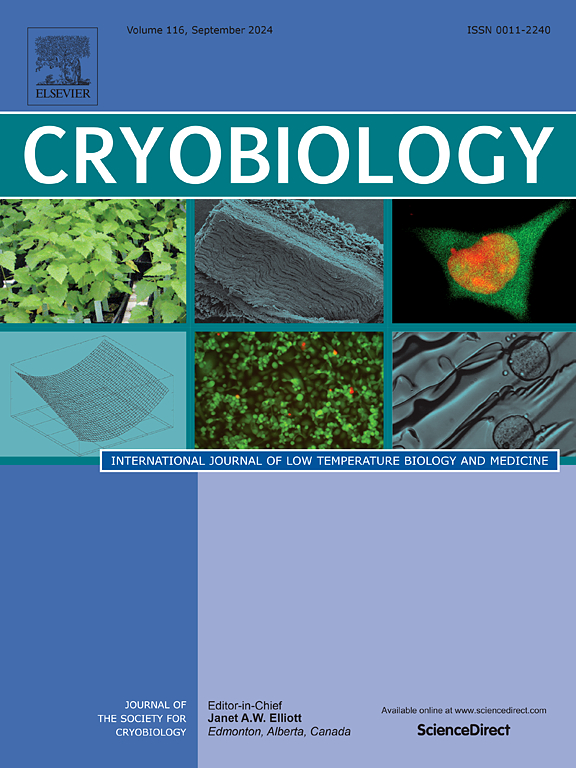
Cryobiology: International Journal of Low Temperature Biology and Medicine publishes research articles on all aspects of low temperature biology and medicine.
Research Areas include:
• Cryoprotective additives and their pharmacological actions
• Cryosurgery
• Freeze-drying
• Freezing
• Frost hardiness in plants
• Hibernation
• Hypothermia
• Medical applications of reduced temperature
• Perfusion of organs
• All pertinent methodologies
Cryobiology is the official journal of the Society for Cryobiology.

 求助内容:
 应助结果提醒方式:


 京公网安备 11010802042870号


