
Climate Change Experienced by Life on Earth—Drivers and Mechanisms of Future Trends in Microclimates

IF 12.5 1区 环境科学与生态学 Q1 BIODIVERSITY CONSERVATION
C. Greiser, E. Gril, I. M. D. Maclean, R. Beugnon, P. le Roux, J. Kemppinen, M. W. Rhodes, J. Aalto, D. M. Christiansen, P. De Frenne, S. Haesen, D. Klinges, M. Kopecký, J. Lenoir, M. Luoto, L. M. Mercado, M. Rantanen, G. Strandberg, L. van den Brink, J. Lembrechts, K. Van Meerbeek
{"title":"Climate Change Experienced by Life on Earth—Drivers and Mechanisms of Future Trends in Microclimates","authors":"C. Greiser, E. Gril, I. M. D. Maclean, R. Beugnon, P. le Roux, J. Kemppinen, M. W. Rhodes, J. Aalto, D. M. Christiansen, P. De Frenne, S. Haesen, D. Klinges, M. Kopecký, J. Lenoir, M. Luoto, L. M. Mercado, M. Rantanen, G. Strandberg, L. van den Brink, J. Lembrechts, K. Van Meerbeek","doi":"10.1111/gcb.71140","DOIUrl":null,"url":null,"abstract":"Microclimate, the climate directly experienced by organisms, is crucial for understanding ecological responses to climate change, yet its long‐term dynamics and the drivers of decadal microclimate changes remain underexplored in ecology and global change biology. Microclimate changes do not necessarily track macroclimate trends. Changes in meteorological conditions (e.g., cloud cover, wind patterns) and vegetation dynamics (e.g., canopy opening, desertification in drylands, shrub encroachment in the tundra) associated with climate change can lead to locally divergent microclimate trends, thereby altering spatial variability. Understanding and quantifying how macroclimate change translates to fine‐scale microclimate change experienced by organisms, populations and communities is therefore essential for predicting ecological responses to global environmental change. This review examines how macroclimate change drives microclimate changes as experienced by life on Earth—and how these micro‐scale changes may, in turn, feed back into the regional and global climate system. Our primary focus is on near‐surface air and soil temperature—due to their relevance to most terrestrial organisms and ecosystem processes. The review is structured around three pathways of microclimate changes: (I) direct effects of changes in meteorological conditions, (II) indirect effects via vegetation changes, and (III) feedbacks between microclimate and climate change. Using three mechanistic model simulations in real‐world landscapes, we illustrate and quantify the key mechanisms that lead to divergent warming trends. We show that microclimate change emerges from interacting atmospheric, land‐surface, and biophysical processes, which can differ substantially across space and time. Predicting future microclimates therefore requires accounting for these processes and their temporal dynamics. By providing an accessible synthesis of these processes, this review aims to strengthen links between ecology and atmospheric science and improve our understanding of how climate change translates into microclimatic conditions relevant to life on Earth.","PeriodicalId":175,"journal":{"name":"Global Change Biology","volume":"1 1","pages":""},"PeriodicalIF":12.5000,"publicationDate":"2026-10-21","publicationTypes":"Journal Article","fieldsOfStudy":null,"isOpenAccess":false,"openAccessPdf":"","citationCount":"0","resultStr":null,"platform":"Semanticscholar","paperid":null,"PeriodicalName":"Global Change Biology","FirstCategoryId":"93","ListUrlMain":"https://doi.org/10.1111/gcb.71140","RegionNum":1,"RegionCategory":"环境科学与生态学","ArticlePicture":[],"TitleCN":null,"AbstractTextCN":null,"PMCID":null,"EPubDate":"","PubModel":"","JCR":"Q1","JCRName":"BIODIVERSITY CONSERVATION","Score":null,"Total":0}
引用次数: 0

Abstract

Microclimate, the climate directly experienced by organisms, is crucial for understanding ecological responses to climate change, yet its long‐term dynamics and the drivers of decadal microclimate changes remain underexplored in ecology and global change biology. Microclimate changes do not necessarily track macroclimate trends. Changes in meteorological conditions (e.g., cloud cover, wind patterns) and vegetation dynamics (e.g., canopy opening, desertification in drylands, shrub encroachment in the tundra) associated with climate change can lead to locally divergent microclimate trends, thereby altering spatial variability. Understanding and quantifying how macroclimate change translates to fine‐scale microclimate change experienced by organisms, populations and communities is therefore essential for predicting ecological responses to global environmental change. This review examines how macroclimate change drives microclimate changes as experienced by life on Earth—and how these micro‐scale changes may, in turn, feed back into the regional and global climate system. Our primary focus is on near‐surface air and soil temperature—due to their relevance to most terrestrial organisms and ecosystem processes. The review is structured around three pathways of microclimate changes: (I) direct effects of changes in meteorological conditions, (II) indirect effects via vegetation changes, and (III) feedbacks between microclimate and climate change. Using three mechanistic model simulations in real‐world landscapes, we illustrate and quantify the key mechanisms that lead to divergent warming trends. We show that microclimate change emerges from interacting atmospheric, land‐surface, and biophysical processes, which can differ substantially across space and time. Predicting future microclimates therefore requires accounting for these processes and their temporal dynamics. By providing an accessible synthesis of these processes, this review aims to strengthen links between ecology and atmospheric science and improve our understanding of how climate change translates into microclimatic conditions relevant to life on Earth.
地球生命经历的气候变化——微气候未来趋势的驱动因素和机制
小气候是生物直接经历的气候,对于理解生态对气候变化的响应至关重要,但其长期动态和年代际小气候变化的驱动因素在生态学和全球变化生物学中仍未得到充分探讨。小气候变化不一定能跟踪大气候趋势。与气候变化相关的气象条件(如云量、风型)和植被动态(如林冠开度、旱地荒漠化、苔原灌木侵蚀)的变化可导致局部不同的小气候趋势,从而改变空间变异性。因此,了解和量化宏观气候变化如何转化为生物、种群和群落所经历的细尺度小气候变化,对于预测对全球环境变化的生态响应至关重要。本文综述了宏观气候变化如何驱动地球上生命所经历的小气候变化,以及这些微尺度变化如何反过来反馈到区域和全球气候系统。我们的主要重点是近地表空气和土壤温度,因为它们与大多数陆地生物和生态系统过程相关。本文围绕小气候变化的三种途径进行综述,即:(1)气象条件变化的直接影响;(2)植被变化的间接影响;(3)小气候与气候变化之间的反馈作用。通过对现实世界景观的三种机制模式模拟,我们阐明并量化了导致不同变暖趋势的关键机制。研究表明,小气候变化产生于大气、陆地表面和生物物理过程的相互作用,这些过程在空间和时间上可能存在很大差异。因此,预测未来的小气候需要考虑这些过程及其时间动态。通过提供这些过程的综合,本综述旨在加强生态学和大气科学之间的联系,并提高我们对气候变化如何转化为与地球上生命相关的小气候条件的理解。
本文章由计算机程序翻译,如有差异,请以英文原文为准。
求助全文
约1分钟内获得全文 求助全文
来源期刊
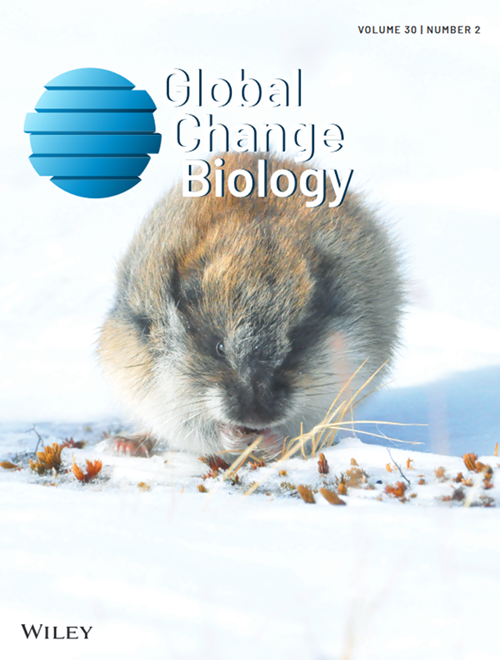
Global Change Biology
Global Change Biology 环境科学-环境科学
CiteScore
21.50
自引率
5.20%
发文量
497
审稿时长
3.3 months
期刊介绍: Global Change Biology is an environmental change journal committed to shaping the future and addressing the world's most pressing challenges, including sustainability, climate change, environmental protection, food and water safety, and global health. Dedicated to fostering a profound understanding of the impacts of global change on biological systems and offering innovative solutions, the journal publishes a diverse range of content, including primary research articles, technical advances, research reviews, reports, opinions, perspectives, commentaries, and letters. Starting with the 2024 volume, Global Change Biology will transition to an online-only format, enhancing accessibility and contributing to the evolution of scholarly communication.

×
引用
GB/T 7714-2015
复制
MLA
复制
APA
复制
导出至
BibTeX EndNote RefMan NoteFirst NoteExpress
×
提示
您的信息不完整,为了账户安全,请先补充。
现在去补充
×
提示
您因"违规操作"
具体请查看互助需知
我知道了
×
提示
确定
请完成安全验证×
copy
已复制链接
快去分享给好友吧!
我知道了
右上角分享
点击右上角分享
0
联系我们:info@booksci.cn Book学术提供免费学术资源搜索服务,方便国内外学者检索中英文文献。致力于提供最便捷和优质的服务体验。 Copyright © 2023 布克学术 All rights reserved.
京ICP备2023020795号-1
ghs 京公网安备 11010802042870号
Book学术文献互助
Book学术文献互助群
群 号:604180095
Book学术官方微信
小红书


