
Surface-Confined Pt–Ov–Mn Atomic Interfaces Promote Deep Benzene Mineralization through Coupled Electron Transfer and Lattice-Oxygen Activation

IF 12.2 1区 环境科学与生态学 Q1 ENGINEERING, ENVIRONMENTAL
Wenbo Pei,Xinzhu Wu,Jianwei Wang,Tao Ban,Pan Zhang,Wenqiang Yang,Qi Peng,Qing Wang,Jinyao Liu,Hao Guo,Di Hu,Hongxing Dai,Haibao Huang
{"title":"Surface-Confined Pt–Ov–Mn Atomic Interfaces Promote Deep Benzene Mineralization through Coupled Electron Transfer and Lattice-Oxygen Activation","authors":"Wenbo Pei,Xinzhu Wu,Jianwei Wang,Tao Ban,Pan Zhang,Wenqiang Yang,Qi Peng,Qing Wang,Jinyao Liu,Hao Guo,Di Hu,Hongxing Dai,Haibao Huang","doi":"10.1021/acs.est.6c09929","DOIUrl":null,"url":null,"abstract":"Single-atom catalysts are promising for VOC abatement, but their application is limited by the trade-off between the stability of isolated atoms and the redox activity. Herein, we report a surface-confined Pt–Ov–Mn atomic interface constructed within the outer layer of Mn2O3 via thermal self-reconstruction. Oxygen vacancies trap isolated Pt atoms and electronically connect them with neighboring Mn centers, forming a vacancy-rich interfacial active center. For benzene oxidation, Pt1/Mn2O3 achieved a specific reaction rate of 45.70 μmol gPt–1 s–1 at 140 °C, which is 3.8 and 11.2 times those of the Pt nanocluster and nanoparticle counterparts, respectively. The catalyst also exhibited excellent thermal stability and enhanced tolerance to SO2 poisoning. Mechanistic studies reveal that the Pt–Ov–Mn interface enables electron–lattice-oxygen coupling: interfacial Pt 5d–Mn 3d electronic interaction upshifts the Pt d-band center, strengthening benzene π adsorption and promoting C–H activation and ring opening, while adjacent oxygen vacancies accelerate lattice-oxygen migration and replenishment through a Mars–van Krevelen cycle. This coupled pathway suppresses the accumulation of partially oxidized intermediates and drives deep mineralization to CO2. These findings identify surface-layer atomic interfaces as designable active centers for developing robust SACs toward hazardous VOC control.","PeriodicalId":36,"journal":{"name":"环境科学与技术","volume":"60 1","pages":""},"PeriodicalIF":12.2000,"publicationDate":"2026-10-21","publicationTypes":"Journal Article","fieldsOfStudy":null,"isOpenAccess":false,"openAccessPdf":"","citationCount":"0","resultStr":null,"platform":"Semanticscholar","paperid":null,"PeriodicalName":"环境科学与技术","FirstCategoryId":"1","ListUrlMain":"https://doi.org/10.1021/acs.est.6c09929","RegionNum":1,"RegionCategory":"环境科学与生态学","ArticlePicture":[],"TitleCN":null,"AbstractTextCN":null,"PMCID":null,"EPubDate":"","PubModel":"","JCR":"Q1","JCRName":"ENGINEERING, ENVIRONMENTAL","Score":null,"Total":0}
引用次数: 0

Abstract

Single-atom catalysts are promising for VOC abatement, but their application is limited by the trade-off between the stability of isolated atoms and the redox activity. Herein, we report a surface-confined Pt–Ov–Mn atomic interface constructed within the outer layer of Mn2O3 via thermal self-reconstruction. Oxygen vacancies trap isolated Pt atoms and electronically connect them with neighboring Mn centers, forming a vacancy-rich interfacial active center. For benzene oxidation, Pt1/Mn2O3 achieved a specific reaction rate of 45.70 μmol gPt–1 s–1 at 140 °C, which is 3.8 and 11.2 times those of the Pt nanocluster and nanoparticle counterparts, respectively. The catalyst also exhibited excellent thermal stability and enhanced tolerance to SO2 poisoning. Mechanistic studies reveal that the Pt–Ov–Mn interface enables electron–lattice-oxygen coupling: interfacial Pt 5d–Mn 3d electronic interaction upshifts the Pt d-band center, strengthening benzene π adsorption and promoting C–H activation and ring opening, while adjacent oxygen vacancies accelerate lattice-oxygen migration and replenishment through a Mars–van Krevelen cycle. This coupled pathway suppresses the accumulation of partially oxidized intermediates and drives deep mineralization to CO2. These findings identify surface-layer atomic interfaces as designable active centers for developing robust SACs toward hazardous VOC control.

Abstract Image

表面约束的Pt-Ov-Mn原子界面通过耦合电子转移和晶格-氧活化促进深层苯矿化
单原子催化剂在挥发性有机化合物的减排方面具有广阔的前景,但其应用受到孤立原子稳定性和氧化还原活性之间权衡的限制。在此,我们报告了一个表面受限的Pt-Ov-Mn原子界面通过热自重构在Mn2O3的外层构建。氧空位捕获孤立的Pt原子,并以电子方式将它们与相邻的Mn中心连接起来,形成一个富含空位的界面活性中心。对于苯的氧化,Pt1/Mn2O3在140℃下的比反应速率为45.70 μmol gPt-1 s-1,分别是Pt纳米团簇和纳米颗粒的3.8倍和11.2倍。该催化剂还表现出优异的热稳定性和对SO2中毒的耐受性。机理研究表明,Pt - ov - mn界面实现了电子-晶格-氧耦合:界面Pt 5d-Mn 3d电子相互作用使Pt d带中心上升,加强苯π吸附,促进C-H活化和环打开,而邻近的氧空位通过Mars-van Krevelen循环加速了晶格-氧迁移和补充。这一耦合途径抑制了部分氧化中间体的富集,驱动深部矿化生成CO2。这些发现确定了表面层原子界面作为可设计的活性中心,用于开发针对有害VOC控制的健壮sac。
本文章由计算机程序翻译,如有差异,请以英文原文为准。
求助全文
约1分钟内获得全文 求助全文
来源期刊
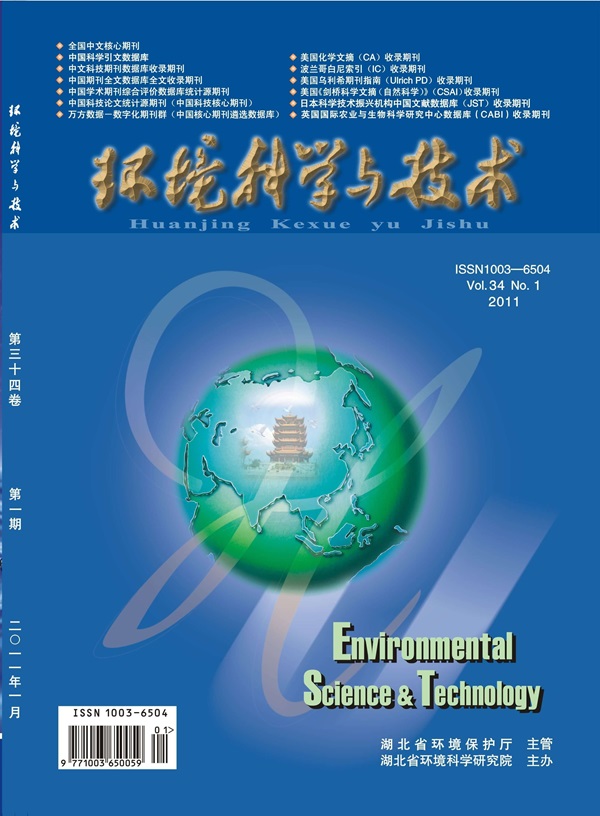
环境科学与技术
环境科学与技术 环境科学-工程:环境
CiteScore
17.50
自引率
9.60%
发文量
12359
审稿时长
2.8 months
期刊介绍: Environmental Science & Technology (ES&T) is a co-sponsored academic and technical magazine by the Hubei Provincial Environmental Protection Bureau and the Hubei Provincial Academy of Environmental Sciences. Environmental Science & Technology (ES&T) holds the status of Chinese core journals, scientific papers source journals of China, Chinese Science Citation Database source journals, and Chinese Academic Journal Comprehensive Evaluation Database source journals. This publication focuses on the academic field of environmental protection, featuring articles related to environmental protection and technical advancements.

×
引用
GB/T 7714-2015
复制
MLA
复制
APA
复制
导出至
BibTeX EndNote RefMan NoteFirst NoteExpress
×
提示
您的信息不完整,为了账户安全,请先补充。
现在去补充
×
提示
您因"违规操作"
具体请查看互助需知
我知道了
×
提示
确定
请完成安全验证×
copy
已复制链接
快去分享给好友吧!
我知道了
右上角分享
点击右上角分享
0
联系我们:info@booksci.cn Book学术提供免费学术资源搜索服务,方便国内外学者检索中英文文献。致力于提供最便捷和优质的服务体验。 Copyright © 2023 布克学术 All rights reserved.
京ICP备2023020795号-1
ghs 京公网安备 11010802042870号
Book学术文献互助
Book学术文献互助群
群 号:604180095
Book学术官方微信
小红书


