
Sequential-Photocuring-Assisted Transformation of Planar Multilayer Structures into Curved Geometries

IF 7.8 2区 材料科学 Q1 MATERIALS SCIENCE, MULTIDISCIPLINARY
Daihyun Hwang,Jeonghyo Lee,Yeonseo Lee,Yougyoung Lee,Sungjun Han,Hosun Lim,Jung Ah Lim,Heesuk Kim,Wonbin Hong,Min Sang Kwon
{"title":"Sequential-Photocuring-Assisted Transformation of Planar Multilayer Structures into Curved Geometries","authors":"Daihyun Hwang,Jeonghyo Lee,Yeonseo Lee,Yougyoung Lee,Sungjun Han,Hosun Lim,Jung Ah Lim,Heesuk Kim,Wonbin Hong,Min Sang Kwon","doi":"10.1021/acsami.6c13437","DOIUrl":null,"url":null,"abstract":"The integration of functional electronic structures into curved geometries remains challenging, as conventional approaches rely on post-shaping or adhesive-assisted assembly that separate structure formation from shape definition. Here, we present a sequential-photocuring-assisted fabrication strategy that transforms planar multilayer structures into curved forms within a single material system. A wavelength-selective acrylate–epoxy resin is designed to create a deformable intermediate state under visible light, followed by a fixation-enabled final state through UV-triggered curing. A gradient-like curing strategy, involving time-dependent evolution of conversion during sequential irradiation, allows controlled partial epoxy conversion and provides both processability and subsequent reactivity. The second curing step induces simultaneous interfacial bonding and structural stiffening, enabling adhesive-free integration and fixation of the mold-imposed geometry. A multilayer patch antenna operating at 28 GHz is fabricated and transformed from planar to curved geometry while maintaining its performance. This approach provides a material-based framework for integrating planar-fabricated structures into three-dimensional form factors without thermoforming or adhesives.","PeriodicalId":5,"journal":{"name":"ACS Applied Materials & Interfaces","volume":"56 1","pages":""},"PeriodicalIF":7.8000,"publicationDate":"2026-10-21","publicationTypes":"Journal Article","fieldsOfStudy":null,"isOpenAccess":false,"openAccessPdf":"","citationCount":"0","resultStr":null,"platform":"Semanticscholar","paperid":null,"PeriodicalName":"ACS Applied Materials & Interfaces","FirstCategoryId":"88","ListUrlMain":"https://doi.org/10.1021/acsami.6c13437","RegionNum":2,"RegionCategory":"材料科学","ArticlePicture":[],"TitleCN":null,"AbstractTextCN":null,"PMCID":null,"EPubDate":"","PubModel":"","JCR":"Q1","JCRName":"MATERIALS SCIENCE, MULTIDISCIPLINARY","Score":null,"Total":0}
引用次数: 0

Abstract

The integration of functional electronic structures into curved geometries remains challenging, as conventional approaches rely on post-shaping or adhesive-assisted assembly that separate structure formation from shape definition. Here, we present a sequential-photocuring-assisted fabrication strategy that transforms planar multilayer structures into curved forms within a single material system. A wavelength-selective acrylate–epoxy resin is designed to create a deformable intermediate state under visible light, followed by a fixation-enabled final state through UV-triggered curing. A gradient-like curing strategy, involving time-dependent evolution of conversion during sequential irradiation, allows controlled partial epoxy conversion and provides both processability and subsequent reactivity. The second curing step induces simultaneous interfacial bonding and structural stiffening, enabling adhesive-free integration and fixation of the mold-imposed geometry. A multilayer patch antenna operating at 28 GHz is fabricated and transformed from planar to curved geometry while maintaining its performance. This approach provides a material-based framework for integrating planar-fabricated structures into three-dimensional form factors without thermoforming or adhesives.

Abstract Image

平面多层结构的顺序光固化转化为弯曲几何
将功能电子结构集成到弯曲几何形状中仍然具有挑战性,因为传统的方法依赖于后成型或粘合剂辅助组装,将结构形成与形状定义分开。在这里,我们提出了一种顺序光固化辅助制造策略,将平面多层结构转化为单一材料系统中的弯曲形式。一种波长选择性丙烯酸酯-环氧树脂被设计用于在可见光下产生可变形的中间状态,然后通过紫外线触发固化形成可固定的最终状态。一种类似梯度的固化策略,包括顺序照射过程中随时间变化的转化,允许控制环氧树脂的部分转化,并提供可加工性和后续反应性。第二个固化步骤同时诱导界面粘合和结构硬化,实现无粘合剂的集成和模具施加几何形状的固定。制作了一种工作在28ghz的多层贴片天线,并在保持其性能的同时将其从平面几何形状转换为弯曲几何形状。这种方法提供了一种基于材料的框架,可以将平面制造的结构集成到三维形状因素中,而无需热成型或粘合剂。
本文章由计算机程序翻译,如有差异,请以英文原文为准。
求助全文
约1分钟内获得全文 求助全文
来源期刊
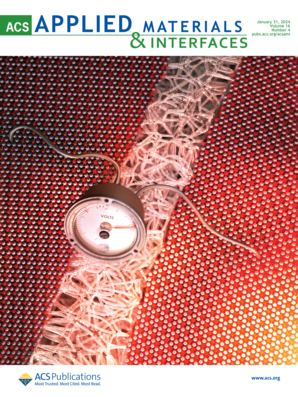
ACS Applied Materials & Interfaces
ACS Applied Materials & Interfaces 工程技术-材料科学:综合
CiteScore
16.00
自引率
6.30%
发文量
4978
审稿时长
1.8 months
期刊介绍: ACS Applied Materials & Interfaces is a leading interdisciplinary journal that brings together chemists, engineers, physicists, and biologists to explore the development and utilization of newly-discovered materials and interfacial processes for specific applications. Our journal has experienced remarkable growth since its establishment in 2009, both in terms of the number of articles published and the impact of the research showcased. We are proud to foster a truly global community, with the majority of published articles originating from outside the United States, reflecting the rapid growth of applied research worldwide.

×
引用
GB/T 7714-2015
复制
MLA
复制
APA
复制
导出至
BibTeX EndNote RefMan NoteFirst NoteExpress
×
提示
您的信息不完整,为了账户安全,请先补充。
现在去补充
×
提示
您因"违规操作"
具体请查看互助需知
我知道了
×
提示
确定
请完成安全验证×
copy
已复制链接
快去分享给好友吧!
我知道了
右上角分享
点击右上角分享
0
联系我们:info@booksci.cn Book学术提供免费学术资源搜索服务,方便国内外学者检索中英文文献。致力于提供最便捷和优质的服务体验。 Copyright © 2023 布克学术 All rights reserved.
京ICP备2023020795号-1
ghs 京公网安备 11010802042870号
Book学术文献互助
Book学术文献互助群
群 号:604180095
Book学术官方微信
小红书


