
Temporal and spatial distributions of pathogens in managed Florida honey bee (Apis mellifera) colonies

IF 2.4 3区 生物学 Q1 ZOOLOGY
Journal of invertebrate pathology Pub Date : 2027-02-01 Epub Date: 2026-10-19 DOI:10.1016/j.jip.2026.108768
Julia St. Amant, Hannah Connell, James D. Ellis, Cameron J. Jack
{"title":"Temporal and spatial distributions of pathogens in managed Florida honey bee (Apis mellifera) colonies","authors":"Julia St. Amant,&nbsp;Hannah Connell,&nbsp;James D. Ellis,&nbsp;Cameron J. Jack","doi":"10.1016/j.jip.2026.108768","DOIUrl":null,"url":null,"abstract":"<div><div>Western honey bee (<em>Apis mellifera</em>) pathogens are a major concern for beekeepers and pose a significant threat to colony health. From January – December 2024, adult honey bees were sampled monthly by beekeepers in twenty counties distributed throughout Florida. Honey bees from each colony sample were analyzed using PCR (all pathogens) and microscopy (<em>Nosema</em> spp. only) to determine the temporal and spatial distribution of the following honey bee pathogens: <em>Ascosphaera apis</em>, <em>Crithidia mellificae</em>, <em>Melissococcus plutonius</em>, <em>Malpighamoeba mellificae</em>, <em>Lotmaria passim</em>, <em>Nosema apis</em>, <em>Nosema ceranae,</em> and <em>Apis mellifera</em> filamentous virus (AmFV). In total, 710 samples were collected, of which 4.4% were positive for <em>A. apis</em>, 65.5% were positive for L. <em>passim</em>, 25.5% were positive for <em>M. plutonius</em>, 85.5% were positive for <em>N. ceranae</em>, &lt;0.01% were positive for <em>M. mellificae,</em> and 97.4% were positive for AmFV. <em>Crithidia mellificae</em> and <em>N. apis</em> were not detected in any of the samples. There were significant differences in the prevalence of L. <em>passim</em>, <em>M. plutonius</em>, and <em>N. ceranae</em> pathogen load based on the time of year and location of the colony, with pathogens trending towards higher abundance in summer. These data highlight the need to augment monitoring efforts to determine the geographic and seasonal distribution of pathogens that infect honey bees.</div></div>","PeriodicalId":16296,"journal":{"name":"Journal of invertebrate pathology","volume":"220 ","pages":"Article 108768"},"PeriodicalIF":2.4000,"publicationDate":"2027-02-01","publicationTypes":"Journal Article","fieldsOfStudy":null,"isOpenAccess":false,"openAccessPdf":"","citationCount":"0","resultStr":null,"platform":"Semanticscholar","paperid":null,"PeriodicalName":"Journal of invertebrate pathology","FirstCategoryId":"99","ListUrlMain":"https://www.sciencedirect.com/science/article/pii/S0022201126002442","RegionNum":3,"RegionCategory":"生物学","ArticlePicture":[],"TitleCN":null,"AbstractTextCN":null,"PMCID":null,"EPubDate":"2026/10/19 0:00:00","PubModel":"Epub","JCR":"Q1","JCRName":"ZOOLOGY","Score":null,"Total":0}
引用次数: 0

Abstract

Western honey bee (Apis mellifera) pathogens are a major concern for beekeepers and pose a significant threat to colony health. From January – December 2024, adult honey bees were sampled monthly by beekeepers in twenty counties distributed throughout Florida. Honey bees from each colony sample were analyzed using PCR (all pathogens) and microscopy (Nosema spp. only) to determine the temporal and spatial distribution of the following honey bee pathogens: Ascosphaera apis, Crithidia mellificae, Melissococcus plutonius, Malpighamoeba mellificae, Lotmaria passim, Nosema apis, Nosema ceranae, and Apis mellifera filamentous virus (AmFV). In total, 710 samples were collected, of which 4.4% were positive for A. apis, 65.5% were positive for L. passim, 25.5% were positive for M. plutonius, 85.5% were positive for N. ceranae, <0.01% were positive for M. mellificae, and 97.4% were positive for AmFV. Crithidia mellificae and N. apis were not detected in any of the samples. There were significant differences in the prevalence of L. passim, M. plutonius, and N. ceranae pathogen load based on the time of year and location of the colony, with pathogens trending towards higher abundance in summer. These data highlight the need to augment monitoring efforts to determine the geographic and seasonal distribution of pathogens that infect honey bees.

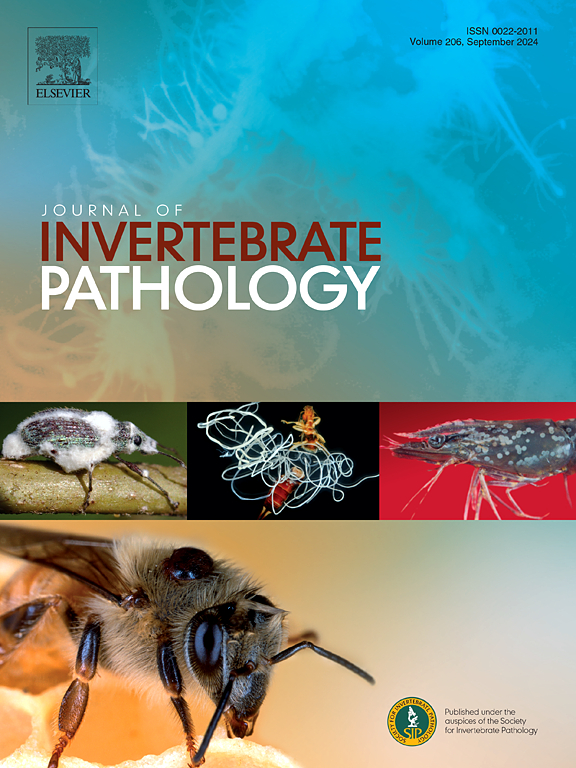
Abstract Image

佛罗里达蜜蜂(Apis mellifera)种群病原菌时空分布。
西方蜜蜂(Apis mellifera)病原体是养蜂人关注的主要问题,对蜂群健康构成重大威胁。从2024年1月到12月,分布在佛罗里达州20个县的养蜂人每月对成年蜜蜂进行取样。采用PCR(所有病原菌)和显微镜(仅微孔虫属)对各菌落样本的蜜蜂进行分析,确定蜜蜂病原菌的时空分布:蜜蜂Ascosphaera apis、Crithidia mellificae、Melissococcus plutonius、Malpighamoeba mellificae、Lotmaria pasm、apis Nosema apis、Nosema ceranae和apis mellifera丝状病毒(AmFV)。共采集标本710份,其中apis艾螨阳性4.4%,白斑乳杆菌阳性65.5%,plutonius阳性25.5%,ceranae阳性85.5%;
本文章由计算机程序翻译,如有差异,请以英文原文为准。
求助全文
约1分钟内获得全文 求助全文
来源期刊
CiteScore
6.10
自引率
5.90%
发文量
94
审稿时长
1 months
期刊介绍: The Journal of Invertebrate Pathology presents original research articles and notes on the induction and pathogenesis of diseases of invertebrates, including the suppression of diseases in beneficial species, and the use of diseases in controlling undesirable species. In addition, the journal publishes the results of physiological, morphological, genetic, immunological and ecological studies as related to the etiologic agents of diseases of invertebrates. The Journal of Invertebrate Pathology is the adopted journal of the Society for Invertebrate Pathology, and is available to SIP members at a special reduced price.

×
引用
GB/T 7714-2015
复制
MLA
复制
APA
复制
导出至
BibTeX EndNote RefMan NoteFirst NoteExpress
×
提示
您的信息不完整,为了账户安全,请先补充。
现在去补充
×
提示
您因"违规操作"
具体请查看互助需知
我知道了
×
提示
确定
请完成安全验证×
copy
已复制链接
快去分享给好友吧!
我知道了
右上角分享
点击右上角分享
0
联系我们:info@booksci.cn Book学术提供免费学术资源搜索服务,方便国内外学者检索中英文文献。致力于提供最便捷和优质的服务体验。 Copyright © 2023 布克学术 All rights reserved.
京ICP备2023020795号-1
ghs 京公网安备 11010802042870号
Book学术文献互助
Book学术文献互助群
群 号:604180095
Book学术官方微信
小红书


