{"title":"Hexacatenar Columnar Liquid Crystals with a Perfluoronaphthalene-Core: Synthesis, Self-Organization, Charge Transport and Photoluminescence","authors":"Jiao Jian, Yu Luo, Chong-Yang Zeng, Xiao-Yan Bai, Bo Xiao, Ke-Qing Zhao, Bertrand Donnio","doi":"10.1021/acs.cgd.6c01042","DOIUrl":null,"url":null,"abstract":"<p>Columnar liquid crystals featuring one-dimensional charge transport and self-assembly are of considerable interest for organic electronic applications such as organic field-effect transistors (OFETs) and organic light-emitting diodes (OLEDs). Fluorination emerges as a powerful strategy to fine-tune the mesomorphic behavior through noncovalent interactions thereby optimizing stability, charge mobility, and device performance. In this work, we report the design and synthesis of a series of hexacatenar compounds (<strong>2</strong><sub><em>n</em></sub> series) constructed from an electron-deficient central perfluoronaphthalene core and two peripheral multi-tailed benzene units via butyllithium-mediated nucleophilic aromatic substitution (S<sub>N</sub>Ar). This palladium-free route affords the target compounds in 48−68% yield, circumventing the use of noble metal catalysts for cross-coupling. For comparative structure−property analysis, two control compounds were prepared: a nonfluorinated naphthalene-core analog (<strong>4</strong><sub>6</sub>) and a fluorinated naphthalene-core deprived of alkoxy chains (<strong>2</strong>H). The mesomorphic behavior was systematically investigated by differential scanning calorimetry (DSC), polarizing optical microscopy (POM), and small- and wide-angle X-ray scattering (S/WAXS). All <strong>2</strong><sub><em>n</em></sub> hexacatenars exhibit a hexagonal columnar (Col<sub>hex</sub>) mesophase over a wide temperature range. Increasing the alkyl chain length gradually lowers the clearing point from 100 °C to 78 °C, whereas the incorporation of branched chains extends the mesophase stability down to room temperature, significantly broadening the mesogenic window. Notably, the nonfluorinated alkylated control compound (<strong>4</strong><sub>6</sub>) is not mesogenic, unequivocally demonstrating that fluorine-induced noncovalent interactions<span></span>likely involving F···H and F···π contacts<span></span>serve as the essential driving force for mesophase formation. Beyond their mesogenic properties, the target compounds exhibit blue-violet photoluminescence both in solution and in the solid state, with a fluorescence quantum yield of up to 30% in cyclohexane, underscoring their favorable photophysical characteristics. SCLC measurements reveal that the chain topology, whether linear or branched, directly influences charge transport, resulting in either electron-dominated charge transport or ambipolar charge transport, with electron mobility ranging from 10<sup>−4</sup> to 10<sup>−3</sup> cm<sup>2</sup> V<sup>−1</sup> s<sup>−1</sup>.The combined modulation of mesomorphism by fluorination and flexible chain engineering, together with the efficient, metal-free synthetic protocol, provides a robust molecular design strategy for optimizing polycatenar columnar liquid crystal materials for opto-electronic applications.</p>","PeriodicalId":34,"journal":{"name":"Crystal Growth & Design","volume":"26 20","pages":"8464–8472"},"PeriodicalIF":3.6000,"publicationDate":"2026-10-21","publicationTypes":"Journal Article","fieldsOfStudy":null,"isOpenAccess":false,"openAccessPdf":"","citationCount":"0","resultStr":null,"platform":"Semanticscholar","paperid":null,"PeriodicalName":"Crystal Growth & Design","FirstCategoryId":"92","ListUrlMain":"https://pubs.acs.org/doi/10.1021/acs.cgd.6c01042","RegionNum":2,"RegionCategory":"化学","ArticlePicture":[],"TitleCN":null,"AbstractTextCN":null,"PMCID":null,"EPubDate":"2026/10/10 0:00:00","PubModel":"Epub","JCR":"Q2","JCRName":"CHEMISTRY, MULTIDISCIPLINARY","Score":null,"Total":0}
引用次数: 0
Abstract
Columnar liquid crystals featuring one-dimensional charge transport and self-assembly are of considerable interest for organic electronic applications such as organic field-effect transistors (OFETs) and organic light-emitting diodes (OLEDs). Fluorination emerges as a powerful strategy to fine-tune the mesomorphic behavior through noncovalent interactions thereby optimizing stability, charge mobility, and device performance. In this work, we report the design and synthesis of a series of hexacatenar compounds (2n series) constructed from an electron-deficient central perfluoronaphthalene core and two peripheral multi-tailed benzene units via butyllithium-mediated nucleophilic aromatic substitution (SNAr). This palladium-free route affords the target compounds in 48−68% yield, circumventing the use of noble metal catalysts for cross-coupling. For comparative structure−property analysis, two control compounds were prepared: a nonfluorinated naphthalene-core analog (46) and a fluorinated naphthalene-core deprived of alkoxy chains (2H). The mesomorphic behavior was systematically investigated by differential scanning calorimetry (DSC), polarizing optical microscopy (POM), and small- and wide-angle X-ray scattering (S/WAXS). All 2n hexacatenars exhibit a hexagonal columnar (Colhex) mesophase over a wide temperature range. Increasing the alkyl chain length gradually lowers the clearing point from 100 °C to 78 °C, whereas the incorporation of branched chains extends the mesophase stability down to room temperature, significantly broadening the mesogenic window. Notably, the nonfluorinated alkylated control compound (46) is not mesogenic, unequivocally demonstrating that fluorine-induced noncovalent interactionslikely involving F···H and F···π contactsserve as the essential driving force for mesophase formation. Beyond their mesogenic properties, the target compounds exhibit blue-violet photoluminescence both in solution and in the solid state, with a fluorescence quantum yield of up to 30% in cyclohexane, underscoring their favorable photophysical characteristics. SCLC measurements reveal that the chain topology, whether linear or branched, directly influences charge transport, resulting in either electron-dominated charge transport or ambipolar charge transport, with electron mobility ranging from 10−4 to 10−3 cm2 V−1 s−1.The combined modulation of mesomorphism by fluorination and flexible chain engineering, together with the efficient, metal-free synthetic protocol, provides a robust molecular design strategy for optimizing polycatenar columnar liquid crystal materials for opto-electronic applications.
期刊介绍:
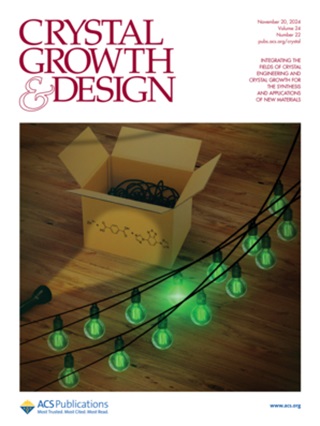
The aim of Crystal Growth & Design is to stimulate crossfertilization of knowledge among scientists and engineers working in the fields of crystal growth, crystal engineering, and the industrial application of crystalline materials.
Crystal Growth & Design publishes theoretical and experimental studies of the physical, chemical, and biological phenomena and processes related to the design, growth, and application of crystalline materials. Synergistic approaches originating from different disciplines and technologies and integrating the fields of crystal growth, crystal engineering, intermolecular interactions, and industrial application are encouraged.

 求助内容:
 应助结果提醒方式:


 京公网安备 11010802042870号


