Mingjun Zou, Yuhang Wu, Zhishuo Zhang, Guoyong Chen, An Duan, Zhirong Zhong, Lin Zhou, Wenjing Guo, Zhenhong Wei, Hu Cai
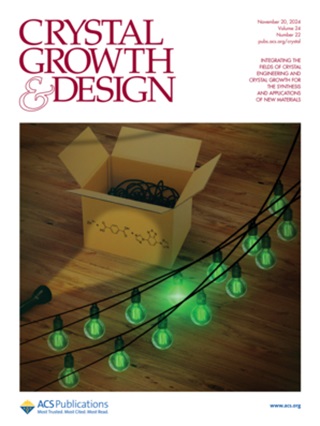
{"title":"Halogen Substitution-Controlled Phase Transition, Dielectric Anomaly, and SHG Switching in Ga-Based Hybrid Molecular Ferroelectrics","authors":"Mingjun Zou, Yuhang Wu, Zhishuo Zhang, Guoyong Chen, An Duan, Zhirong Zhong, Lin Zhou, Wenjing Guo, Zhenhong Wei, Hu Cai","doi":"10.1021/acs.cgd.6c00854","DOIUrl":null,"url":null,"abstract":"<p>Halogen engineering provides a versatile strategy for modulating intermolecular interactions and structural flexibility, enabling precise control over phase transition behaviors and functional responses. In this work, using 1,5-diazabicyclo[3.3.0]nonane (1,5−3.3.0-dabcn) as the organic scaffold, three organic−inorganic hybrid switchable phase-change materials, [1,5−3.3.0-dabcn-CH<sub>2</sub>Br][GaCl<sub>4</sub>] (<strong>1</strong>), [1,5−3.3.0-dabcn-CH<sub>2</sub>Br][GaBr<sub>4</sub>] (<strong>2</strong>), and [1,5−3.3.0-dabcn-CH<sub>2</sub>Br][GaI<sub>4</sub>] (<strong>3</strong>), were successfully synthesized via reaction with GaX<sub>3</sub> (X = Cl, Br, I) in aqueous HX solutions. Compounds <strong>1</strong> and <strong>2</strong> exhibit reversible phase transitions, distinct dielectric anomalies, temperature-triggered second-harmonic generation (SHG) switching, and room-temperature ferroelectricity. In contrast, compound <strong>3</strong> shows only phase transition behavior without ferroelectricity or SHG activity. Comparative structural and Hirshfeld surface analyses reveal that halogen substitution systematically alters the strength and distribution of H···X hydrogen bonds, as well as the packing symmetry, thereby governing the observed functional evolution from polar (<strong>1</strong>, <strong>2</strong>) to centrosymmetric (<strong>3</strong>) structures. This study demonstrates an effective molecular design strategy for constructing gallium halide hybrid materials with tunable physical properties.</p>","PeriodicalId":34,"journal":{"name":"Crystal Growth & Design","volume":"26 20","pages":"8243–8251"},"PeriodicalIF":3.6000,"publicationDate":"2026-10-21","publicationTypes":"Journal Article","fieldsOfStudy":null,"isOpenAccess":false,"openAccessPdf":"","citationCount":"0","resultStr":null,"platform":"Semanticscholar","paperid":null,"PeriodicalName":"Crystal Growth & Design","FirstCategoryId":"92","ListUrlMain":"https://pubs.acs.org/doi/10.1021/acs.cgd.6c00854","RegionNum":2,"RegionCategory":"化学","ArticlePicture":[],"TitleCN":null,"AbstractTextCN":null,"PMCID":null,"EPubDate":"2026/10/5 0:00:00","PubModel":"Epub","JCR":"Q2","JCRName":"CHEMISTRY, MULTIDISCIPLINARY","Score":null,"Total":0}
引用次数: 0
Abstract
Halogen engineering provides a versatile strategy for modulating intermolecular interactions and structural flexibility, enabling precise control over phase transition behaviors and functional responses. In this work, using 1,5-diazabicyclo[3.3.0]nonane (1,5−3.3.0-dabcn) as the organic scaffold, three organic−inorganic hybrid switchable phase-change materials, [1,5−3.3.0-dabcn-CH2Br][GaCl4] (1), [1,5−3.3.0-dabcn-CH2Br][GaBr4] (2), and [1,5−3.3.0-dabcn-CH2Br][GaI4] (3), were successfully synthesized via reaction with GaX3 (X = Cl, Br, I) in aqueous HX solutions. Compounds 1 and 2 exhibit reversible phase transitions, distinct dielectric anomalies, temperature-triggered second-harmonic generation (SHG) switching, and room-temperature ferroelectricity. In contrast, compound 3 shows only phase transition behavior without ferroelectricity or SHG activity. Comparative structural and Hirshfeld surface analyses reveal that halogen substitution systematically alters the strength and distribution of H···X hydrogen bonds, as well as the packing symmetry, thereby governing the observed functional evolution from polar (1, 2) to centrosymmetric (3) structures. This study demonstrates an effective molecular design strategy for constructing gallium halide hybrid materials with tunable physical properties.
期刊介绍:
The aim of Crystal Growth & Design is to stimulate crossfertilization of knowledge among scientists and engineers working in the fields of crystal growth, crystal engineering, and the industrial application of crystalline materials.
Crystal Growth & Design publishes theoretical and experimental studies of the physical, chemical, and biological phenomena and processes related to the design, growth, and application of crystalline materials. Synergistic approaches originating from different disciplines and technologies and integrating the fields of crystal growth, crystal engineering, intermolecular interactions, and industrial application are encouraged.

 求助内容:
 应助结果提醒方式:


 京公网安备 11010802042870号


