
Fast and Sensitive Ionogel Capacitive Sensing of Acetic Acid at Room Temperature for Early Plant Salt Stress Detection
IF 10.9
1区 化学
Q1 CHEMISTRY, ANALYTICAL
引用次数: 0
Abstract
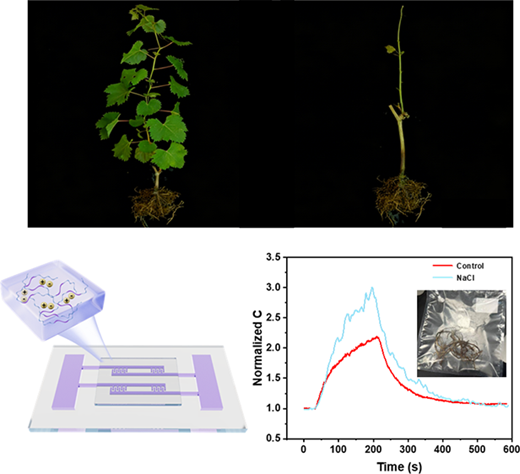
Acetic acid has been identified as an early biomarker of salt stress in plants, enabling precise monitoring of plant health and timely detection of stress. However, its rapid and selective detection at room temperature remains challenging. Herein, we report an ionogel capacitive chemical sensor based on a polydimethylsiloxane (PDMS) matrix incorporating the ionic liquid 1-butyl-3-vinylimidazolium tetrafluoroborate ([VBIM][BF4]). The resulting ionogel sensor exhibits high selectivity toward acetic acid over common volatile organic compounds, originating from solvent effects and electrostatic interactions between acetic acid molecules and the ionic liquid, as revealed by density functional theory (DFT) calculations. Owing to these interactions, the sensor achieves a rapid response time of approximately 6 s at room temperature, and the practical limit of detection is as low as 500 ppb. In addition, the sensor shows excellent long-term stability and mechanical flexibility. The sensor maintains stable sensing performance after 180 days of storage at room temperature and can be integrated with a wireless monitoring system. Furthermore, the sensor detects the acetic acid released by salt-stressed plants, highlighting its potential as an early-warning platform for agricultural stress monitoring.
快速灵敏的室温乙酸离子凝胶电容传感技术用于植物早期盐胁迫检测
乙酸已被确定为植物盐胁迫的早期生物标志物,可以精确监测植物的健康状况,及时发现胁迫。然而,其在室温下的快速和选择性检测仍然具有挑战性。在此,我们报道了一种基于离子液体1-丁基-3-乙烯基咪唑四氟硼酸盐([VBIM][BF4])的聚二甲基硅氧烷(PDMS)基质的离子凝胶电容式化学传感器。根据密度泛函理论(DFT)计算,所得到的离子凝胶传感器对醋酸的选择性高于普通挥发性有机化合物,这是由于溶剂效应和醋酸分子与离子液体之间的静电相互作用造成的。由于这些相互作用,传感器在室温下实现了大约6秒的快速响应时间,并且检测的实际极限低至500 ppb。此外,该传感器具有优异的长期稳定性和机械灵活性。该传感器在室温下储存180天后仍能保持稳定的传感性能,并可与无线监测系统集成。此外,该传感器还可以检测盐胁迫植物释放的乙酸,突出了其作为农业胁迫监测预警平台的潜力。
本文章由计算机程序翻译,如有差异,请以英文原文为准。
求助全文
约1分钟内获得全文
求助全文
来源期刊
ACS Sensors
Chemical Engineering-Bioengineering
CiteScore
14.50
自引率
3.40%
发文量
372
期刊介绍:
ACS Sensors is a peer-reviewed research journal that focuses on the dissemination of new and original knowledge in the field of sensor science, particularly those that selectively sense chemical or biological species or processes. The journal covers a broad range of topics, including but not limited to biosensors, chemical sensors, gas sensors, intracellular sensors, single molecule sensors, cell chips, and microfluidic devices. It aims to publish articles that address conceptual advances in sensing technology applicable to various types of analytes or application papers that report on the use of existing sensing concepts in new ways or for new analytes.
 求助内容:
 应助结果提醒方式:


 京公网安备 11010802042870号


