
Unlocking the Exceptional Activity of CuS in Fenton-Like Reactions via a Novel Hydroxide–Sulfur Interaction

IF 12.2 1区 环境科学与生态学 Q1 ENGINEERING, ENVIRONMENTAL
Liangjie Wang,Xinyi Zhang,Jian Wei,Xinyue Xie,Yu Gao,Zhixiong Hu,Xinyao Liu,Zhuang Guo,Yue Liu,Lixuan Ma,Huazhang Zhao,Yonghui Song
{"title":"Unlocking the Exceptional Activity of CuS in Fenton-Like Reactions via a Novel Hydroxide–Sulfur Interaction","authors":"Liangjie Wang,Xinyi Zhang,Jian Wei,Xinyue Xie,Yu Gao,Zhixiong Hu,Xinyao Liu,Zhuang Guo,Yue Liu,Lixuan Ma,Huazhang Zhao,Yonghui Song","doi":"10.1021/acs.est.6c14066","DOIUrl":null,"url":null,"abstract":"Promoters have been explored to improve Fenton-like reactions for wastewater treatment, yet they are often costly and may cause secondary pollution. This study demonstrates that alkali (OH–), as an inexpensive and environmentally friendly chemical, acts as an efficient promoter for copper sulfide (CuS) by inducing polarization of the disulfide bonds in CuS. OH– substantially enhanced the generation of hydroxyl and sulfate radicals in the CuS/peroxymonosulfate (PMS) system, achieving a >100-fold increase in the apparent degradation rate of sulfamethoxazole (SMX). With OH– assistance, a CuS-packed continuous-flow reactor demonstrated long-term stability (≥800 h), sustaining >95% SMX removal, <1% residual PMS, <0.03 mg/L Cu2+ leaching. Final effluent pH remained stable at 6–9, meeting all applicable discharge standards. Furthermore, the OH–/CuS/PMS system significantly reduced the toxicity of actual wastewater. Density functional theory calculations revealed that the interaction between OH– and disulfide bonds in CuS enhanced the electron spin density and improved the 3d orbital energy level of CuS, promoting electron transfer from CuS to PMS. This work presents a cost-effective Fenton-like system that achieves robust pollutant degradation while ensuring exceptionally low metal dissolution and a consistently discharge-compliant effluent pH (6–9), collectively underscoring its viability for sustainable wastewater remediation.","PeriodicalId":36,"journal":{"name":"环境科学与技术","volume":"13 1","pages":""},"PeriodicalIF":12.2000,"publicationDate":"2026-10-20","publicationTypes":"Journal Article","fieldsOfStudy":null,"isOpenAccess":false,"openAccessPdf":"","citationCount":"0","resultStr":null,"platform":"Semanticscholar","paperid":null,"PeriodicalName":"环境科学与技术","FirstCategoryId":"1","ListUrlMain":"https://doi.org/10.1021/acs.est.6c14066","RegionNum":1,"RegionCategory":"环境科学与生态学","ArticlePicture":[],"TitleCN":null,"AbstractTextCN":null,"PMCID":null,"EPubDate":"","PubModel":"","JCR":"Q1","JCRName":"ENGINEERING, ENVIRONMENTAL","Score":null,"Total":0}
引用次数: 0

Abstract

Promoters have been explored to improve Fenton-like reactions for wastewater treatment, yet they are often costly and may cause secondary pollution. This study demonstrates that alkali (OH–), as an inexpensive and environmentally friendly chemical, acts as an efficient promoter for copper sulfide (CuS) by inducing polarization of the disulfide bonds in CuS. OH– substantially enhanced the generation of hydroxyl and sulfate radicals in the CuS/peroxymonosulfate (PMS) system, achieving a >100-fold increase in the apparent degradation rate of sulfamethoxazole (SMX). With OH– assistance, a CuS-packed continuous-flow reactor demonstrated long-term stability (≥800 h), sustaining >95% SMX removal, <1% residual PMS, <0.03 mg/L Cu2+ leaching. Final effluent pH remained stable at 6–9, meeting all applicable discharge standards. Furthermore, the OH–/CuS/PMS system significantly reduced the toxicity of actual wastewater. Density functional theory calculations revealed that the interaction between OH– and disulfide bonds in CuS enhanced the electron spin density and improved the 3d orbital energy level of CuS, promoting electron transfer from CuS to PMS. This work presents a cost-effective Fenton-like system that achieves robust pollutant degradation while ensuring exceptionally low metal dissolution and a consistently discharge-compliant effluent pH (6–9), collectively underscoring its viability for sustainable wastewater remediation.

Abstract Image

通过一种新的氢氧化物-硫相互作用,解锁类芬顿反应中cu的特殊活性
促进剂已被用于改善废水处理中的类芬顿反应,但它们往往成本高且可能造成二次污染。本研究表明,碱(OH -)作为一种廉价且环保的化学物质,通过诱导cu中二硫键的极化,作为硫化铜(cu)的有效促进剂。OH -显著增强了CuS/过氧单硫酸盐(PMS)体系中羟基自由基和硫酸盐自由基的生成,使磺胺甲恶唑(SMX)的表观降解率提高了100倍。在OH -辅助下,cu填料连续流反应器表现出长期稳定性(≥800 h), SMX去除率达95%,PMS残留量<1%,Cu2+浸出率<0.03 mg/L。最终出水pH值稳定在6-9,符合所有适用的排放标准。此外,OH - / cu /PMS系统显著降低了实际废水的毒性。密度泛函理论计算表明,cu中OH -键与二硫键之间的相互作用增强了cu的电子自旋密度,提高了cu的三维轨道能级,促进了电子从cu向PMS的转移。本研究提出了一种具有成本效益的类芬顿系统,在确保极低的金属溶解和始终符合排放的废水pH值(6-9)的同时,实现了强大的污染物降解,共同强调了其可持续废水修复的可行性。
本文章由计算机程序翻译,如有差异,请以英文原文为准。
求助全文
约1分钟内获得全文 求助全文
来源期刊
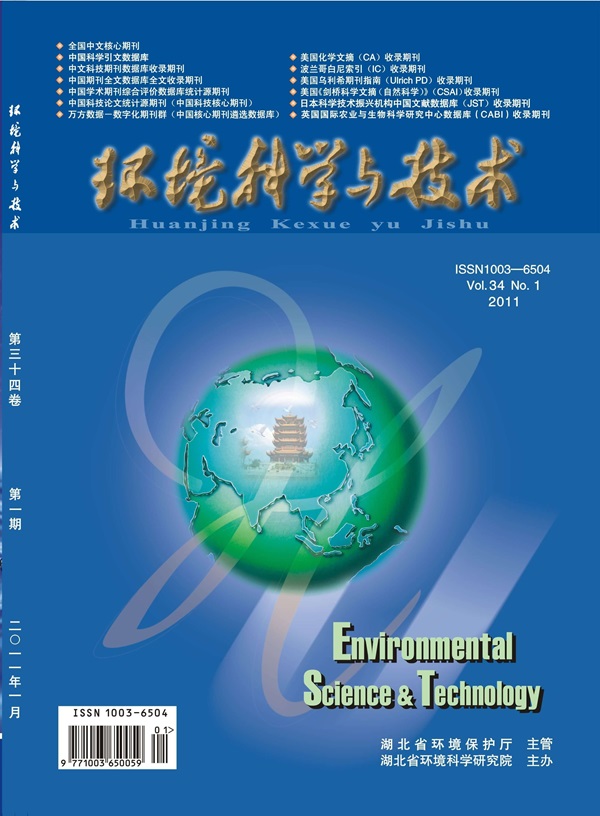
环境科学与技术
环境科学与技术 环境科学-工程:环境
CiteScore
17.50
自引率
9.60%
发文量
12359
审稿时长
2.8 months
期刊介绍: Environmental Science & Technology (ES&T) is a co-sponsored academic and technical magazine by the Hubei Provincial Environmental Protection Bureau and the Hubei Provincial Academy of Environmental Sciences. Environmental Science & Technology (ES&T) holds the status of Chinese core journals, scientific papers source journals of China, Chinese Science Citation Database source journals, and Chinese Academic Journal Comprehensive Evaluation Database source journals. This publication focuses on the academic field of environmental protection, featuring articles related to environmental protection and technical advancements.

×
引用
GB/T 7714-2015
复制
MLA
复制
APA
复制
导出至
BibTeX EndNote RefMan NoteFirst NoteExpress
×
提示
您的信息不完整,为了账户安全,请先补充。
现在去补充
×
提示
您因"违规操作"
具体请查看互助需知
我知道了
×
提示
确定
请完成安全验证×
copy
已复制链接
快去分享给好友吧!
我知道了
右上角分享
点击右上角分享
0
联系我们:info@booksci.cn Book学术提供免费学术资源搜索服务,方便国内外学者检索中英文文献。致力于提供最便捷和优质的服务体验。 Copyright © 2023 布克学术 All rights reserved.
京ICP备2023020795号-1
ghs 京公网安备 11010802042870号
Book学术文献互助
Book学术文献互助群
群 号:604180095
Book学术官方微信
小红书


