
Atmospheric Concentrations and Emissions of Major HFCs at Six Background Stations in China during 2012–2023
IF 12.2
1区 环境科学与生态学
Q1 ENGINEERING, ENVIRONMENTAL
引用次数: 0
Abstract
In this study, a long-term atmospheric observation of HFC-23, -32, -125, -134a, -143a, and -152a was conducted at six background stations across China from 2011 to 2023. Using a tracer ratio method with HCFC-22 as the reference, emissions from four main economic regions, Northeast Plain (NEP), North China Plain (NCP), Yangtze River Delta (YRD), and Central South China (CSC), were estimated, and their trends were analyzed over four phases: Phase 1 (2012–2016), Phase 2 (2017–2018), Phase 3 (2019–2020), and Phase 4 (2021–2023). The results show that from 2011 to 2023, the atmospheric mixing ratios of all studied HFCs except HFC-152a exhibited increasing trends. Nationally, emissions of HFC-23 show a decreasing tendency during Phase 4, while emissions of HFC-32, -125, -134a, and -143a continued to rise throughout Phases 3 and 4. These four HFCs were identified as the dominant species, accounting for over 76% of total HFCs’ mass emissions. From Phase 3 to Phase 4, CO2-equivalent HFC emissions per capita increased slightly, whereas emissions per unit GDP decreased, which is mainly attributable to significant HFC reductions in the CSC region. Nevertheless, China’s average HFC emission intensities (whether calculated per unit GDP or per capita) remain approximately 1.5–1.6 times the global average.

2012-2023年中国6个本底站大气主要氢氟碳化物浓度及排放
本研究于2011 - 2023年在中国6个本底站进行了HFC-23、-32、-125、-134a、-143a和-152a的长期大气观测。采用示踪比法,以HCFC-22为参考,对东北平原、华北平原、长江三角洲和中南4个主要经济区的碳排放进行了估算,并分析了第1阶段(2012-2016年)、第2阶段(2017-2018年)、第3阶段(2019-2020年)和第4阶段(2021-2023年)的排放趋势。结果表明:2011 - 2023年,除HFC-152a外,所有hfc的大气混合比均呈增加趋势。在全国范围内,HFC-23的排放量在第4阶段呈下降趋势,而HFC-32、-125、-134a和-143a的排放量在第3和第4阶段持续上升。这四种氢氟碳化物被确定为优势物种,占氢氟碳化物总排放量的76%以上。从第三阶段到第四阶段,人均二氧化碳当量HFC排放量略有增加,而单位GDP排放量则有所下降,这主要是由于CSC地区显著减少了HFC。尽管如此,中国的平均氢氟碳化物排放强度(无论是单位GDP还是人均)仍然是全球平均水平的1.5-1.6倍左右。
本文章由计算机程序翻译,如有差异,请以英文原文为准。
求助全文
约1分钟内获得全文
求助全文
来源期刊
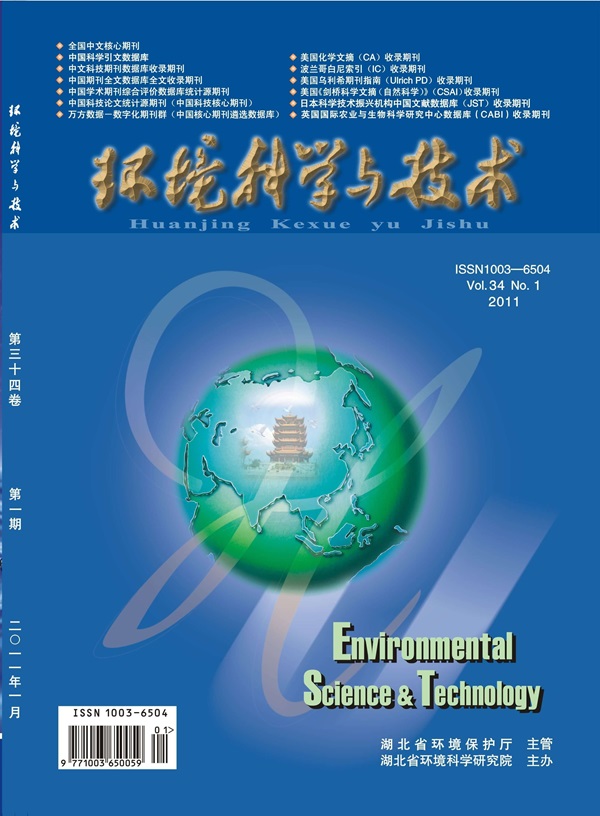
环境科学与技术
环境科学-工程:环境
CiteScore
17.50
自引率
9.60%
发文量
12359
审稿时长
2.8 months
期刊介绍:
Environmental Science & Technology (ES&T) is a co-sponsored academic and technical magazine by the Hubei Provincial Environmental Protection Bureau and the Hubei Provincial Academy of Environmental Sciences.
Environmental Science & Technology (ES&T) holds the status of Chinese core journals, scientific papers source journals of China, Chinese Science Citation Database source journals, and Chinese Academic Journal Comprehensive Evaluation Database source journals. This publication focuses on the academic field of environmental protection, featuring articles related to environmental protection and technical advancements.
 求助内容:
 应助结果提醒方式:


 京公网安备 11010802042870号


