
Engineering Self-Woven Hierarchical Bimetallic Nitride Electrode with Built-In Interfacial Electric Field for Enhanced Alkaline Hydrogen Evolution
IF 7.6
1区 化学
Q1 CHEMISTRY, MULTIDISCIPLINARY
引用次数: 0
Abstract
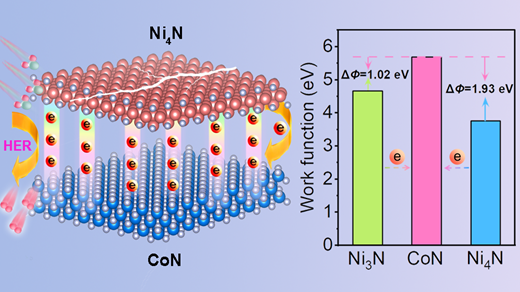
Single-phase transition metal nitrides (TMNs) for alkaline hydrogen evolution reaction (HER) are limited by sluggish charge transfer kinetics, suboptimal adsorption, and restricted accessibility of active sites—intrinsic drawbacks of their electronic structure and conventional electrode architecture. Herein, we circumvent these obstacles by constructing a Ni4N/CoN heterostructure on nickel foam (Ni4N/CoN/NF) with two synergistic features: a built-in interfacial electric field (BIEF) and a hierarchical porous morphology. The work function difference between Ni4N and CoN generates a robust BIEF that drives directional electron transfer from Ni to Co, precisely tailoring the electronic configuration of Ni sites to optimize adsorption energy. Moreover, this hierarchical architecture, assembled from interconnected nanochains and nanosheets, simultaneously enhances active-site exposure, facilitates electron transport, and promotes efficient gas release. Benefiting from these synergistic advantages, the Ni4N/CoN electrode delivers an industrial-level current density of 1000 mA cm–2 at an overpotential of only 213 mV in alkaline media. Moreover, the combination of its robust interwoven nanochain architecture and strong interfacial electronic coupling endows the electrode with outstanding operational stability, sustaining continuous hydrogen evolution for over 500 h at the current density of 500 mA cm–2. This work presents a viable strategy for designing efficient and durable heterostructure electrocatalysts toward practical water electrolysis.
内置界面电场的工程自编织分层氮化双金属电极增强碱性析氢
用于碱性析氢反应(HER)的单相过渡金属氮化物(TMNs)受到电荷转移动力学缓慢、吸附不理想以及活性位点可及性受限的限制,这些都是其电子结构和传统电极结构的固有缺陷。在此,我们通过在泡沫镍上构建Ni4N/CoN异质结构(Ni4N/CoN/NF)来规避这些障碍,该异质结构具有两个协同特征:内置界面电场(BIEF)和分层多孔形态。Ni4N和CoN之间的功函数差异产生了强大的BIEF,驱动从Ni到Co的定向电子转移,精确地调整Ni位点的电子配置以优化吸附能。此外,这种由相互连接的纳米链和纳米片组装而成的分层结构同时增强了活性位点暴露,促进了电子传递,并促进了有效的气体释放。得益于这些协同优势,Ni4N/CoN电极在碱性介质中过电位仅为213 mV时可提供1000 mA cm-2的工业级电流密度。此外,其强大的交织纳米链结构和强大的界面电子耦合相结合,使电极具有出色的操作稳定性,在500 mA cm-2的电流密度下持续500小时以上的析氢。本研究为设计高效耐用的异质结构电催化剂提供了可行的策略。
本文章由计算机程序翻译,如有差异,请以英文原文为准。
求助全文
约1分钟内获得全文
求助全文
来源期刊
ACS Sustainable Chemistry & Engineering
CHEMISTRY, MULTIDISCIPLINARY-ENGINEERING, CHEMICAL
CiteScore
13.80
自引率
4.80%
发文量
1470
审稿时长
1.7 months
期刊介绍:
ACS Sustainable Chemistry & Engineering is a prestigious weekly peer-reviewed scientific journal published by the American Chemical Society. Dedicated to advancing the principles of green chemistry and green engineering, it covers a wide array of research topics including green chemistry, green engineering, biomass, alternative energy, and life cycle assessment.
The journal welcomes submissions in various formats, including Letters, Articles, Features, and Perspectives (Reviews), that address the challenges of sustainability in the chemical enterprise and contribute to the advancement of sustainable practices. Join us in shaping the future of sustainable chemistry and engineering.
 求助内容:
 应助结果提醒方式:


 京公网安备 11010802042870号


