
Regulation of Lattice Oxygen and Phase Transition in O3-Type High-Entropy Layered Sodium-Ion Cathodes
IF 7.6
1区 化学
Q1 CHEMISTRY, MULTIDISCIPLINARY
引用次数: 0
Abstract
Irreversible phase transition and lattice-oxygen loss above 4.0 V cause rapid capacity decay in high-capacity O3-type layered cathodes for sodium-ion batteries (SIBs). Herein, a novel high-entropy layered cathode of Na0.95Li0.05Ni0.3Fe0.1Mn0.3Zn0.05Ti0.2O2 (LNFMZT) with regulated lattice oxygen through a high-entropy configuration and multi-element compositional regulation is successfully synthesized by a high-temperature solid-state method. We show that high-entropy modification stabilizes the single-phase structure, expands Na+ diffusion pathways, and optimizes the transition-metal (TM)–O coordination environment. The LNFMZT delivers a high initial capacity (163.7 mAh g–1 at 0.1 C) and good cycling stability (64.0% retention over 250 cycles at 1 C) at a high-voltage window of 2.0–4.2 V. Combining in situ and ex situ experimental characterizations, we find that a high-entropy layered cathode exhibits reduced charge-transfer resistance, enhanced Na+ diffusion dynamics, good reversibility of lattice oxygen redox, and smoother O3-P3-OP2 evolution, which greatly improve the structural integrity and electrochemical durability. This work underscores the critical role of high-entropy modification in coupling lattice oxygen stability with phase transition reversibility for advanced SIB cathodes.
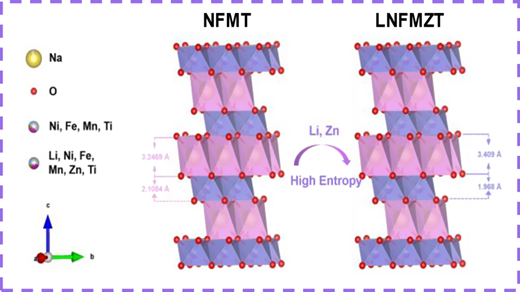
o3型高熵层状钠离子阴极中晶格氧和相变的调控
不可逆相变和4.0 V以上的晶格氧损失导致高容量o3型钠离子电池层状阴极容量快速衰减。本文采用高温固相法,通过高熵结构和多元素组成调控,成功地合成了一种新型高熵层状阴极Na0.95Li0.05Ni0.3Fe0.1Mn0.3Zn0.05Ti0.2O2 (LNFMZT)。研究表明,高熵改性稳定了单相结构,扩展了Na+扩散途径,并优化了过渡金属(TM) -O配位环境。LNFMZT在2.0-4.2 V的高电压窗口下提供高初始容量(0.1 C时163.7 mAh g-1)和良好的循环稳定性(在1 C下250次循环保持64.0%)。结合原位和非原位实验表征,我们发现高熵层状阴极具有电荷转移电阻降低、Na+扩散动力学增强、晶格氧氧化还原可逆性好、O3-P3-OP2演化更平稳等特点,大大提高了结构完整性和电化学耐久性。这项工作强调了高熵修饰在高级SIB阴极晶格氧稳定性与相变可逆性耦合中的关键作用。
本文章由计算机程序翻译,如有差异,请以英文原文为准。
求助全文
约1分钟内获得全文
求助全文
来源期刊
ACS Sustainable Chemistry & Engineering
CHEMISTRY, MULTIDISCIPLINARY-ENGINEERING, CHEMICAL
CiteScore
13.80
自引率
4.80%
发文量
1470
审稿时长
1.7 months
期刊介绍:
ACS Sustainable Chemistry & Engineering is a prestigious weekly peer-reviewed scientific journal published by the American Chemical Society. Dedicated to advancing the principles of green chemistry and green engineering, it covers a wide array of research topics including green chemistry, green engineering, biomass, alternative energy, and life cycle assessment.
The journal welcomes submissions in various formats, including Letters, Articles, Features, and Perspectives (Reviews), that address the challenges of sustainability in the chemical enterprise and contribute to the advancement of sustainable practices. Join us in shaping the future of sustainable chemistry and engineering.
 求助内容:
 应助结果提醒方式:


 京公网安备 11010802042870号


