
2D/3D g-C₃N₄ Nanosheet/CeO₂ Shuttle Heterostructure with Type-II Band Alignment for Visible-Light-Driven Pollutant Degradation
IF 5.4
2区 化学
Q2 CHEMISTRY, PHYSICAL
Colloids and Surfaces A: Physicochemical and Engineering Aspects
Pub Date : 2026-10-15
DOI:10.1016/j.colsurfa.2026.142096
引用次数: 0
Abstract
Persistent chlorophenolic pollutants require efficient and reusable photocatalysts for sustainable wastewater remediation. We hypothesized that coupling two-dimensional graphitic carbon nitride (g-C₃N₄) nanosheets with three-dimensional shuttle-like cerium dioxide (CeO₂) would create an extended heterointerface that promotes photogenerated charge separation and enhances visible-light photocatalytic activity. To test this hypothesis, morphology-engineered g-C₃N₄/CeO₂ heterojunctions were constructed through hydrothermal and wet-chemical methods. Microscopic observations and elemental mapping confirmed intimate interfacial contact and homogeneous dispersion of g-C₃N₄ nanosheets over the CeO₂ shuttles. X-ray photoelectron spectra revealed a shift of the O 1 s signal toward lower binding energy, indicating interfacial electron transfer and increased electron density around the oxygen atoms of CeO₂. Photoluminescence, photocurrent, and electrochemical impedance measurements further demonstrated suppressed electron–hole recombination, accelerated interfacial charge transport, and reduced charge-transfer resistance. Consequently, the optimized composite, prepared with 15% g-C₃N₄ relative to CeO₂ by mass, achieved 96.6% degradation of 2,4-dichlorophenol within 3 h under visible-light irradiation, compared with only 30% degradation using pristine CeO₂. The combined surface, optical, photoelectrochemical, and radical-trapping results supported a proposed Type-II charge-transfer pathway, in which CeO₂ acts as an electron acceptor and superoxide radicals (•O₂⁻) serve as the predominant reactive species. The optimized photocatalyst maintained nearly unchanged activity over four consecutive cycles. The novelty of this work lies in constructing a morphology-controlled two-dimensional/three-dimensional nanosheet–shuttle interface that provides extensive interfacial contact, efficient charge migration, high photocatalytic performance and reproducible cycling behaviour under constant catalyst-loading conditions.
2D/3D g-C₃N₄纳米片/CeO₂穿梭异质结构ⅱ型波段对准可见光驱动污染物降解
持久性氯酚类污染物需要高效、可重复使用的光催化剂来实现废水的可持续修复。我们假设将二维石墨氮化碳(g-C₃N₄)纳米片与三维梭状二氧化铈(CeO₂)偶联可以形成一个扩展的异质界面,促进光生电荷分离,提高可见光光催化活性。为了验证这一假设,通过水热法和湿化学法构建了形态工程的g-C₃N₄/CeO₂异质结。微观观察和元素映射证实了g-C₃N₄纳米片在CeO₂梭上的密切界面接触和均匀分散。x射线光电子能谱显示O 1s信号向较低结合能方向移动,表明界面电子转移和氧原子周围电子密度增加。光致发光、光电流和电化学阻抗测量进一步证明了抑制电子-空穴复合、加速界面电荷传输和降低电荷转移电阻。结果表明,在可见光照射下,g-C₃N₄与ceo2质量比为15%的复合材料对2,4-二氯苯酚的降解率为96.6%,而原始ceo2的降解率仅为30%。结合表面,光学,光电化学和自由基捕获的结果支持了ii型电荷转移途径,其中ceo2作为电子受体,超氧自由基(O₂-)是主要的反应物质。优化后的光催化剂在连续四个循环中几乎保持不变的活性。这项工作的新颖之处在于构建了一个形态控制的二维/三维纳米片-穿梭界面,它提供了广泛的界面接触,有效的电荷迁移,高光催化性能和在恒定催化剂负载条件下可重复的循环行为。
本文章由计算机程序翻译,如有差异,请以英文原文为准。
求助全文
约1分钟内获得全文
求助全文
来源期刊
CiteScore
8.70
自引率
9.60%
发文量
2421
审稿时长
56 days
期刊介绍:
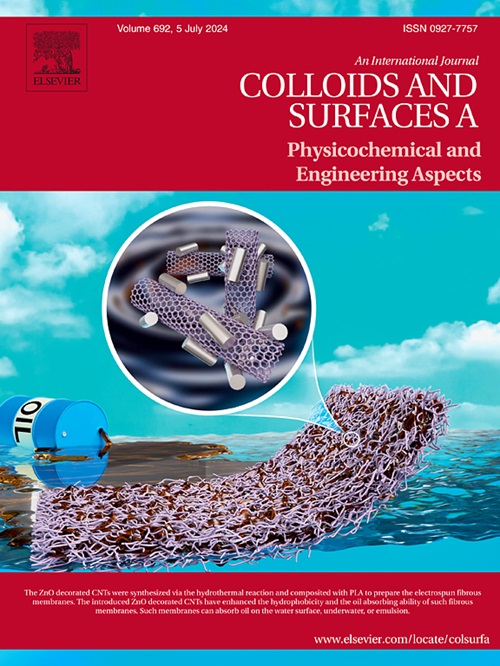
Colloids and Surfaces A: Physicochemical and Engineering Aspects is an international journal devoted to the science underlying applications of colloids and interfacial phenomena.
The journal aims at publishing high quality research papers featuring new materials or new insights into the role of colloid and interface science in (for example) food, energy, minerals processing, pharmaceuticals or the environment.
 求助内容:
 应助结果提醒方式:


 京公网安备 11010802042870号


