
Diastereoselective Heterogeneous Hydrogenation of Fused Arenes Directed by Amines and Alcohols
IF 13.6
1区 化学
Q1 CHEMISTRY, PHYSICAL
引用次数: 0
Abstract
Abstract The heterogeneous hydrogenation of aromatic compounds using supported metal catalysts is an efficient strategy to increase the three-dimensionality and molecular complexity of organic molecules. However, most heterogeneous hydrogenation methods lack stereoselectivity or rely upon the steric properties of the substrate for stereocontrol, which limit their predictability and generality for pharmaceutical synthesis applications. In this work, we develop two synthetic methods for the amine- and hydroxyl-directed hydrogenation of benzofused arenes using Rh/C and Pt3Cu/SiO2 as heterogeneous catalysts, respectively. Mechanistic studies on the amine-directed reaction reveal that simultaneous adsorption of the amine and benzene functional groups to the Rh metal surface is extremely strong, outcompeting the adsorption of the benzene or amine individually and enabling good turnover and high diastereoselectivity toward the amine-directed product. A broad scope of benzofused scaffolds are effective substrates, generating up to four stereocenters in a single step. The utility of the method is demonstrated in the synthesis of a pyridine bisoxazoline compound derived from perhydro-cis-aminoindanol.胺和醇导向的非对映选择性非均相加氢反应
摘要负载型金属催化剂对芳香化合物进行多相加氢反应是提高有机分子三维度和分子复杂性的有效手段。然而,大多数非均相加氢方法缺乏立体选择性或依赖于底物的立体控制,这限制了它们在药物合成应用中的可预测性和普遍性。本文以Rh/C和Pt3Cu/SiO2为非均相催化剂,研究了苯并芳烃的胺定向加氢和羟基定向加氢两种合成方法。胺导向反应的机理研究表明,胺和苯官能团在铑金属表面的同时吸附非常强,优于苯或胺的单独吸附,对胺导向产物具有良好的周转率和高的非对映选择性。广泛的苯并杂化支架是有效的基质,在一个步骤中产生多达四个立体中心。以过氢顺式氨基吲哚醇为原料合成吡啶双恶唑啉化合物,证明了该方法的实用性。
本文章由计算机程序翻译,如有差异,请以英文原文为准。
求助全文
约1分钟内获得全文
求助全文
来源期刊
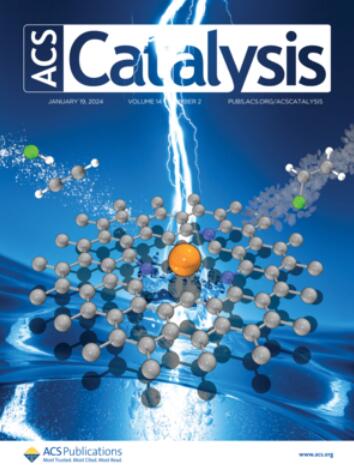
ACS Catalysis
CHEMISTRY, PHYSICAL-
CiteScore
20.80
自引率
6.20%
发文量
1253
审稿时长
1.5 months
期刊介绍:
ACS Catalysis is an esteemed journal that publishes original research in the fields of heterogeneous catalysis, molecular catalysis, and biocatalysis. It offers broad coverage across diverse areas such as life sciences, organometallics and synthesis, photochemistry and electrochemistry, drug discovery and synthesis, materials science, environmental protection, polymer discovery and synthesis, and energy and fuels.
The scope of the journal is to showcase innovative work in various aspects of catalysis. This includes new reactions and novel synthetic approaches utilizing known catalysts, the discovery or modification of new catalysts, elucidation of catalytic mechanisms through cutting-edge investigations, practical enhancements of existing processes, as well as conceptual advances in the field. Contributions to ACS Catalysis can encompass both experimental and theoretical research focused on catalytic molecules, macromolecules, and materials that exhibit catalytic turnover.
 求助内容:
 应助结果提醒方式:


 京公网安备 11010802042870号


