
The layered structure of the lithosphere: From the Archean to the present day
IF 4.6
1区 地球科学
Q1 GEOLOGY
引用次数: 0
Abstract
Mid-lithospheric discontinuities (MLDs) mark layering observed across cratons and younger lithospheres, yet their link to mantle dynamics and secular cooling remains unexplored. Using numerical simulations of mantle convection with melting and dehydration-dependent rheology, we show that convective thinning drives decompression melting, generating contrasting density and viscosity, strain localization, and porosity gradients within the lithosphere. Subsequent deformation (with imbrication and tilting) and cooling freeze the lithosphere into a three-layer structure: a paleo-thermal boundary layer, a compositionally modified layer, and a thermal sublayer. These features explain observed geophysical properties and reproduce seismic velocity gradients across MLD interfaces, though matching the full contrasts likely requires additional fluids/melt retention. This mechanism operates across the full range of mantle temperatures, from Archean to present-day conditions, providing a unified explanation for the abundance of MLDs in cratons, decreasing prevalence with secular cooling, and persistent occurrence in modern lithosphere on Earth and other planets.岩石圈的分层结构:从太古代到现在
中岩石圈不连续(MLDs)标志着在克拉通和更年轻的岩石圈中观察到的分层,但它们与地幔动力学和长期冷却的联系仍未被探索。通过对地幔对流熔融和脱水流变学的数值模拟,我们发现对流变薄驱动减压熔融,在岩石圈内产生不同的密度和粘度、应变局部化和孔隙度梯度。随后的变形(瓦叠和倾斜)和冷却将岩石圈冻结成三层结构:古热边界层、成分改变层和热亚层。这些特征解释了观测到的地球物理性质,并重现了MLD界面上的地震速度梯度,尽管要匹配完整的对比可能需要额外的流体/熔体保留。这一机制适用于从太古宙到现代的整个地幔温度范围,为克拉通中MLDs的丰富,随着长期冷却而减少,以及在地球和其他行星的现代岩石圈中持续出现提供了统一的解释。
本文章由计算机程序翻译,如有差异,请以英文原文为准。
求助全文
约1分钟内获得全文
求助全文
来源期刊
Geology
地学-地质学
CiteScore
10.00
自引率
3.40%
发文量
228
审稿时长
6.2 months
期刊介绍:
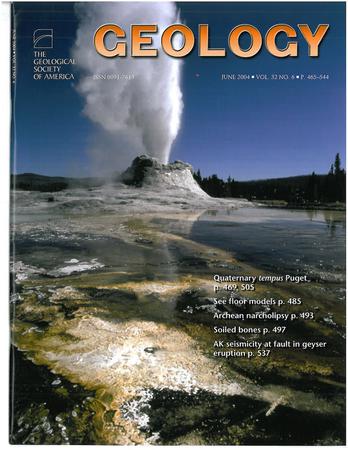
Published since 1973, Geology features rapid publication of about 23 refereed short (four-page) papers each month. Articles cover all earth-science disciplines and include new investigations and provocative topics. Professional geologists and university-level students in the earth sciences use this widely read journal to keep up with scientific research trends. The online forum section facilitates author-reader dialog. Includes color and occasional large-format illustrations on oversized loose inserts.
 求助内容:
 应助结果提醒方式:


 京公网安备 11010802042870号


