
Pt-Modified CoFe Alloy Electrode Enables Ampere-Level Coproduction of Acetate and Hydrogen
IF 7.6
1区 化学
Q1 CHEMISTRY, MULTIDISCIPLINARY
引用次数: 0
Abstract
Abstract Paired electrolysis integrating the ethanol oxidation reaction (EOR) with the hydrogen evolution reaction (HER) provides an energy-efficient strategy for the simultaneous production of value-added chemicals and green hydrogen. Herein, we report a Pt-modified CoFe alloy electrode directly grown on nickel foam (Pt-CoFe/NF) through a facile two-step strategy. The conductive CoFe alloy maximizes Pt utilization, while the electronically coupled Pt-CoFe interface regulates the electronic structure, accelerates charge transfer, and generates abundant catalytic active sites. Operando spectroscopic investigations, together with density functional theory calculations reveal that the Pt-CoFe heterointerface promotes water activation and *OH generation for ethanol oxidation, while simultaneously optimizing *H adsorption for hydrogen evolution, thereby synergistically accelerating both half-reactions. As a result, the Pt-CoFe/NF electrode requires only 1.48 V and 95.8 mV to achieve 1000 mA cm–2 for the EOR and HER, respectively, and also delivers a high acetate Faradaic efficiency (90.6%) with a yield rate of 4.30 mmol h–1 cm–2 at 1.9 V. In addition, the assembled EOR‖HER electrolyzer delivers a low cell voltage of 2.25 V to reach 1 A cm–2, high yields of H2/acetate and realizes long-term stability for 100 h.pt修饰的CoFe合金电极使乙酸和氢的安培级协同生产
结合乙醇氧化反应(EOR)和析氢反应(HER)的配对电解为同时生产增值化学品和绿色氢提供了一种节能策略。在此,我们报告了通过简单的两步策略直接在泡沫镍上生长pt修饰的CoFe合金电极(Pt-CoFe/NF)。导电的CoFe合金最大限度地利用了Pt,而电子耦合的Pt-CoFe界面调节了电子结构,加速了电荷转移,并产生了丰富的催化活性位点。Operando光谱研究和密度泛函理论计算表明,Pt-CoFe异质界面促进水活化和乙醇氧化生成*OH,同时优化*H吸附析氢,从而协同加速两种半反应。结果表明,Pt-CoFe/NF电极仅需要1.48 V和95.8 mV即可分别达到1000 mA cm-2的EOR和HER,并且在1.9 V下具有较高的乙酸法拉第效率(90.6%),产率为4.30 mmol h-1 cm-2。此外,组装的EOR‖HER电解槽提供2.25 V的低电池电压,达到1 a cm-2, H2/乙酸的高产率,并实现100小时的长期稳定。
本文章由计算机程序翻译,如有差异,请以英文原文为准。
求助全文
约1分钟内获得全文
求助全文
来源期刊
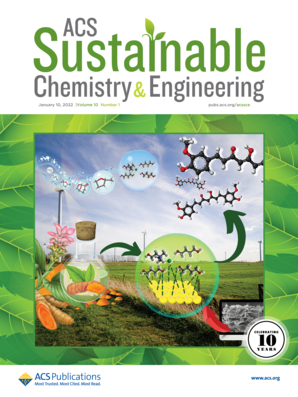
ACS Sustainable Chemistry & Engineering
CHEMISTRY, MULTIDISCIPLINARY-ENGINEERING, CHEMICAL
CiteScore
13.80
自引率
4.80%
发文量
1470
审稿时长
1.7 months
期刊介绍:
ACS Sustainable Chemistry & Engineering is a prestigious weekly peer-reviewed scientific journal published by the American Chemical Society. Dedicated to advancing the principles of green chemistry and green engineering, it covers a wide array of research topics including green chemistry, green engineering, biomass, alternative energy, and life cycle assessment.
The journal welcomes submissions in various formats, including Letters, Articles, Features, and Perspectives (Reviews), that address the challenges of sustainability in the chemical enterprise and contribute to the advancement of sustainable practices. Join us in shaping the future of sustainable chemistry and engineering.
 求助内容:
 应助结果提醒方式:


 京公网安备 11010802042870号


