
Alloying-Induced Asymmetrical Pd Sites Enabling Efficient and Durable Formic Acid Dehydrogenation
IF 7.6
1区 化学
Q1 CHEMISTRY, MULTIDISCIPLINARY
引用次数: 0
Abstract
Abstract Developing Pd-based catalysts for formic acid (HCOOH) dehydrogenation is of great significance to the advancement of renewable hydrogen utilization. However, traditional Pd surfaces typically display symmetrical electronic and geometrical configurations that suffer from both selectivity issues and CO poisoning phenomena, deteriorating their long-term HCOOH dehydrogenation performance. In this study, we report a bismuth–palladium (BiPd) alloy catalyst with asymmetric electronic and geometric Pd sites that achieved an exceptional H2-evolving turnover frequency (5893.7 h–1) of HCOOH dehydrogenation while maintaining over 96% catalytic activities spanning consecutive 15-round experiments. High-angle annular dark-field scanning transmission electron microscopy (HAADF-STEM) and synchrotron X-ray absorption spectroscopy (XAS) characterizations verified the successful construction of BiPd alloys and that Bi components desymmetrized the electronic configuration of Pd sites toward the thermodynamically favored HCOOH dehydrogenation pathway for H2 evolution. On the other hand, in situ diffuse reflectance infrared fourier transform spectroscopy (DRIFTS) and kinetic isotope effect experiments combined with density functional theory (DFT) calculations collectively demonstrated that Bi also diluted Pd ensembles, and the resulting asymmetric Pd architectures reduced the diversity of *CO adsorption configurations on the surface of BiPd alloys, effectively mitigating CO poisoning. This work underscores the critical role of alloying engineering in designing Pd-based catalysts for practically implementing sustainable hydrogen release from liquid organic hydrogen carriers.合金化诱导不对称Pd位实现甲酸高效持久脱氢
开发pd基甲酸脱氢催化剂对推进可再生氢利用具有重要意义。然而,传统的钯表面通常呈现对称的电子和几何构型,同时存在选择性问题和CO中毒现象,从而降低了它们的长期HCOOH脱氢性能。在这项研究中,我们报道了一种具有不对称电子和几何Pd位的铋钯(BiPd)合金催化剂,该催化剂在HCOOH脱氢过程中取得了优异的h2演化周转率(5893.7 h-1),同时在连续15轮实验中保持了96%以上的催化活性。高角度环形暗场扫描透射电子显微镜(HAADF-STEM)和同步加速器x射线吸收光谱(XAS)表征证实了BiPd合金的成功构建,并且Bi组分使Pd位的电子构型向热力学上有利的HCOOH脱氢途径去对称。另一方面,原位漫反射红外傅立叶变换光谱(DRIFTS)和动力学同位素效应实验结合密度泛函理论(DFT)计算共同表明,Bi也稀释了Pd系综,由此产生的不对称Pd结构减少了BiPd合金表面*CO吸附构型的多样性,有效减轻了CO中毒。这项工作强调了合金工程在设计钯基催化剂方面的关键作用,以实际实现液态有机氢载体的可持续氢释放。
本文章由计算机程序翻译,如有差异,请以英文原文为准。
求助全文
约1分钟内获得全文
求助全文
来源期刊
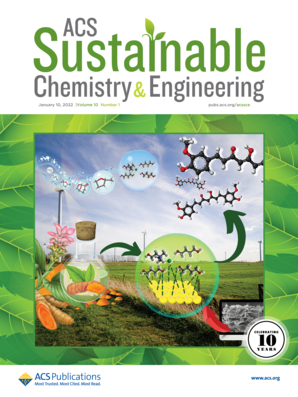
ACS Sustainable Chemistry & Engineering
CHEMISTRY, MULTIDISCIPLINARY-ENGINEERING, CHEMICAL
CiteScore
13.80
自引率
4.80%
发文量
1470
审稿时长
1.7 months
期刊介绍:
ACS Sustainable Chemistry & Engineering is a prestigious weekly peer-reviewed scientific journal published by the American Chemical Society. Dedicated to advancing the principles of green chemistry and green engineering, it covers a wide array of research topics including green chemistry, green engineering, biomass, alternative energy, and life cycle assessment.
The journal welcomes submissions in various formats, including Letters, Articles, Features, and Perspectives (Reviews), that address the challenges of sustainability in the chemical enterprise and contribute to the advancement of sustainable practices. Join us in shaping the future of sustainable chemistry and engineering.
 求助内容:
 应助结果提醒方式:


 京公网安备 11010802042870号


