
Phase‐Controlled Asymmetric Resonances for Enhanced Spectral Slope in a Ge‐OI Microring Resonator at 4.2 μm
IF 6.8
2区 物理与天体物理
Q1 MATERIALS SCIENCE, MULTIDISCIPLINARY
引用次数: 0
Abstract
ABSTRACT Microring resonators (MRRs) are key components of photonic integrated circuits for filtering, modulation, and spectroscopic sensing. In the mid‐infrared (mid‐IR), asymmetric resonances are attractive because their steep local spectral transitions can enhance wavelength discrimination in compact resonant devices. Here, we demonstrate geometry‐controlled asymmetric resonances in a germanium‐on‐insulator (Ge‐OI) MRR at 4.2 μm by introducing a single subwavelength air hole into the bus‐waveguide coupling region as a localized phase perturbation. Effective‐index analysis shows that the hole geometry estimates a controllable phase shift Δ ϕ of up to 0.82π rad, enabling systematic evolution from a nearly symmetric Lorentzian resonance to a strongly asymmetric Fano‐like response. The results are explained by a phase‐modified transmission model and are described using a weighted Fano–Lorentz formalism, which explains the resonance evolution in the ( δ , η ) parameter space. Among our devices, the optimum point is achieved at an intermediate perturbation rather than at the maximum Δ ϕ , yielding a loaded quality factor Q of 2.15 × 10 5 and a slope rate of 435 dB/nm. These results show that compact air‐hole perturbation can tune high‐ Q asymmetric resonances in Ge‐OI mid‐IR photonics, where the useful high‐slope regime is determined by a balance among phase‐induced asymmetry, linewidth preservation, coupling condition, and local transmission contrast.4.2 μm Ge - OI微环谐振腔中相位控制的非对称共振增强了光谱斜率
微环谐振器(MRRs)是光子集成电路中滤波、调制和光谱传感的关键部件。在中红外(mid - IR)中,不对称共振是有吸引力的,因为它们陡峭的局部光谱跃迁可以增强紧凑谐振器件的波长辨别能力。在这里,我们展示了几何控制的不对称共振,在4.2 μm的锗绝缘体(Ge - OI) MRR中,通过在母线波导耦合区引入单个亚波长空气孔作为局部相位扰动。有效指数分析表明,孔洞几何形状估计可控制相移Δ φ高达0.82π rad,使系统从几乎对称的洛伦兹共振演变为强烈不对称的范诺样响应。结果由相位修正传输模型解释,并使用加权法诺-洛伦兹形式描述,该形式解释了(δ, η)参数空间中的共振演化。在我们的器件中,最佳点是在中间扰动而不是在最大Δ ϕ处实现的,产生2.15 × 10.5的负载质量因子Q和435 dB/nm的斜率率。这些结果表明,紧凑的空穴扰动可以调节Ge - OI中红外光子学中的高Q不对称共振,其中有用的高坡区是由相位诱导的不对称性、线宽保持、耦合条件和局部传输对比度之间的平衡决定的。
本文章由计算机程序翻译,如有差异,请以英文原文为准。
求助全文
约1分钟内获得全文
求助全文
来源期刊
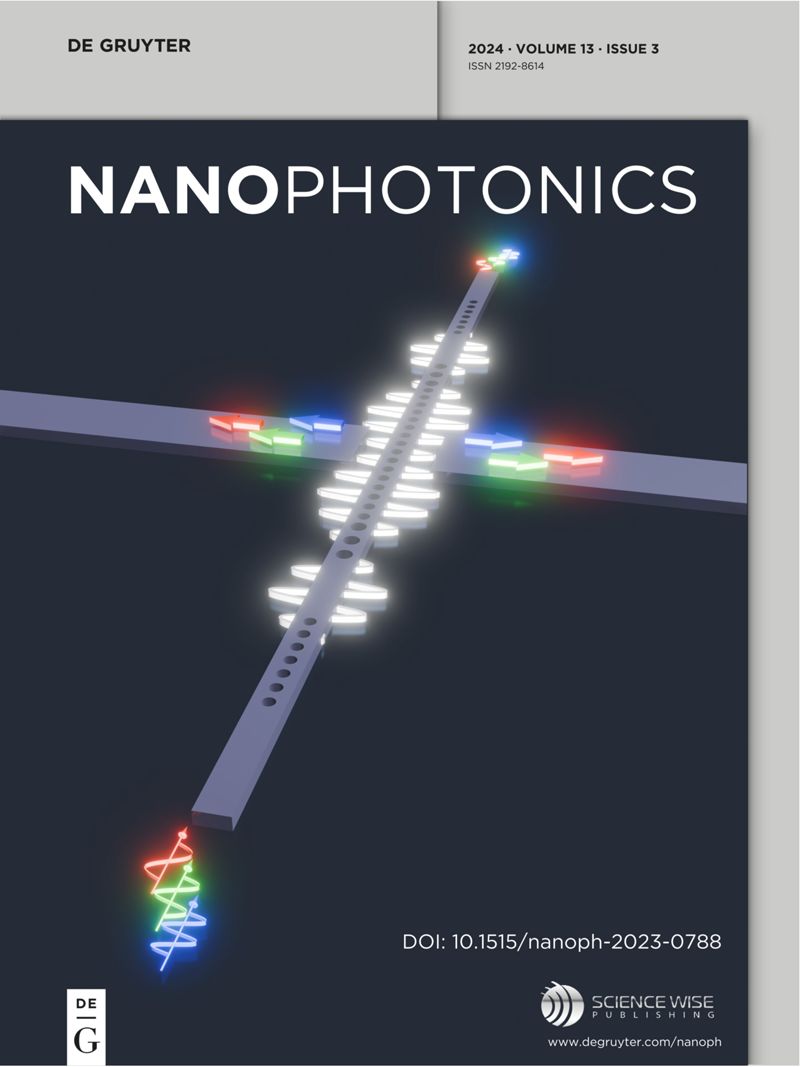
Nanophotonics
NANOSCIENCE & NANOTECHNOLOGY-MATERIALS SCIENCE, MULTIDISCIPLINARY
CiteScore
13.50
自引率
6.70%
发文量
358
审稿时长
7 weeks
期刊介绍:
Nanophotonics, published in collaboration with Sciencewise, is a prestigious journal that showcases recent international research results, notable advancements in the field, and innovative applications. It is regarded as one of the leading publications in the realm of nanophotonics and encompasses a range of article types including research articles, selectively invited reviews, letters, and perspectives.
The journal specifically delves into the study of photon interaction with nano-structures, such as carbon nano-tubes, nano metal particles, nano crystals, semiconductor nano dots, photonic crystals, tissue, and DNA. It offers comprehensive coverage of the most up-to-date discoveries, making it an essential resource for physicists, engineers, and material scientists.
 求助内容:
 应助结果提醒方式:


 京公网安备 11010802042870号


