
Development of a Potent QS‐21‐Derived Adjuvant Photoaffinity Probe: Identification of Cathepsin D as the Molecular Receptor
IF 17.6
1区 化学
Q1 CHEMISTRY, MULTIDISCIPLINARY
引用次数: 0
Abstract
The saponin natural product QS‐21 is a potent immunological adjuvant used in human vaccines to enhance the immune response but suffers from scarcity, instability, and dose‐limiting toxicity, precluding its advancement as a stand‐alone adjuvant. Further, putative cellular receptor(s) and its molecular mechanisms of action are unknown, which has prevented the rational design of saponin adjuvants, emphasizing the need for discovering these receptors and elucidating mechanisms. Herein, we have developed novel saponin photoaffinity probes for molecular target identification, merging synthetic chemistry, photoaffinity labeling, and chemical proteomics. One of these potent adjuvants generated superior antibody responses to QS‐21 with less toxicity and enabled identification of Cathepsin D (CatD) as the selective receptor driving saponin adjuvant effects. Binding to surface‐exposed CatD, lipid raft interactions, and lysosomal acidification were shown to be key for CatD‐mediated saponin‐induced immune activation, whereas neither photocrosslinking nor apparent binding was observed in comparative experiments with other lysosomal cathepsins, confirming the specificity of the interaction. These studies highlight the promise of this saponin probe as a potent vaccine adjuvant, unveiling CatD as the molecular target. This breakthrough sets the stage for elucidating the precise mechanisms of saponin immunopotentiation, facilitating rational adjuvant design and development of optimized adjuvant–antigen combinations for future vaccines.强效QS‐21衍生佐剂光亲和探针的开发:组织蛋白酶D作为分子受体的鉴定
皂苷天然产物QS‐21是一种有效的免疫佐剂,用于人类疫苗中,以增强免疫反应,但由于缺乏、不稳定性和剂量限制性毒性,使其无法作为单独的佐剂。此外,假定的细胞受体及其作用的分子机制尚不清楚,这阻碍了皂苷佐剂的合理设计,强调了发现这些受体和阐明机制的必要性。在此,我们开发了一种新的皂素光亲和探针,用于分子靶标鉴定,融合了合成化学、光亲和标记和化学蛋白质组学。其中一种有效的佐剂对QS‐21产生了较好的抗体反应,毒性较小,并且能够鉴定组织蛋白酶D (CatD)作为驱动皂苷佐剂作用的选择性受体。与表面暴露的CatD结合、脂质筏相互作用和溶酶体酸化被证明是CatD介导的皂素诱导的免疫激活的关键,而在与其他溶酶体组织蛋白酶的比较实验中,既没有观察到光交联,也没有观察到明显的结合,证实了相互作用的特异性。这些研究突出了这种皂苷探针作为一种有效的疫苗佐剂的前景,揭示了CatD作为分子靶点的潜力。这一突破为阐明皂苷免疫增强的精确机制奠定了基础,促进了合理的佐剂设计和开发优化的佐剂-抗原组合,以用于未来的疫苗。
本文章由计算机程序翻译,如有差异,请以英文原文为准。
求助全文
约1分钟内获得全文
求助全文
来源期刊
CiteScore
26.60
自引率
6.60%
发文量
3549
审稿时长
1.5 months
期刊介绍:
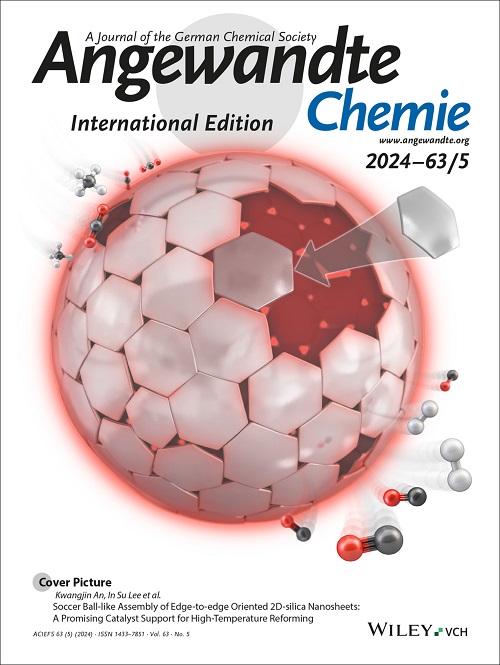
Angewandte Chemie, a journal of the German Chemical Society (GDCh), maintains a leading position among scholarly journals in general chemistry with an impressive Impact Factor of 16.6 (2022 Journal Citation Reports, Clarivate, 2023). Published weekly in a reader-friendly format, it features new articles almost every day. Established in 1887, Angewandte Chemie is a prominent chemistry journal, offering a dynamic blend of Review-type articles, Highlights, Communications, and Research Articles on a weekly basis, making it unique in the field.
 求助内容:
 应助结果提醒方式:


 京公网安备 11010802042870号


