
Ligand Electronics and Metal‐Site Acidity Enable High‐Voltage MOF Electrolytes for Quasi‐Solid‐State Lithium‐Metal Batteries
IF 25.5
1区 材料科学
Q1 CHEMISTRY, PHYSICAL
引用次数: 0
Abstract
Lithium‐metal batteries (LMBs) coupled with Ni‐rich cathodes offer high energy density for next‐generation energy storage. Their practical implementation, however, is limited by electrolyte oxidation and interfacial degradation under high voltage. Metal‐organic frameworks (MOFs) would regulate ion solvation and stabilize electrode‐electrolyte interfaces in quasi‐solid‐state electrolytes, yet the molecular origins of their oxidation stability remain unclear. Here, we identify ligand electronics and metal‐site acidity as key descriptors for high‐voltage‐stable MOF electrolytes. Electron‐withdrawing ligands lower the HOMO energy levels of MOFs, while hard Lewis‐acidic Al sites further enhance oxidation resistance. Guided by this principle, we design a perfluorinated Al‐based MOF, Al‐FBDC, featuring a high oxidation onset potential of 4.82 V (vs. Li配体电子和金属酸性使准固态锂金属电池的高压MOF电解质成为可能
锂金属电池(lmb)与富镍阴极相结合,为下一代储能系统提供了高能量密度。然而,它们的实际应用受到电解液氧化和高压下界面降解的限制。金属有机框架(mof)可以调节离子溶剂化并稳定准固态电解质中的电极-电解质界面,但其氧化稳定性的分子起源尚不清楚。在这里,我们确定配体电子学和金属位酸度是高电压稳定MOF电解质的关键描述符。吸电子配体降低了mof的HOMO能级,而硬Lewis酸性Al位点进一步增强了mof的抗氧化性。在这一原理的指导下,我们设计了一种全氟铝基MOF, Al - FBDC,具有4.82 V (vs. Li + /Li)的高氧化电位。在复合阴极中掺入Al - FBDC可重建颗粒级界面的局部电解质环境,从而抑制高压下的寄生反应和阴极降解。结果表明,Li||Al‐FBDC@NCM准固态电池具有优异的长期循环稳定性和倍率性能,在3.0—4.5 V、1℃条件下200次循环后仍能保持82%的容量,即使在4.6和4.8 V截止电压和控制电解质负载下也能保持稳定的性能。这项工作确定了高压稳定MOF电解质的一般设计原则,并为高能量密度lmb提供了一条实用的途径。
本文章由计算机程序翻译,如有差异,请以英文原文为准。
求助全文
约1分钟内获得全文
求助全文
来源期刊
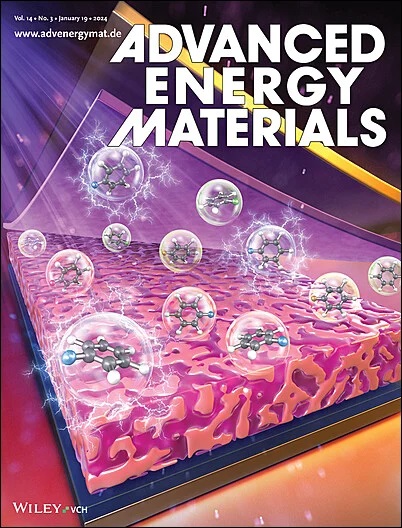
Advanced Energy Materials
CHEMISTRY, PHYSICAL-ENERGY & FUELS
CiteScore
41.90
自引率
4.00%
发文量
889
审稿时长
1.4 months
期刊介绍:
Established in 2011, Advanced Energy Materials is an international, interdisciplinary, English-language journal that focuses on materials used in energy harvesting, conversion, and storage. It is regarded as a top-quality journal alongside Advanced Materials, Advanced Functional Materials, and Small.
With a 2022 Impact Factor of 27.8, Advanced Energy Materials is considered a prime source for the best energy-related research. The journal covers a wide range of topics in energy-related research, including organic and inorganic photovoltaics, batteries and supercapacitors, fuel cells, hydrogen generation and storage, thermoelectrics, water splitting and photocatalysis, solar fuels and thermosolar power, magnetocalorics, and piezoelectronics.
The readership of Advanced Energy Materials includes materials scientists, chemists, physicists, and engineers in both academia and industry. The journal is indexed in various databases and collections, such as Advanced Technologies & Aerospace Database, FIZ Karlsruhe, INSPEC (IET), Science Citation Index Expanded, Technology Collection, and Web of Science, among others.
 求助内容:
 应助结果提醒方式:


 京公网安备 11010802042870号


