
Covalently Locked Donor–Acceptor Block Copolymer Nanoparticles Enable Efficient, Stable and Reproducible Photocatalytic Hydrogen Evolution

IF 25.5 1区 材料科学 Q1 CHEMISTRY, PHYSICAL
Alexandre Holmes, Qiaonan Chen, Rafael Bicudo Ribeiro, Leandro R. Franco, Soumi Roy, Linnea Lind, Xiaoman Bi, Mateus Bergami, Mathis Mortensen Brette, Lunjie Zeng, Eva Olsson, Bo Albinsson, Márcio T. do N. Varella, C. Moyses Araujo, Ergang Wang
{"title":"Covalently Locked Donor–Acceptor Block Copolymer Nanoparticles Enable Efficient, Stable and Reproducible Photocatalytic Hydrogen Evolution","authors":"Alexandre Holmes, Qiaonan Chen, Rafael Bicudo Ribeiro, Leandro R. Franco, Soumi Roy, Linnea Lind, Xiaoman Bi, Mateus Bergami, Mathis Mortensen Brette, Lunjie Zeng, Eva Olsson, Bo Albinsson, Márcio T. do N. Varella, C. Moyses Araujo, Ergang Wang","doi":"10.1002/aenm.71708","DOIUrl":null,"url":null,"abstract":"Organic photocatalysts with tailored properties and unique processability offer a sustainable route to solar hydrogen. To maximize light harvesting and charge generation, donor and acceptor materials are usually physically mixed to form D:A heterojunction nanoparticles (NPs). However, weakly constrained interactions can promote phase segregation, morphological evolution, and limited reproducibility. Here, we introduce an all‐conjugated donor–acceptor block copolymer, PBDB‐T‐ <jats:italic>b</jats:italic> ‐PYT, in which covalent linkage between PBDB‐T and PYT segments constrains nanoscale donor–acceptor organization and promotes intramolecular charge transfer. Compared with nanoparticles prepared from a physical PBDB‐T:PYT blend, PBDB‐T‐ <jats:italic>b</jats:italic> ‐PYT nanoparticles exhibit stronger photoluminescence quenching, more persistent charge‐associated transient absorption features, and improved photoelectrochemical charge extraction. As a result, hydrogen evolution reaction (HER) rates exceeding 120 mmol cm <jats:sup>−2</jats:sup> g <jats:sup>−1</jats:sup> h <jats:sup>−1</jats:sup> (&gt;450 µmol h <jats:sup>−1</jats:sup> ) are achieved with low Pt loading (&lt;3 wt.%). PBDB‐T‐ <jats:italic>b</jats:italic> ‐PYT NPs retained 95% of the initial HER rate after 96 h of photocatalysis. Conversely, NPs prepared from physically mixed PBDB‐T and PYT show lower activity and faster deactivation, consistent with morphology‐driven losses. PBDB‐T‐ <jats:italic>b</jats:italic> ‐PYT also maintains high performance across polymer batches, improving reproducibility. These results establish all‐conjugated donor–acceptor block copolymers as a promising design strategy for combining high activity, operational stability, and reproducibility in organic nanoparticle photocatalysis.","PeriodicalId":111,"journal":{"name":"Advanced Energy Materials","volume":"30 1","pages":""},"PeriodicalIF":25.5000,"publicationDate":"2026-10-18","publicationTypes":"Journal Article","fieldsOfStudy":null,"isOpenAccess":false,"openAccessPdf":"","citationCount":"0","resultStr":null,"platform":"Semanticscholar","paperid":null,"PeriodicalName":"Advanced Energy Materials","FirstCategoryId":"88","ListUrlMain":"https://doi.org/10.1002/aenm.71708","RegionNum":1,"RegionCategory":"材料科学","ArticlePicture":[],"TitleCN":null,"AbstractTextCN":null,"PMCID":null,"EPubDate":"","PubModel":"","JCR":"Q1","JCRName":"CHEMISTRY, PHYSICAL","Score":null,"Total":0}
引用次数: 0

Abstract

Organic photocatalysts with tailored properties and unique processability offer a sustainable route to solar hydrogen. To maximize light harvesting and charge generation, donor and acceptor materials are usually physically mixed to form D:A heterojunction nanoparticles (NPs). However, weakly constrained interactions can promote phase segregation, morphological evolution, and limited reproducibility. Here, we introduce an all‐conjugated donor–acceptor block copolymer, PBDB‐T‐ b ‐PYT, in which covalent linkage between PBDB‐T and PYT segments constrains nanoscale donor–acceptor organization and promotes intramolecular charge transfer. Compared with nanoparticles prepared from a physical PBDB‐T:PYT blend, PBDB‐T‐ b ‐PYT nanoparticles exhibit stronger photoluminescence quenching, more persistent charge‐associated transient absorption features, and improved photoelectrochemical charge extraction. As a result, hydrogen evolution reaction (HER) rates exceeding 120 mmol cm −2 g −1 h −1 (>450 µmol h −1 ) are achieved with low Pt loading (<3 wt.%). PBDB‐T‐ b ‐PYT NPs retained 95% of the initial HER rate after 96 h of photocatalysis. Conversely, NPs prepared from physically mixed PBDB‐T and PYT show lower activity and faster deactivation, consistent with morphology‐driven losses. PBDB‐T‐ b ‐PYT also maintains high performance across polymer batches, improving reproducibility. These results establish all‐conjugated donor–acceptor block copolymers as a promising design strategy for combining high activity, operational stability, and reproducibility in organic nanoparticle photocatalysis.
共价锁定供体-受体嵌段共聚物纳米颗粒实现高效,稳定和可再生的光催化析氢
有机光催化剂具有定制的性能和独特的可加工性,为太阳能氢的可持续发展提供了一条途径。为了最大限度地收集光和产生电荷,供体和受体材料通常物理混合形成D:A异质结纳米颗粒(NPs)。然而,弱约束的相互作用会促进相分离、形态进化和有限的可重复性。在这里,我们引入了一种全共轭的给体-受体嵌段共聚物,PBDB - T - b - PYT,其中PBDB - T和PYT片段之间的共价键限制了纳米级给体-受体组织并促进分子内电荷转移。与物理PBDB - T:PYT共混制备的纳米颗粒相比,PBDB - T - b - PYT纳米颗粒表现出更强的光致发光猝灭,更持久的电荷相关瞬态吸收特征,以及改进的光电化学电荷提取。结果,在低Pt负载(<3 wt.%)下,析氢反应(HER)速率超过120 mmol cm−2 g−1 h−1 (>450µmol h−1)。光催化96小时后,PBDB - T - b - PYT NPs保持了95%的初始HER率。相反,由PBDB - T和PYT物理混合制备的NPs表现出较低的活性和更快的失活,与形态驱动的损失一致。PBDB - T - b - PYT还在聚合物批次中保持了高性能,提高了再现性。这些结果表明,全共轭给体-受体嵌段共聚物在有机纳米粒子光催化中具有高活性、操作稳定性和可重复性,是一种很有前途的设计策略。
本文章由计算机程序翻译,如有差异,请以英文原文为准。
求助全文
约1分钟内获得全文 求助全文
来源期刊
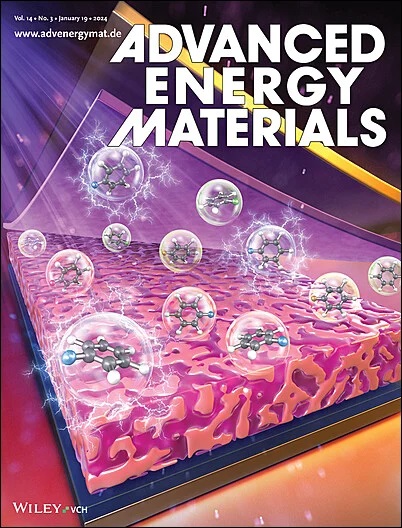
Advanced Energy Materials
Advanced Energy Materials CHEMISTRY, PHYSICAL-ENERGY & FUELS
CiteScore
41.90
自引率
4.00%
发文量
889
审稿时长
1.4 months
期刊介绍: Established in 2011, Advanced Energy Materials is an international, interdisciplinary, English-language journal that focuses on materials used in energy harvesting, conversion, and storage. It is regarded as a top-quality journal alongside Advanced Materials, Advanced Functional Materials, and Small. With a 2022 Impact Factor of 27.8, Advanced Energy Materials is considered a prime source for the best energy-related research. The journal covers a wide range of topics in energy-related research, including organic and inorganic photovoltaics, batteries and supercapacitors, fuel cells, hydrogen generation and storage, thermoelectrics, water splitting and photocatalysis, solar fuels and thermosolar power, magnetocalorics, and piezoelectronics. The readership of Advanced Energy Materials includes materials scientists, chemists, physicists, and engineers in both academia and industry. The journal is indexed in various databases and collections, such as Advanced Technologies & Aerospace Database, FIZ Karlsruhe, INSPEC (IET), Science Citation Index Expanded, Technology Collection, and Web of Science, among others.

×
引用
GB/T 7714-2015
复制
MLA
复制
APA
复制
导出至
BibTeX EndNote RefMan NoteFirst NoteExpress
×
提示
您的信息不完整,为了账户安全,请先补充。
现在去补充
×
提示
您因"违规操作"
具体请查看互助需知
我知道了
×
提示
确定
请完成安全验证×
copy
已复制链接
快去分享给好友吧!
我知道了
右上角分享
点击右上角分享
0
联系我们:info@booksci.cn Book学术提供免费学术资源搜索服务,方便国内外学者检索中英文文献。致力于提供最便捷和优质的服务体验。 Copyright © 2023 布克学术 All rights reserved.
京ICP备2023020795号-1
ghs 京公网安备 11010802042870号
Book学术文献互助
Book学术文献互助群
群 号:604180095
Book学术官方微信
小红书


