
Disrupting Solvent Self‐Association via Dipole–Dipole Interactions for Improved Performance of Perovskite Solar Cell

IF 25.5 1区 材料科学 Q1 CHEMISTRY, PHYSICAL
Yuqi Du, Wenxiang Xiang, Jiahui Li, Shanwen Wang, Jing Chen, Zhaokui Wang, Geping Qu, Zong‐Xiang Xu, Xiangqian Shen, Liyuan Han, Yanbo Wang
{"title":"Disrupting Solvent Self‐Association via Dipole–Dipole Interactions for Improved Performance of Perovskite Solar Cell","authors":"Yuqi Du, Wenxiang Xiang, Jiahui Li, Shanwen Wang, Jing Chen, Zhaokui Wang, Geping Qu, Zong‐Xiang Xu, Xiangqian Shen, Liyuan Han, Yanbo Wang","doi":"10.1002/aenm.71715","DOIUrl":null,"url":null,"abstract":"High‐quality perovskite films demand strongly coordinating solvents (SCS, e.g., DMSO, NMP) for crystal growth regulation, yet such solvents often leave residue and induce notorious voids. Prior work elucidated the voids distribution along the vertical direction but cannot explain their lateral dimensions and spatial patterning. Here, we find that the hundreds‐of‐nanometer lateral dimension and clustered morphology of buried voids originate from the self‐association of SCS. The tailored‐made 1‐bromo‐4‐dimethylphosphoryl‐benzene (BPPO) with inherently weak intermolecular interaction is introduced, which mainly exists in a monomeric form and can efficiently modify the buried interface by constructing dipole‐dipole interactions with SCS. The self‐association is disrupted, enabling uniform SCS distribution rather than forming big cluster, which accelerates the escape and ultimately eliminates voids at the buried interface. Perovskite solar cells (PSCs) based on BPPO show an efficiency increase from 25.2% to 27.2% (certified efficiency of 27.0%, aperture area of 0.0712 cm <jats:sup>2</jats:sup> ), with improved stability under ISOS‐D‐2 and ISOS‐L‐2 protocols. Furthermore, the BPPO‐modified perovskite solar module (PSMs, aperture area of 17.4 cm <jats:sup>2</jats:sup> ) achieved an efficiency of 24.2%, demonstrating its excellent scalability.","PeriodicalId":111,"journal":{"name":"Advanced Energy Materials","volume":"30 1","pages":""},"PeriodicalIF":25.5000,"publicationDate":"2026-10-16","publicationTypes":"Journal Article","fieldsOfStudy":null,"isOpenAccess":false,"openAccessPdf":"","citationCount":"0","resultStr":null,"platform":"Semanticscholar","paperid":null,"PeriodicalName":"Advanced Energy Materials","FirstCategoryId":"88","ListUrlMain":"https://doi.org/10.1002/aenm.71715","RegionNum":1,"RegionCategory":"材料科学","ArticlePicture":[],"TitleCN":null,"AbstractTextCN":null,"PMCID":null,"EPubDate":"","PubModel":"","JCR":"Q1","JCRName":"CHEMISTRY, PHYSICAL","Score":null,"Total":0}
引用次数: 0

Abstract

High‐quality perovskite films demand strongly coordinating solvents (SCS, e.g., DMSO, NMP) for crystal growth regulation, yet such solvents often leave residue and induce notorious voids. Prior work elucidated the voids distribution along the vertical direction but cannot explain their lateral dimensions and spatial patterning. Here, we find that the hundreds‐of‐nanometer lateral dimension and clustered morphology of buried voids originate from the self‐association of SCS. The tailored‐made 1‐bromo‐4‐dimethylphosphoryl‐benzene (BPPO) with inherently weak intermolecular interaction is introduced, which mainly exists in a monomeric form and can efficiently modify the buried interface by constructing dipole‐dipole interactions with SCS. The self‐association is disrupted, enabling uniform SCS distribution rather than forming big cluster, which accelerates the escape and ultimately eliminates voids at the buried interface. Perovskite solar cells (PSCs) based on BPPO show an efficiency increase from 25.2% to 27.2% (certified efficiency of 27.0%, aperture area of 0.0712 cm 2 ), with improved stability under ISOS‐D‐2 and ISOS‐L‐2 protocols. Furthermore, the BPPO‐modified perovskite solar module (PSMs, aperture area of 17.4 cm 2 ) achieved an efficiency of 24.2%, demonstrating its excellent scalability.
通过偶极-偶极相互作用破坏溶剂自缔合以提高钙钛矿太阳能电池的性能
高质量的钙钛矿薄膜需要强配合溶剂(SCS,如DMSO, NMP)来调节晶体生长,但这些溶剂通常会留下残留物并诱发臭名昭著的空隙。以往的研究阐明了孔隙沿垂直方向的分布,但不能解释其横向尺寸和空间格局。在这里,我们发现数百纳米的横向尺寸和埋藏空隙的簇状形态源于SCS的自关联。介绍了具有弱分子间相互作用的定制化1 -溴- 4 -二甲基磷酰苯(BPPO),它主要以单体形式存在,可以通过与SCS构建偶极子-偶极子相互作用来有效地修饰隐藏界面。自结合被破坏,使SCS均匀分布,而不是形成大簇,这加速了逃逸,最终消除了埋藏界面的空隙。基于BPPO的钙钛矿太阳能电池(PSCs)的效率从25.2%提高到27.2%(认证效率为27.0%,孔径面积为0.0712 cm 2),并且在ISOS‐D‐2和ISOS‐L‐2协议下稳定性得到改善。此外,BPPO修饰的钙钛矿太阳能组件(psm,孔径面积为17.4 cm 2)的效率达到了24.2%,证明了其出色的可扩展性。
本文章由计算机程序翻译,如有差异,请以英文原文为准。
求助全文
约1分钟内获得全文 求助全文
来源期刊
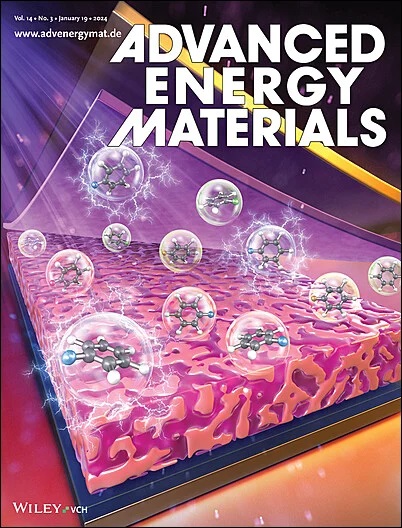
Advanced Energy Materials
Advanced Energy Materials CHEMISTRY, PHYSICAL-ENERGY & FUELS
CiteScore
41.90
自引率
4.00%
发文量
889
审稿时长
1.4 months
期刊介绍: Established in 2011, Advanced Energy Materials is an international, interdisciplinary, English-language journal that focuses on materials used in energy harvesting, conversion, and storage. It is regarded as a top-quality journal alongside Advanced Materials, Advanced Functional Materials, and Small. With a 2022 Impact Factor of 27.8, Advanced Energy Materials is considered a prime source for the best energy-related research. The journal covers a wide range of topics in energy-related research, including organic and inorganic photovoltaics, batteries and supercapacitors, fuel cells, hydrogen generation and storage, thermoelectrics, water splitting and photocatalysis, solar fuels and thermosolar power, magnetocalorics, and piezoelectronics. The readership of Advanced Energy Materials includes materials scientists, chemists, physicists, and engineers in both academia and industry. The journal is indexed in various databases and collections, such as Advanced Technologies & Aerospace Database, FIZ Karlsruhe, INSPEC (IET), Science Citation Index Expanded, Technology Collection, and Web of Science, among others.

×
引用
GB/T 7714-2015
复制
MLA
复制
APA
复制
导出至
BibTeX EndNote RefMan NoteFirst NoteExpress
×
提示
您的信息不完整,为了账户安全,请先补充。
现在去补充
×
提示
您因"违规操作"
具体请查看互助需知
我知道了
×
提示
确定
请完成安全验证×
copy
已复制链接
快去分享给好友吧!
我知道了
右上角分享
点击右上角分享
0
联系我们:info@booksci.cn Book学术提供免费学术资源搜索服务,方便国内外学者检索中英文文献。致力于提供最便捷和优质的服务体验。 Copyright © 2023 布克学术 All rights reserved.
京ICP备2023020795号-1
ghs 京公网安备 11010802042870号
Book学术文献互助
Book学术文献互助群
群 号:604180095
Book学术官方微信
小红书


