Gaobo Chang, Hanqing Zhao, Cheng Huang, Shulian Lei, Junxiang Wang, Zeyu Qiao, Kun Lin, Steven S C Chuang, Zhong Li, Xianran Xing, Jieshan Qiu
{"title":"Negative-Thermal-Expansion Strategy Enables Hard Carbon With Tuned Heat/Strain Tolerances for Sodium Storage.","authors":"Gaobo Chang, Hanqing Zhao, Cheng Huang, Shulian Lei, Junxiang Wang, Zeyu Qiao, Kun Lin, Steven S C Chuang, Zhong Li, Xianran Xing, Jieshan Qiu","doi":"10.1002/adma.75284","DOIUrl":null,"url":null,"abstract":"<p><p>The thermal/stress runaways pose a risk to the safety and industrialization of sodium-ion battery (SIB), which hence requires external management equipment. Actually, the thermal/stress generation originates from the repetitive Na<sup>+</sup> intercalation within carbon interlayers and pore-filling in the initial stage. Herein, we propose a regulation strategy of \"in situ thermal strain relief\" to achieve internal thermal and stress managements of SIB hard carbon (HC) anode by incorporating negative thermal expansion oxide ZrW<sub>2</sub>O<sub>8</sub>. The results indicate that the heat and strain were reduced obviously after cycling, leading to rapid diffusion kinetics and enhanced sodium storage capacity. Moreover, the microstructure and efficient electron/ion transport within HC were preserved, demonstrating excellent capacity stability even after high-rate and long-term cycling over wide operating temperature ranges (-20°C to 60°C). This study provides a new approach for thermal and stress management inside the battery, which may play a joint effort with the conventional management equipment outside the battery and beyond.</p>","PeriodicalId":114,"journal":{"name":"Advanced Materials","volume":" ","pages":"e75284"},"PeriodicalIF":29.1000,"publicationDate":"2026-10-16","publicationTypes":"Journal Article","fieldsOfStudy":null,"isOpenAccess":false,"openAccessPdf":"","citationCount":"0","resultStr":null,"platform":"Semanticscholar","paperid":null,"PeriodicalName":"Advanced Materials","FirstCategoryId":"88","ListUrlMain":"https://doi.org/10.1002/adma.75284","RegionNum":1,"RegionCategory":"材料科学","ArticlePicture":[],"TitleCN":null,"AbstractTextCN":null,"PMCID":null,"EPubDate":"","PubModel":"","JCR":"Q1","JCRName":"CHEMISTRY, MULTIDISCIPLINARY","Score":null,"Total":0}
引用次数: 0
Abstract
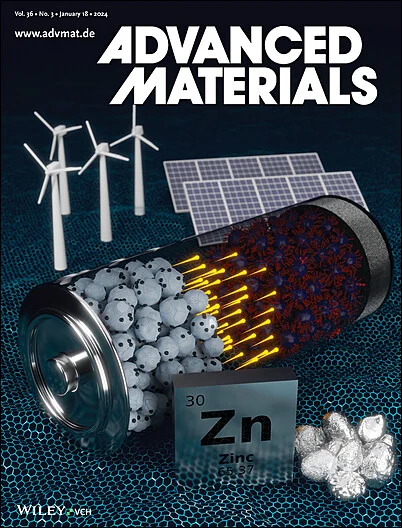
The thermal/stress runaways pose a risk to the safety and industrialization of sodium-ion battery (SIB), which hence requires external management equipment. Actually, the thermal/stress generation originates from the repetitive Na+ intercalation within carbon interlayers and pore-filling in the initial stage. Herein, we propose a regulation strategy of "in situ thermal strain relief" to achieve internal thermal and stress managements of SIB hard carbon (HC) anode by incorporating negative thermal expansion oxide ZrW2O8. The results indicate that the heat and strain were reduced obviously after cycling, leading to rapid diffusion kinetics and enhanced sodium storage capacity. Moreover, the microstructure and efficient electron/ion transport within HC were preserved, demonstrating excellent capacity stability even after high-rate and long-term cycling over wide operating temperature ranges (-20°C to 60°C). This study provides a new approach for thermal and stress management inside the battery, which may play a joint effort with the conventional management equipment outside the battery and beyond.
期刊介绍:
Advanced Materials, one of the world's most prestigious journals and the foundation of the Advanced portfolio, is the home of choice for best-in-class materials science for more than 30 years. Following this fast-growing and interdisciplinary field, we are considering and publishing the most important discoveries on any and all materials from materials scientists, chemists, physicists, engineers as well as health and life scientists and bringing you the latest results and trends in modern materials-related research every week.

 求助内容:
 应助结果提醒方式:


 京公网安备 11010802042870号


