Adam T Hand, Adiat A Fakolujo, Michael J Jenkins, Brandon D Watson-Sanders, Lei Chen, Zhenxing Wang, Yongqiang Cheng, Mykhaylo Ozerov, Luke L Daemen, Zheng Gai, Zi-Ling Xue
{"title":"Magnetism of penta-coordinate Co(II) complexes with field-induced single-molecule magnet properties. Effects of distortion from <i>C</i><sub>2v</sub> symmetry.","authors":"Adam T Hand, Adiat A Fakolujo, Michael J Jenkins, Brandon D Watson-Sanders, Lei Chen, Zhenxing Wang, Yongqiang Cheng, Mykhaylo Ozerov, Luke L Daemen, Zheng Gai, Zi-Ling Xue","doi":"10.1039/d6dt02200f","DOIUrl":null,"url":null,"abstract":"<p><p>Molecular magnetic materials, especially those showing single-molecule magnet (SMM) behaviors, have potential applications in, <i>e.g.</i>, spintronics and high-density information storage. Penta-coordination in high-spin Co<sup>II</sup> complexes leads to magnetic anisotropy and such complexes have been pursued in the search for SMMs. High-spin [Co(terpy)X<sub>2</sub>] [X = Cl (Co-Cl), Br (Co-Br), I (Co-I); terpy = 2,2':6',2″-terpyridine] have been studied to determine their structural, magnetic, and spectroscopic properties. Advanced spectroscopic techniques [high-frequency and -field electron paramagnetic resonance (HFEPR), far-IR magneto-spectroscopy (FIRMS), and inelastic neutron scattering (INS)] and DC magnetic susceptibility measurements have been used to probe magnetic transitions in the three complexes. The structure of Co-Cl is significantly deviated from <i>C</i><sub>2v</sub> symmetry, leading to orbital contributions and the largest magnetic anisotropy in Co-X. The structures of Co-Br and Co-I are only slightly diverged from <i>C</i><sub>2v</sub> symmetry with quenched orbital contributions to their magnetic properties. <i>Ab initio</i> ligand field theory (AILFT) calculations help understand differences in magnetic properties between Co-Cl and Co-Br/Co-I. Data from alternating current (AC) susceptibility suggest that spin relaxation is primarily through the direct process at low temperatures. Spin-phonon couplings near magnetic transitions have been observed in FIRMS, contributing to spin relaxation. The current work provides a detailed study of the magnetic properties of the three five-coordinate Co<sup>II</sup> complexes as field-induced SMMs.</p>","PeriodicalId":71,"journal":{"name":"Dalton Transactions","volume":" ","pages":""},"PeriodicalIF":3.3000,"publicationDate":"2026-10-15","publicationTypes":"Journal Article","fieldsOfStudy":null,"isOpenAccess":false,"openAccessPdf":"","citationCount":"0","resultStr":null,"platform":"Semanticscholar","paperid":null,"PeriodicalName":"Dalton Transactions","FirstCategoryId":"92","ListUrlMain":"https://doi.org/10.1039/d6dt02200f","RegionNum":3,"RegionCategory":"化学","ArticlePicture":[],"TitleCN":null,"AbstractTextCN":null,"PMCID":null,"EPubDate":"","PubModel":"","JCR":"Q2","JCRName":"CHEMISTRY, INORGANIC & NUCLEAR","Score":null,"Total":0}
引用次数: 0
Abstract
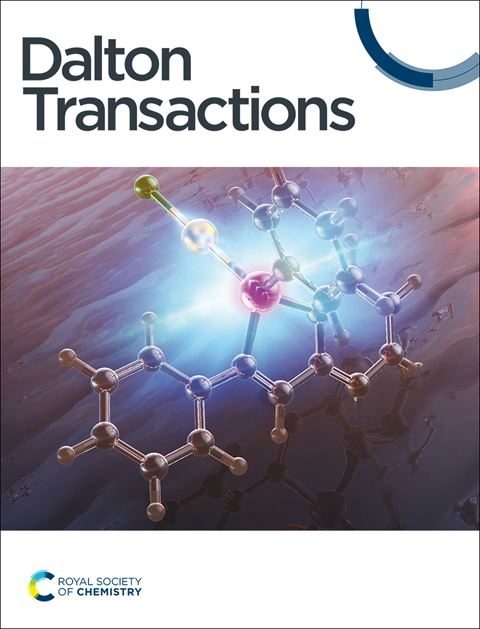
Molecular magnetic materials, especially those showing single-molecule magnet (SMM) behaviors, have potential applications in, e.g., spintronics and high-density information storage. Penta-coordination in high-spin CoII complexes leads to magnetic anisotropy and such complexes have been pursued in the search for SMMs. High-spin [Co(terpy)X2] [X = Cl (Co-Cl), Br (Co-Br), I (Co-I); terpy = 2,2':6',2″-terpyridine] have been studied to determine their structural, magnetic, and spectroscopic properties. Advanced spectroscopic techniques [high-frequency and -field electron paramagnetic resonance (HFEPR), far-IR magneto-spectroscopy (FIRMS), and inelastic neutron scattering (INS)] and DC magnetic susceptibility measurements have been used to probe magnetic transitions in the three complexes. The structure of Co-Cl is significantly deviated from C2v symmetry, leading to orbital contributions and the largest magnetic anisotropy in Co-X. The structures of Co-Br and Co-I are only slightly diverged from C2v symmetry with quenched orbital contributions to their magnetic properties. Ab initio ligand field theory (AILFT) calculations help understand differences in magnetic properties between Co-Cl and Co-Br/Co-I. Data from alternating current (AC) susceptibility suggest that spin relaxation is primarily through the direct process at low temperatures. Spin-phonon couplings near magnetic transitions have been observed in FIRMS, contributing to spin relaxation. The current work provides a detailed study of the magnetic properties of the three five-coordinate CoII complexes as field-induced SMMs.
期刊介绍:
Dalton Transactions is a journal for all areas of inorganic chemistry, which encompasses the organometallic, bioinorganic and materials chemistry of the elements, with applications including synthesis, catalysis, energy conversion/storage, electrical devices and medicine. Dalton Transactions welcomes high-quality, original submissions in all of these areas and more, where the advancement of knowledge in inorganic chemistry is significant.

 求助内容:
 应助结果提醒方式:


 京公网安备 11010802042870号


